
Clinical picture. J., a 20-year-old undergraduate with a confirmed ADHD-inattentive presentation, reported failing two consecutive midterms despite subjectively "studying all weekend." On closer questioning, most of that time was spent reopening the same chapter after repeated distraction, followed by a single overnight cram session. The clinician introduced the avoidance-panic loop diagram from the psychoeducation sheet and named what J. had been experiencing as a structural problem, not a character flaw. Together they mapped one concrete change: a fixed 45-minute slot at the same desk each evening, phone in another room, ending with three self-quiz questions written by hand. At the following session J. noted that starting had felt "less like a fight" and that he had retained more material than expected going into his next exam.
Study Tips for ADHD and Test Anxiety: PDF Worksheet, Tools and Exercises
A printable psychoeducation fiche clinicians can use in session to break the avoidance-panic loop, reframe the 'lazy' narrative, and give ADHD and test-anxious patients concrete structural anchors.
Clinical vignettes
Reframing Avoidance in a College Student
Exam Panic and Spaced Practice
Clinical picture. M., a 17-year-old with a longstanding anxiety disorder and a recent ADHD diagnosis, described a predictable pattern: avoidance early in the revision cycle, escalating dread as the exam date approached, and near-total memory block during the test itself. The clinician shared the informational sheet as brief psychoeducation and focused on the mechanism linking avoidance to panic, specifically the way cramming preserves the belief that the material is not yet secure. M. and her mother worked out a simple schedule of three short spaced sessions per topic spread over two weeks, each ending with a self-generated quiz. M. reported reduced anticipatory anxiety before her next assessment, attributing the change to "already knowing I had seen it before" rather than hoping she had studied enough.
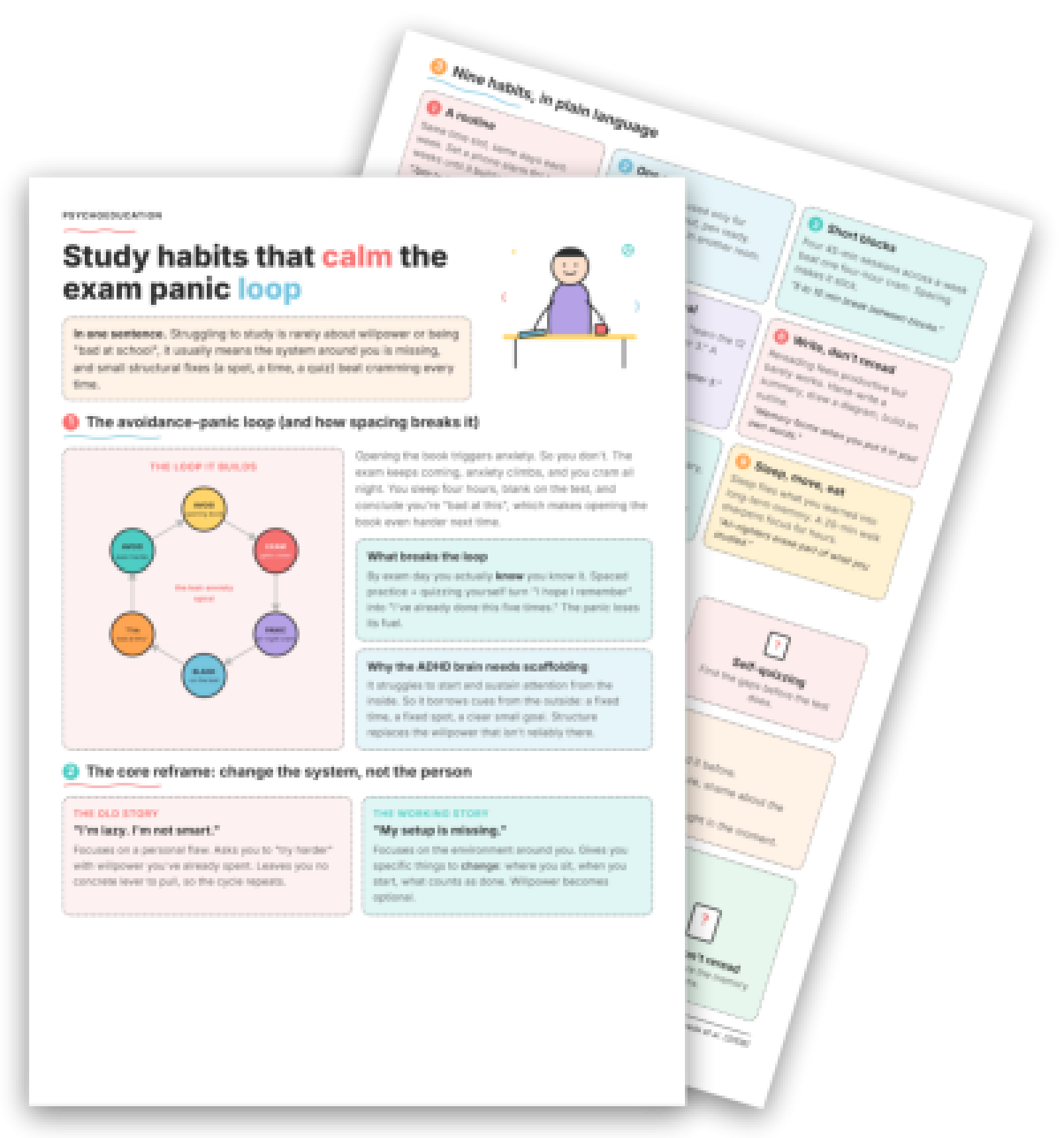
Explaining study scaffolding to an ADHD or test-anxious patient at the oral level alone rarely takes hold. The patient nods, intends to change, and sits down two days later paralyzed in front of a closed textbook. This fiche PDF gives you a shared visual map to make the mechanism explicit in session, so the patient leaves with a structure they can actually see, not just a good intention.
Use this resource with your patients
Handout, exercises and materials ready to use, right inside SessionFuel.
Why the avoidance-panic loop resists verbal explanation
The core clinical difficulty here is not lack of information. Adolescents and young adults referred for ADHD or exam anxiety can often explain the problem themselves. What they cannot do is see the loop clearly enough to break it. The moment a therapist describes the spiral ("you avoid, the exam approaches, you panic, you cram, you blank, you conclude you are bad at this"), the patient's attention is already scattered or drawn inward by shame. A verbal description lands partially; a diagram lands whole.
There is a second layer specific to ADHD: executive dysfunction makes the internal cueing system unreliable. Standard advice ("just start earlier") targets willpower rather than structure. Without an explicit reframe, the patient keeps attributing failure to character rather than to a missing scaffold. That attribution feeds the failure schema and makes every new attempt heavier. The fiche cuts through this by anchoring the explanation in a visible model, not in a personality verdict.
Test-anxious patients without a formal ADHD diagnosis present with similar blocking patterns. The cycle of avoidance is the same mechanism, only the cognitive load shifts more toward anticipatory catastrophizing. Both profiles benefit from the same structural psychoeducation, delivered with a concrete visual in hand.
What the fiche contains, and what the visual layout adds
The fiche opens with a one-sentence frame: "Struggling to study is rarely about willpower or being 'bad at school', it usually means the system around you is missing." This sets the reframe immediately, before any list of habits, and gives you a ready-made formulation to borrow verbatim.
Section 1 presents the avoidance-panic loop as a labeled diagram: AVOID → EXAM GETS CLOSER → PANIC → ALL-NIGHT CRAM → BLANK ON THE TEST → "I'M BAD AT THIS" → AVOID EVEN HARDER. The circular visual makes the self-reinforcing nature of the spiral legible in under ten seconds. No oral explanation produces the same effect. Alongside it, the fiche shows what breaks the loop: spaced practice and self-quizzing convert "I hope I remember" into "I've already done this five times", removing the panic's fuel.
Section 2 presents two columns side by side: the old story ("I'm lazy. I'm not smart. Try harder with willpower you've already spent.") against the working story ("My setup is missing. Change where you sit, when you start, what counts as done."). The contrast is immediately usable in session and maps naturally onto all-or-nothing thinking and fixed-mindset patterns you may already be working on.
Section 3 lists nine habits in plain language, each with a one-line rationale and a concrete example phrase. Rather than leaving the patient to choose from nine items, Section 4 isolates the highest-yield trio: a dedicated spot, a fixed time block, and self-quizzing. "A new setting can re-engage attention when willpower won't" is the kind of mechanism-level explanation that lands better when the patient can read it alongside you.
The fiche closes with three specific prompts for in-session discussion, when to revisit the loop, what obstacles block fixed time slots, and how to handle the "I'm bad at this" thought when self-quizzing reveals a gap. These are not patient homework questions. They are your clinical agenda items, printed on the page.
> À retenir: this fiche is a visual psychoeducation support designed to be worked through in session, not handed over for solo reading. It makes the avoidance-panic loop visible, provides a ready-made cognitive reframe, and leaves the patient a concrete reference between appointments.
750+ clinical tools
A library built with and for clinicians, ready to use in session and extend between appointments.
Access all the toolsWhen and how to introduce it
This fiche fits naturally in early-to-mid work with adolescents and young adults carrying an ADHD diagnosis, a test-anxiety presentation, or both. It pairs well with resources on ADHD in children and adolescents, managing ADHD executive difficulties, and procrastination patterns. For patients where a parental figure is part of the system, ADHD parenting resources can run in parallel.
A clean introduction: "I'd like to look at something with you that maps out exactly why sitting down to study feels so hard, because I don't think it's about effort at all." Avoid framing it as homework feedback or a self-monitoring grid. The patient should experience it as psychoeducation delivered by you, not a form to fill in alone.
Debrief by staying close to the highest-yield trio rather than reviewing all nine habits. Ask which one single habit they are willing to try for two weeks, and note the obstacle they name, since that obstacle is often the clinical material worth pursuing next. For patients with prominent shame around academic performance, the loop diagram and the two-column reframe deserve their own session before any habit-setting. The fiche does not replace the formulation work; it makes one part of it considerably faster to explain.
Use it with your patients
Share this tool in the mobile app and follow the work between sessions.
Sources
- Nkrumah, I., & Szu-Yin, C. (2023). Is practice good enough? Retrieval benefits students with ADHD but does not compensate for poor encoding in unmedicated students. Frontiers in Psychology, 14, 1186566.
- Gard, A. M., & Burt, S. A. (2022). The relationship between executive function, neurodevelopmental disorder traits, and academic achievement in university students. Frontiers in Psychology, 13, 958013.
Your session continues in your patients' pocket
Use with a patientYour resources, available everywhere
The handouts, exercises, programs and audios above: you choose which ones to make available to your patients, in the mobile app dedicated to them.
And far more than a library
The app goes well beyond resources, to support your patients every day:
Related categories
Explore other clinical resources by category.

Anxiety
Clinical hub for anxiety disorders: CBT and ACT worksheets, psychoeducation sheets, and exercises for assessment and treatment across the anxiety spectrum.

Behaviours
Clinical hub for behaviors in therapy: worksheets and tools for coping, eating disorders, CBT formulation, and maladaptive behavioral patterns.

Neurodevelopment
Clinical hub for neurodevelopmental disorders: psychoeducation, worksheets and intervention tools for ADHD, ASD, learning disorders and related conditions.

Understand
Clinical hub for the therapeutic aim 'Understand': worksheets and tools to build patient insight across CBT, ACT, schema therapy and more.

Build skills
Skill-building resources for clinicians: printable worksheets and exercises for coping, assertiveness, and communication skills training in therapy.

Engage & motivate
Clinical hub: printable worksheets and exercises to build therapeutic engagement and motivation across ACT, CBT, and integrative practice. For clinicians.