
Clinical picture. A, a 34-year-old man with a confirmed ADHD diagnosis, presented reporting chronic end-of-day failure despite writing ambitious daily task lists. He described the lists as motivating in the morning and demoralising by noon. The clinician introduced the informational sheet and focused on two scaffolds: under-scheduling (three tasks maximum, with travel and transition time blocked) and shrinking tasks into timed units rather than outcome labels. A returned the following week having completed his reduced list on four of seven days, noting that the protected transition blocks were the detail that changed the structure. He remained skeptical about consistency, and the clinician framed this as expected given ADHD's variable arousal, normalising partial adherence as a workable baseline.
ADHD Management Tips: PDF Worksheet, Tools and Exercises
A visual PDF worksheet with nine concrete scaffolds to help clinicians explain the knowing-doing gap in ADHD and give patients a practical take-home reference.
Clinical vignettes
Under-scheduling and Task Shrinking in Adult ADHD
If-Then Planning to Reduce Mid-Task Derailment
Clinical picture. K, a 27-year-old doctoral student with inattentive-type ADHD, described a pattern of beginning writing sessions that reliably dissolved into unrelated internet searches within fifteen minutes. She could identify the trigger retrospectively but felt unable to interrupt it in the moment. The clinician used the sheet's if-then planning section to help K draft two written plans targeting her two most common derailments, scripted in advance so no real-time decision was required. At follow-up, K reported that having a pre-written response to the urge to search reduced the internal negotiation she described as the point where she always lost. She noted the scaffold did not eliminate the pull toward distraction but shortened the time before she redirected.
Explaining ADHD management strategies verbally often produces the same result the patient lives with every day: understanding without action. This fiche PDF addresses that gap directly, giving clinicians a structured visual support to anchor psychoeducation in something patients can hold, re-read, and actually use.
Use this resource with your patients
Handout, exercises and materials ready to use, right inside SessionFuel.
Why the knowing-doing gap is so hard to explain without a visual
The central clinical challenge with ADHD is not insight. Most patients have read the tips, nodded along in session, and still failed to act. When you explain arousal dysregulation or working memory deficits at the whiteboard, patients understand at a cognitive level, and the explanation dissolves somewhere between the waiting room and home.
What patients consistently miss is that the gap between intent and action is neurobiological, not motivational. Framed verbally, that distinction is easy to agree with and easy to forget. Framed visually, as this fiche does with a clean KNOWING-DOING diagram, it becomes something the patient can point to when the guilt kicks in. That shift from self-blame to self-awareness is often where the therapeutic work begins.
The fiche also anticipates two metacognitive traps that derail implementation: the "I already know this" trap and the "all nine at once" trap. Both are described explicitly on the sheet, which spares you the session time of unpacking them from scratch.
What the fiche contains: nine scaffolds, one worked example, three session prompts
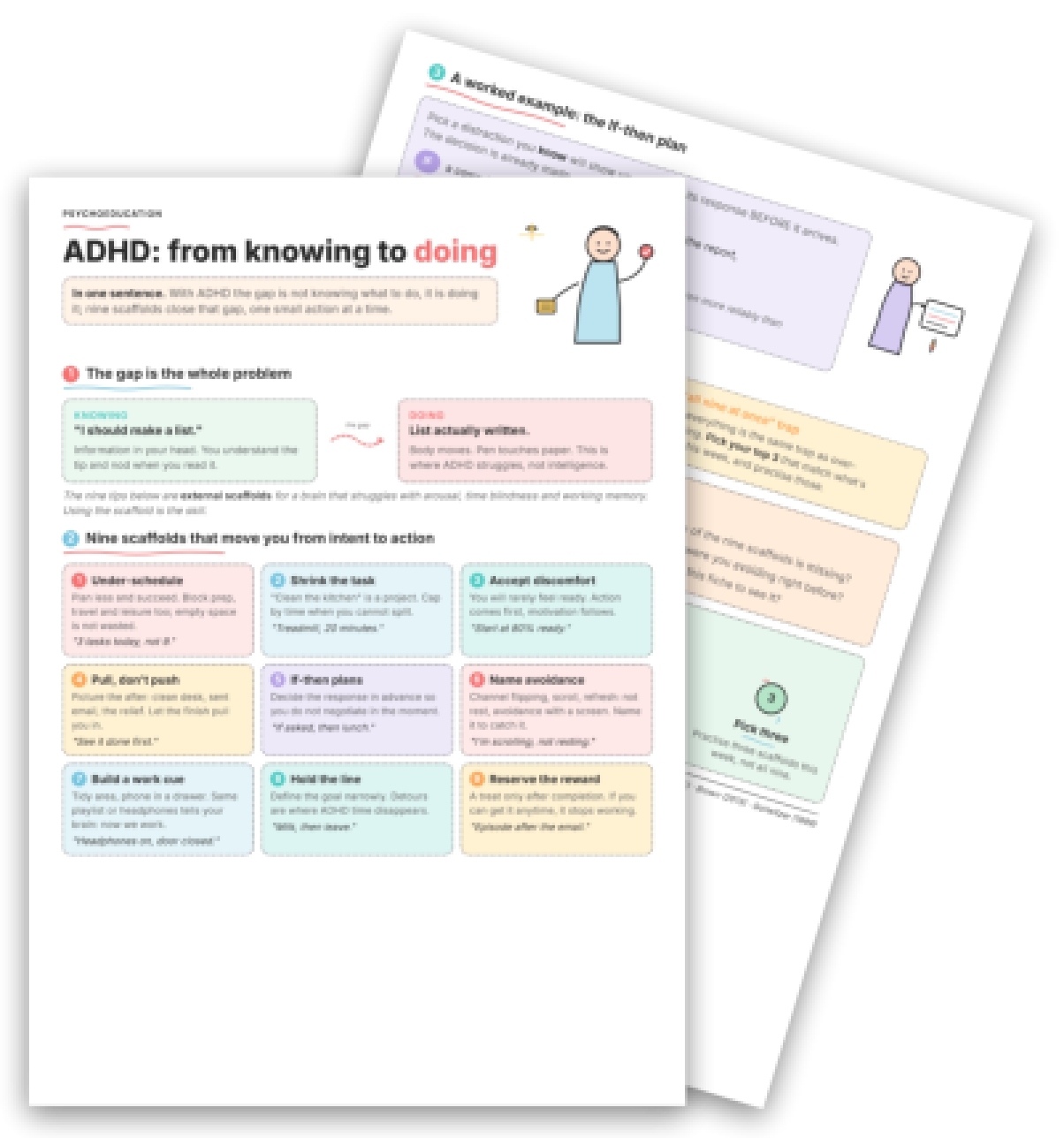
The visual layout is built around four numbered panels. Panel 1 presents the knowing-doing gap as a two-column diagram: "Information in your head" versus "Body moves. Pen touches paper." The caption reads: "This is where ADHD struggles, not intelligence." Showing this to a patient takes about thirty seconds and often does more than ten minutes of verbal explanation.
Panel 2 lists nine external scaffolds, each with a one-line principle and a short phrase to remember it by:
- Under-schedule: "3 tasks today, not 9"
- Shrink the task: cap by time when you cannot split
- Accept discomfort: "Start at 80% ready"
- Pull, don't push: picture the after-state to generate forward momentum
- If-then plans: pre-decided responses based on Gollwitzer's implementation intentions
- Name avoidance: "I'm scrolling, not resting"
- Build a work cue: environmental anchoring for attention
- Hold the line: narrow the goal, protect against the tangent
- Reserve the reward: contingency management, not open access
Panel 3 walks through a worked if-then plan with a concrete coworker scenario, modelling how to construct one before the distraction arrives. For patients who struggle with abstract instruction, this is the panel that makes the technique real.
Panel 4 names the two traps, followed by a "To discuss in session" block with three reflective prompts already written out, for example: "Which of the nine scaffolds is missing when the gap between intent and action widens?" These prompts function as a ready-made debrief structure.
> Key point: this fiche is not a self-help checklist the patient fills in alone. It is a visual support that facilitates the explanation in session, giving both parties a shared vocabulary and a concrete reference to come back to across the care episode.
750+ clinical tools
A library built with and for clinicians, ready to use in session and extend between appointments.
Access all the toolsWhen and how to introduce the fiche
This fiche fits naturally into early psychoeducation work, once you have established the formulation and the patient has named at least one specific context where the knowing-doing gap is costly. Introducing it before that risks the sheet joining a pile of things they know but do not use.
A low-friction framing: "I want to show you something that maps exactly what you just described. It's not a list of things you should have done, it's a diagram of what happens in the brain when ADHD is involved." Opening on the visual, the two-column gap diagram, before naming any of the nine scaffolds preserves curiosity and avoids the "I already know this" trap you will need to address anyway.
For the debrief, the three session prompts on the fiche do the heavy lifting. Ask the patient to choose three scaffolds that match what is hardest that week, and suggest they post the sheet somewhere visible. That last instruction is explicit in the Remember panel: "Pick three. Practise three scaffolds this week, not all nine."
The fiche pairs naturally with time management tools for executive function work and, for patients with comorbid avoidance patterns, with resources on changing avoidance behavior. For younger patients or parent-facing consultations, ADHD parenting strategies and children's ADHD skills extend the same framework to the family system. When procrastination is the presenting complaint rather than a clear ADHD formulation, the habit-building worksheet provides a useful bridge. For academic contexts, study tips for ADHD and test anxiety and the Eisenhower urgency-importance matrix complement the scaffolding approach directly. The Managing ADHD worksheet and the healthy habit planning tool are natural next steps once the patient has practised their three chosen scaffolds for a week or two.
The fiche does not replace the clinical formulation or the work of building executive function skills longitudinally. What it does is make the first explanation faster, clearer, and something the patient actually takes out of the room with them.
Use it with your patients
Share this tool in the mobile app and follow the work between sessions.
Sources
- Barkley, R. A. (1997). ADHD and the Nature of Self-Control. Guilford Press.
- Barkley, R. A. (2012). Executive Functions: What They Are, How They Work, and Why They Evolved. Guilford Press.
- Barkley, R. A., Benton, C. M. (2022). Taking Charge of Adult ADHD: Proven Strategies to Succeed at Work, at Home, and in Relationships (2nd ed.). Guilford Press.
- Ramsay, J. R., Rostain, A. L. (2015). Cognitive Behavioral Therapy for Adult ADHD: An Integrative Psychosocial and Medical Approach (2nd ed.). Routledge.
- Gawrilow, C., Gollwitzer, P. M. (2008). Implementation Intentions Facilitate Response Inhibition in Children with ADHD. Cognitive Therapy and Research.
Your session continues in your patients' pocket
Use with a patientYour resources, available everywhere
The handouts, exercises, programs and audios above: you choose which ones to make available to your patients, in the mobile app dedicated to them.
And far more than a library
The app goes well beyond resources, to support your patients every day:
Related categories
Explore other clinical resources by category.

Behaviours
Clinical hub for behaviors in therapy: worksheets and tools for coping, eating disorders, CBT formulation, and maladaptive behavioral patterns.

Neurodevelopment
Clinical hub for neurodevelopmental disorders: psychoeducation, worksheets and intervention tools for ADHD, ASD, learning disorders and related conditions.

Cognition
Printable cognitive therapy worksheets and clinical tools for therapists: CBT, ACT, schema work, defusion, distortions, and belief restructuring.

Understand
Clinical hub for the therapeutic aim 'Understand': worksheets and tools to build patient insight across CBT, ACT, schema therapy and more.

Build skills
Skill-building resources for clinicians: printable worksheets and exercises for coping, assertiveness, and communication skills training in therapy.

CBT
CBT worksheets, cognitive restructuring exercises & behavioral tools for clinicians. Evidence-based resources for every phase of cognitive behavioral therapy.