
Clinical picture. A mother attended a follow-up session reporting near-daily conflict with her 8-year-old son, T., diagnosed with combined-presentation ADHD, around the morning routine. She described repeated verbal prompting that escalated into shouting before school. The clinician reviewed the informational sheet with her, focusing on the anchor-routine and visual-chart strategies, and suggested she photograph the four morning steps and post them at eye level by the bathroom mirror. At the next session three weeks later, she reported that the chart had not eliminated all friction but had shifted her role from repeated nagger to occasional pointer, which she found more sustainable. T. had begun checking off the steps independently on most mornings, which she had reinforced with brief specific praise as outlined in the sheet.
ADHD Parenting Tips: PDF Worksheet, Tools and Exercises for Clinical Practice
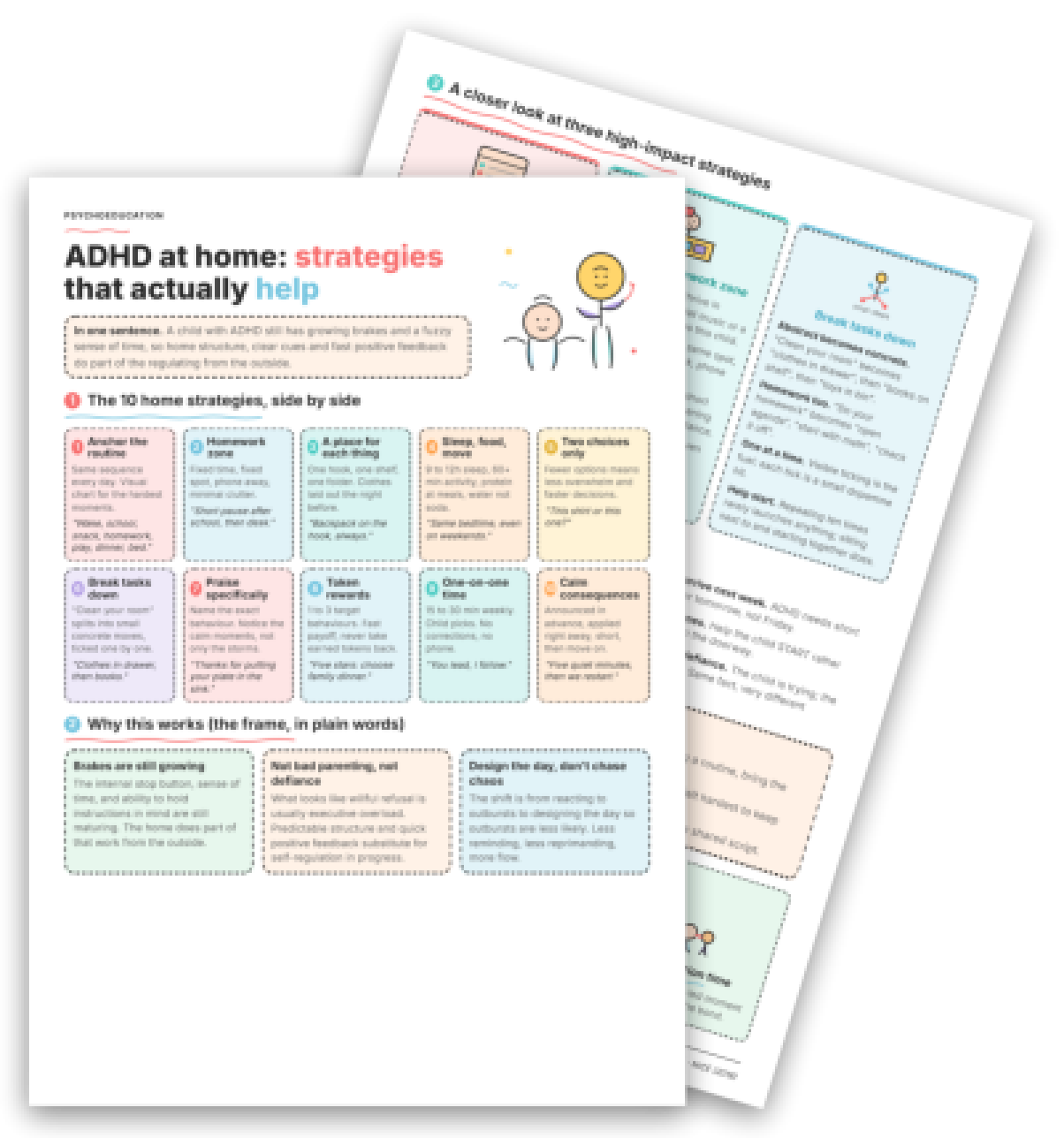
A structured visual fiche PDF with 10 concrete strategies, clinical tools, and exercises to support parents of children with ADHD in and between sessions.
Clinical vignettes
Visual Routine Reduces Morning Conflict
Token System and One-on-One Time
Clinical picture. A father of a 10-year-old girl, M., with ADHD and low frustration tolerance came to session expressing helplessness: nothing he tried held her attention for more than a day. The clinician shared the informational sheet, normalising the pattern as executive overload rather than opposition, and worked with him to select two target behaviours for a token chart, keeping the reward cycle short enough that M. could earn a payoff within the same week. They also discussed scheduling a weekly 20-minute period led entirely by M., without corrections or phones. He returned the following month noting that M. had begun reminding him of their one-on-one time, which he read as a sign of reconnection. Homework compliance remained variable, but the overall atmosphere at home had become less reactive.
Parents of children with ADHD often arrive at session cycling between guilt and frustration, having spent months interpreting executive dysfunction as deliberate defiance. A single oral explanation of the neurodevelopmental model rarely breaks that attribution in one sitting. This fiche PDF gives you a compact visual support to deliver that reframe clearly, in session, with a structure parents can take home and actually use.
Use this resource with your patients
Handout, exercises and materials ready to use, right inside SessionFuel.
Why ADHD Parenting Behaviors Resist Oral Explanation
The interpretive gap is predictable. When a child cannot start homework, forgets the backpack again, or escalates at bedtime, parents' default attribution is motivational: the child could comply, but won't. Explaining inhibitory control development verbally tends to produce polite nodding without genuine schema change.
Two things make this harder. First, parents often arrive with co-parenting disagreements already baked in, meaning any strategy you name will immediately collide with what the other parent does at home. Second, the strategy list for ADHD home management is long. Ten recommendations delivered orally in one appointment blur together by the time the parent reaches the car park.
The fiche addresses both problems at once: it presents all ten strategies side by side, in a scannable visual format, so parents leave with a reference they can return to rather than trying to reconstruct what was said. For families also navigating strong-willed behavior alongside attention difficulties, the Strong-Willed Children psychoeducation program offers a complementary multi-session arc.
What the ADHD Parenting Tips Fiche Contains
The fiche is organized across four panels, all grounded in the same plain-language neurodevelopmental frame.
Panel 1 presents the ten home strategies side by side, each reduced to a single concrete description and a one-line example: "Wake, school, snack, homework, play, dinner, bed." or "Five stars: choose family dinner." The side-by-side layout lets you work through several strategies in a single session without losing the parent in a wall of text.
Panel 2 gives the why in three short frames: brakes are still growing, what looks like defiance is usually executive overload, and the therapeutic shift is from reacting to outbursts to designing the day so outbursts are less likely. This is the panel that does the attributional reframe. Showing it visually, rather than narrating it, makes the logic harder to dismiss.
Panel 3 zooms into three high-impact strategies in more depth: anchoring the routine, building a homework zone, and breaking tasks down. Each includes an observe first prompt and a concrete example, which is useful when parents insist their child is "different" from the general advice.
Panel 4 flags six common pitfalls (too many rules at once, rewards that arrive next week, mixed co-parenting rules, repeating ten times instead of helping the child start, removing earned tokens, and reading effort as defiance). This is often the most clinically productive panel: parents recognize themselves immediately.
The fiche closes with "To discuss in session" prompts, which you can use directly to structure the debrief: "When you notice mornings or bedtimes are still chaotic after two weeks of trying a routine, bring the exact sticking point."
> Key takeaway: This fiche is a visual support that facilitates the psychoeducation explanation in session, not a worksheet the parent completes alone. You work through it together; they take it home as a reference.
750+ clinical tools
A library built with and for clinicians, ready to use in session and extend between appointments.
Access all the toolsWhen and How to Introduce the Fiche in Session
The fiche fits best after initial anamnesis, once you have a functional picture of the home environment and the main friction points. Introducing it too early, before the parent feels heard, risks it reading as a generic handout.
A neutral framing that avoids labeling the parent: "A lot of what feels chaotic at home makes complete sense once you see what the ADHD brain is actually working with. Let me show you a layout that maps the strategies most families find useful." Then work panel by panel, pausing at whichever strategy connects to the specific friction the parent described.
Contraindication to watch for: parents in active conflict over the diagnosis itself. If one parent contests the ADHD formulation, the strategy list will feel prescriptive rather than helpful. In those cases, Panel 2 (the attributional reframe) is the entry point, not Panel 1.
Debrief at the following session using the "To discuss in session" prompts on the fiche. Ask which strategy was hardest to maintain, and where co-parenting alignment broke down: that conversation almost always surfaces the specific sticking point worth working in session.
For broader parent support work, the Parenting Fundamentals 6-session program and the Parent-Child Communication program extend this work across multiple sessions. When emotional dysregulation in the child is also present, pairing the fiche with the 50 Coping Strategies for Children and Adolescents gives parents a complementary toolkit. If anxiety is co-occurring, the Anxiety in Children and Adolescents parent program and the Depression in Children and Adolescents parent program address the most common comorbidity presentations. For families also managing screen use conflicts, the Screen Addiction in Children parent program slots in naturally. And if whining and low frustration tolerance are the main presenting complaints alongside ADHD behaviors, Whining and Complaining in Children provides a focused complement.
The fiche does not replace the therapeutic frame; it makes the psychoeducation explanation more precise, saves time, and gives the parent a concrete reference between appointments.
Use it with your patients
Share this tool in the mobile app and follow the work between sessions.
Sources
- Barkley, R. A. (2022). Taking Charge of ADHD: The Complete, Authoritative Guide for Parents (4th ed.). Guilford Press.
- American Academy of Pediatrics (AAP) Subcommittee on Children and Adolescents With ADHD (2019). Clinical Practice Guideline for the Diagnosis, Evaluation, and Treatment of Attention-Deficit/Hyperactivity Disorder in Children and Adolescents. Pediatrics.
- Centers for Disease Control and Prevention (CDC). Parent Training in Behavior Management for ADHD. CDC.
Your session continues in your patients' pocket
Use with a patientYour resources, available everywhere
The handouts, exercises, programs and audios above: you choose which ones to make available to your patients, in the mobile app dedicated to them.
And far more than a library
The app goes well beyond resources, to support your patients every day:
Related categories
Explore other clinical resources by category.

Relationships
Clinical worksheets and tools on relational functioning: attachment, schemas, assertiveness, and communication skills for therapists. Printable PDF resources.

Neurodevelopment
Clinical hub for neurodevelopmental disorders: psychoeducation, worksheets and intervention tools for ADHD, ASD, learning disorders and related conditions.

Understand
Clinical hub for the therapeutic aim 'Understand': worksheets and tools to build patient insight across CBT, ACT, schema therapy and more.

Build skills
Skill-building resources for clinicians: printable worksheets and exercises for coping, assertiveness, and communication skills training in therapy.

CBT
CBT worksheets, cognitive restructuring exercises & behavioral tools for clinicians. Evidence-based resources for every phase of cognitive behavioral therapy.

Anxiety
Clinical hub for anxiety disorders: CBT and ACT worksheets, psychoeducation sheets, and exercises for assessment and treatment across the anxiety spectrum.