
Clinical picture. A mother presents with her 7-year-old son, T., referred for oppositional behavior concentrated around the evening routine; teeth-brushing had become a nightly conflict lasting up to 40 minutes. The clinician introduced the reward coupon worksheet, walking the mother through selecting one specific, observable target behavior and reviewing the pre-printed coupon deck with T. during the session. T. chose "stay up 10 extra minutes" as his first coupon and helped cross out options that held no appeal for him, which the clinician noted as a key step in securing buy-in. Over the following two weeks the mother reported handing over the coupon immediately after compliance and pairing it with brief verbal praise; bedtime conflicts decreased in frequency and the mother described the exchange as feeling manageable rather than arbitrary. No generalization to other behaviors was claimed, though the mother expressed interest in extending the system to morning routines.
Reward Coupons for Kids: PDF Worksheet, Tools and Exercises
A printable PDF worksheet with 10 ready-made reward coupons, step-by-step guidance, and clinical tools to help parents build consistent, predictable behavioral reinforcement at home.
Clinical vignettes
Coupon System for Bedtime Refusal
Reducing On-the-Fly Bargaining
Clinical picture. A father and his 9-year-old daughter, L., were seen following school reports of low frustration tolerance; at home, reward promises made in the moment had escalated to the point where the father felt unable to set any limit without negotiating a large gift. The clinician used the informational sheet to name the pattern explicitly, distinguishing vague verbal promises from a pre-agreed, visible coupon deck, and the father recognized the "bigger and bigger in the heat of the moment" dynamic immediately. Father and daughter built a small deck together in session, retiring coupons L. found uninteresting and adding a coupon for choosing the Saturday film. At the four-week check-in the father noted that L. would now point to the jar on the fridge rather than argue for an invented reward, reducing the negotiation load noticeably. The clinician reminded the father that consistency in handing coupons over promptly remained the active ingredient, and that the tool was not expected to address the underlying frustration tolerance difficulties on its own.
Most parents who arrive in consultation already use some form of reward, but they improvise it under pressure, escalate it mid-conflict, and forget it when the week gets busy. The result is a contingency management system that teaches the child the opposite of what the parent intends. This fiche PDF gives you a concrete, visually grounded tool to replace that improvisation with a structured, pre-agreed reinforcement deck you can introduce and debrief directly in session.
Use this resource with your patients
Handout, exercises and materials ready to use, right inside SessionFuel.
Why reward-based contingency management resists verbal explanation
The principles behind positive reinforcement are well-established across Kazdin's behavioral parent training model, Webster-Stratton's Incredible Years protocol, and Forehand's work on compliance training. Yet when you explain to a parent why immediate, specific, and consistent reward delivery matters, the concepts tend to dissolve by the next appointment. Parents grasp the rationale abstractly and then default to vague promises ("we'll see at the weekend") or impulsive reward offers that shift in value with their emotional state.
Two failure modes are especially common in practice. The first is reward inflation: the parent invents bigger and bigger incentives in moments of conflict, eroding the predictability that makes operant conditioning work. The second is broken contingency: the earned reward gets withdrawn on a bad day, collapsing the child's trust in the system entirely. Neither failure is about poor parenting motivation. Both are about the absence of a pre-agreed, visible structure that holds when emotions run high.
A purely oral explanation of contingency management leaves no trace. Parents leave the session with good intentions and no scaffolding.
What the fiche contains: a visual support for explaining the system in session
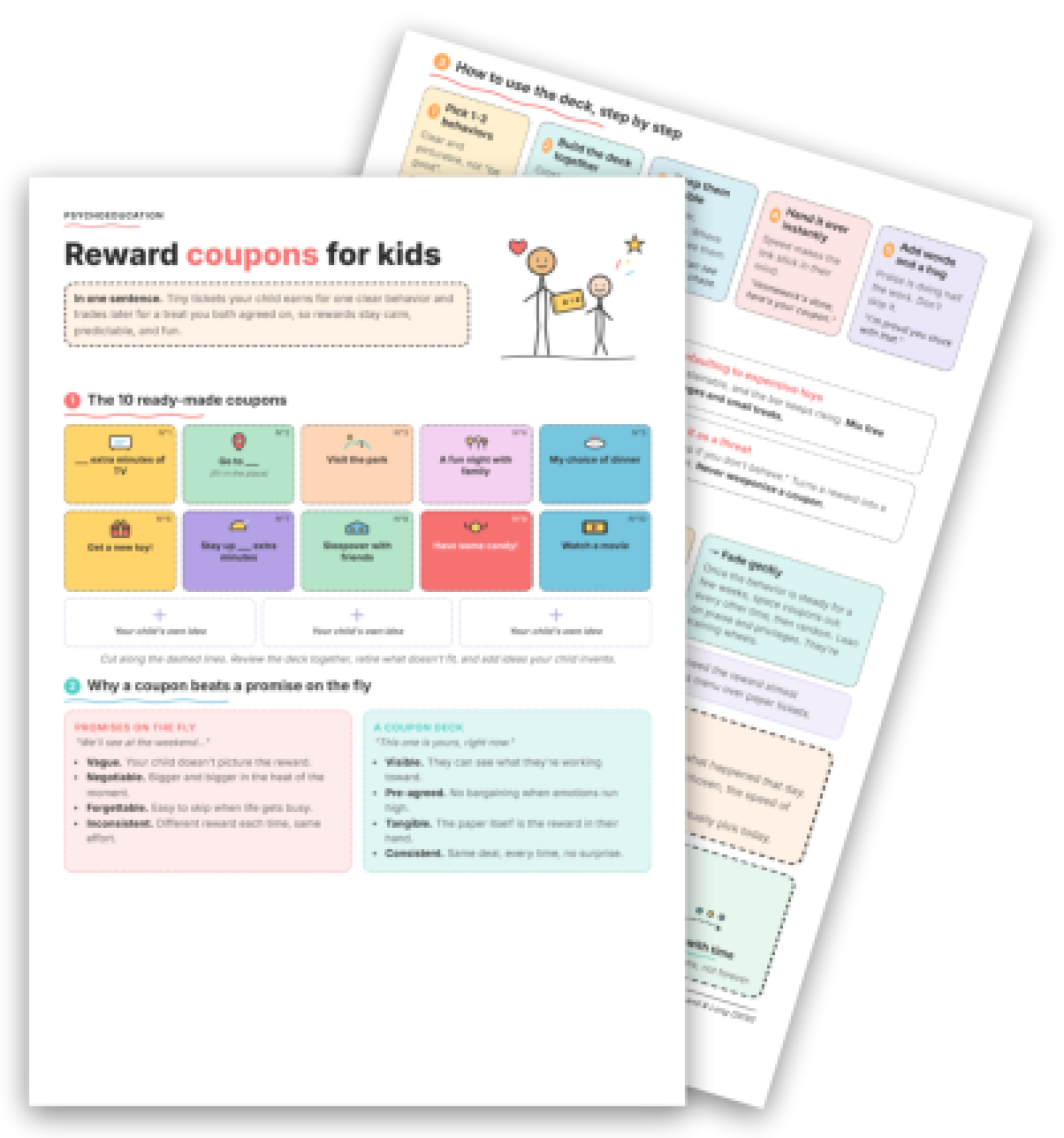
The fiche PDF is built around five clearly sequenced sections, and its strength as a support visuel is that it makes abstract behavioral principles tangible on paper.
Section 1 presents 10 ready-made coupons the parent and child can use immediately: extra screen minutes, a trip to the park, dinner of their choice, a sleepover with friends, a new toy, and others. Three blank coupons invite the child's own ideas. The instruction at the bottom reads: "Cut along the dashed lines. Review the deck together, retire what doesn't fit, and add ideas your child invents." Proposing this together in session lets you model collaborative construction of the deck.
Section 2 is a side-by-side comparison between "promises on the fly" and "a coupon deck", contrasting vague vs. visible, negotiable vs. pre-agreed, forgettable vs. tangible. This two-column layout is the pivot of the fiche: it shows in one glance why the deck outperforms good intentions. No verbal explanation achieves that compression.
Sections 3 and 4 walk through the five implementation steps (picking a clear, picturable target behavior, building the deck together, keeping it visible, handing it over instantly, adding praise) and the four common traps to avoid: inventing rewards in the moment, defaulting to expensive toys, withdrawing an earned coupon, and weaponizing a coupon as a threat.
Section 5 covers fading: moving from coupon-for-every-instance to intermittent reinforcement once the behavior is stable, and eventually leaning on praise and privileges alone. The fiche closes with a "To discuss in session" block that anchors the homework back to the therapeutic frame.
> Key point: the fiche is a visual support that facilitates the explanation of the coupon system in session, not a take-home questionnaire. The clinician works through it with the parent (and ideally the child), then leaves it as a reference the family can return to between appointments.
750+ clinical tools
A library built with and for clinicians, ready to use in session and extend between appointments.
Access all the toolsWhen and how to introduce the fiche
This fiche is most productive once you have identified a specific, observable target behavior in your formulation: refusal at homework time, bedtime resistance, teeth-brushing arguments. Without a concrete behavioral anchor, the deck risks becoming a general bribe menu rather than a structured contingency. Pair it naturally with a brief explanation of operant conditioning principles or rewards and consequences if the parent needs the conceptual grounding first.
It fits cleanly into parenting work for ADHD, strong-willed children, and the oppositional patterns you encounter in DMDD presentations. It also complements the Token Reward System fiche for families who need a points-to-coupon bridge. When working within parenting fundamentals programs or parent-child communication programs, this fiche slots naturally into a session focused on positive reinforcement.
The age range specified in the fiche is roughly 4 to 11 years. For younger children within that range, flag that the reward must follow the behavior almost immediately. The fiche itself notes that older children and adolescents typically respond better to a privilege contract or points menu, so proposing it to the parent of a 13-year-old will require explicit reframing.
A simple introduction: "Before we talk about consequences, I want to show you a structure that takes the negotiation out of the equation. Let's build the deck together now so you leave with something concrete." Debrief at the next session using the "To discuss in session" prompts in the fiche, particularly around identifying behavioral triggers and what changed when the system stalled.
The fiche does not replace the therapeutic frame. It makes one precise piece of behavioral parent training explicit, visible, and reproducible at home.
Use it with your patients
Share this tool in the mobile app and follow the work between sessions.
Sources
- Barkley, R. A. (2013). Defiant Children: A Clinician's Manual for Assessment and Parent Training (3rd ed.). Guilford Press.
- Kazdin, A. E., Rotella, C. (2008). The Kazdin Method for Parenting the Defiant Child: With No Pills, No Therapy, No Contest of Wills. Houghton Mifflin.
- Cincinnati Children's Hospital Medical Center (2017). Contingency Management Systems for Children with ADHD.
Your session continues in your patients' pocket
Use with a patientYour resources, available everywhere
The handouts, exercises, programs and audios above: you choose which ones to make available to your patients, in the mobile app dedicated to them.
And far more than a library
The app goes well beyond resources, to support your patients every day:
Related categories
Explore other clinical resources by category.

Behaviours
Clinical hub for behaviors in therapy: worksheets and tools for coping, eating disorders, CBT formulation, and maladaptive behavioral patterns.

Relationships
Clinical worksheets and tools on relational functioning: attachment, schemas, assertiveness, and communication skills for therapists. Printable PDF resources.

Build skills
Skill-building resources for clinicians: printable worksheets and exercises for coping, assertiveness, and communication skills training in therapy.

CBT
CBT worksheets, cognitive restructuring exercises & behavioral tools for clinicians. Evidence-based resources for every phase of cognitive behavioral therapy.

Anxiety
Clinical hub for anxiety disorders: CBT and ACT worksheets, psychoeducation sheets, and exercises for assessment and treatment across the anxiety spectrum.

Trauma
Clinical hub on trauma and PTSD: assessment, differential diagnosis, treatment phases, and printable resources for practitioners. 155 chars.