
Clinical picture. M., a woman in her late thirties, presented with generalised anxiety and a longstanding pattern of declining social invitations. She described the refusals as reasonable given her workload, and had not connected them to her progressive social withdrawal. During a session focused on the operant conditioning handout, the clinician walked through the ABC model using one of her own recent examples: an invitation arrived, dread followed, she declined by text, and relief came within minutes. Mapping this onto the negative reinforcement contingency made the maintenance cycle visible to her in a way that verbal explanation alone had not achieved. She left the session with the handout and agreed to track the consequence column for one week, which generated material that shaped the subsequent behavioural activation work.
Operant Conditioning: PDF Worksheet, Tools and Exercises for Clinical Practice
A visual PDF worksheet, tools and exercises that make operant conditioning legible in session, so patients can finally see the reinforcement loops sustaining their stuck behaviors.
Clinical vignettes
Negative Reinforcement Maintaining Avoidance
Reassurance Loop in OCD Presentation
Clinical picture. T., a man in his mid-twenties with a diagnosis of OCD, sought reassurance from his partner multiple times each evening about whether he had locked the front door. He understood intellectually that checking was unhelpful, yet the behaviour persisted and had intensified over several months. The clinician introduced the operant conditioning handout to examine why a behaviour both patient and partner found distressing continued to grow rather than extinguish. Identifying the moment of relief following the partner's confirmation, and labelling it as negative reinforcement, shifted T.'s framing: the problem was not weakness or irrationality but a well-trained loop. This reframe reduced self-blame and increased willingness to engage with a response-prevention protocol.
Explaining operant conditioning verbally tends to go sideways fast: patients nod at "positive reinforcement," immediately conflate negative reinforcement with punishment, and the clinical insight that relief is itself a powerful reinforcer gets lost before it can land. This fiche PDF gives you a structured visual scaffold to walk through the mechanism in session, in a way that makes stuck patterns visible rather than theoretical.
Use this resource with your patients
Handout, exercises and materials ready to use, right inside SessionFuel.
Why Operant Conditioning Resists a Purely Verbal Explanation
The central difficulty is not the four contingencies themselves, it is the 30-second window. Reinforcement operates on a timescale completely out of proportion with the costs it generates, and that gap is nearly impossible to convey in speech alone. When a patient cancels a meeting and feels immediate relief, they do not experience "negative reinforcement"; they experience rescue. Naming the mechanism helps, but what actually shifts the frame is showing the patient, in a single glance, how that relief directly feeds the pattern they are trying to break.
Negative reinforcement is the single biggest sticking point. Most patients (and many trainees) read "negative" as "bad" and build a plausible but wrong model of their own behavior. Without a visual that cleanly separates "something added / something removed" from "behavior grows / behavior shrinks," the correction rarely sticks past the session. The same confusion surfaces with reassurance-seeking, compulsive checking, and avoidance patterns: each is maintained by the removal of discomfort, yet patients frame these as failures of willpower rather than as learned contingencies. The fiche PDF resolves this framing problem structurally, before you have said a word about their specific presentation.
What the Fiche Contains: A Four-Panel Visual Scaffold
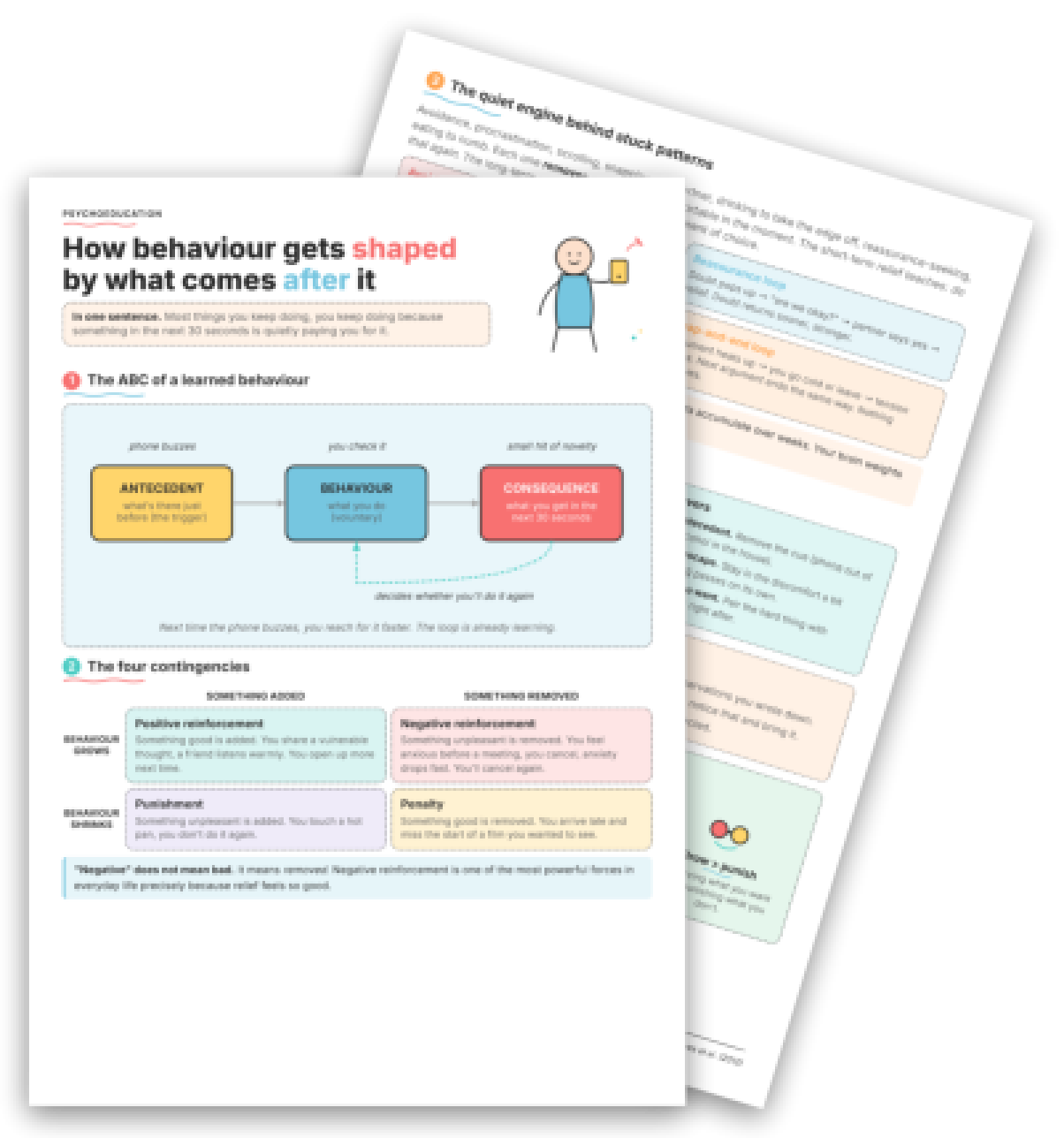
The fiche moves through four numbered panels, each building logically on the last.
Panel 1 lays out the ABC of a learned behaviour, Antecedent, Behaviour, Consequence, anchored immediately in the phone-buzz example ("Next time the phone buzzes, you reach for it faster. The loop is already learning."). This grounds the model in something every patient recognizes, making the pivot to their own presenting behavior almost frictionless.
Panel 2 maps the four contingencies in a 2×2 grid: something added vs. something removed, crossed with behavior growing vs. shrinking. The visual does the definitional work that verbal explanation struggles with. The fiche states it plainly: "'Negative' does not mean bad. It means removed." Seeing that in print, in a grid, dissolves the confusion faster than any amount of oral explanation.
Panel 3 is clinically the richest section. It maps four labeled loops, avoidance, reassurance, withdrawal, and snap-and-end, each showing the short-term relief alongside the long-term cost. These translate directly to common presentations: the avoidance cycle in anxiety, behavioral withdrawal in depression, and interpersonal rupture patterns connected to all-or-nothing thinking. Showing a patient their specific loop on paper, rather than describing it, tends to produce faster recognition and noticeably less defensiveness than a verbal formulation alone.
Panel 4 shifts to application: the ABC notebook exercise (catch a behavior three times, write A/B/C, name the contingency, weigh short-term payoff against long-term cost) and three practical levers (change the antecedent, block the easy escape, reinforce what you actually want). A short "To discuss in session" block flags three specific observations worth bringing back, which structures the debrief for the following appointment.
> Key takeaway: the fiche is a visual support that facilitates in-session explanation of operant conditioning. It is not a self-administered questionnaire but a psychoeducation scaffold the clinician uses to make maintaining processes legible, then leaves with the patient as a concrete reference.
750+ clinical tools
A library built with and for clinicians, ready to use in session and extend between appointments.
Access all the toolsWhen and How to Introduce It in Session
The fiche fits best in early-to-mid treatment, once you have an initial case formulation and the alliance is solid enough to name maintaining processes directly. It works particularly well with:
- Patients who intellectualize ("I know I shouldn't keep checking, but I can't stop")
- Presentations where procrastination or avoidance is a core maintaining factor
- Behavioral activation work, used alongside an activity menu to show why scheduling pleasant events is itself a reinforcement intervention
- Habit change contexts, pairing well with the building new habits framework
- Child and adolescent work, where parents benefit from seeing a token reward system grounded in the same contingency logic
Introduce it with a frame that sidesteps self-blame: "I want to show you something about how behaviors get learned, because it changes where we look for the lever." Walk through the four loops together, ask which one resonates most, then assign the ABC notebook as between-session homework. Debrief by reviewing the written A/B/C observations and naming the contingency together.
The fiche pairs naturally with classical conditioning psychoeducation for a fuller behavioral model, with exposure hierarchy construction once avoidance loops are identified, and with coping strategy evaluation to compare which behaviors grow the problem and which reduce it. It does not replace formulation; it makes one maintaining mechanism visible on paper, which is often precisely what gets a patient unstuck.
Use it with your patients
Share this tool in the mobile app and follow the work between sessions.
Sources
- Skinner, B. F. (1953). Science and Human Behavior. Macmillan.
- Ferster, C. B., Skinner, B. F. (1957). Schedules of Reinforcement. Appleton-Century-Crofts.
- Cooper, J. O., Heron, T. E., Heward, W. L. (2019). Applied Behavior Analysis (3rd ed.). Pearson.
- Miltenberger, R. G. (2024). Behavior Modification: Principles and Procedures (7th ed.). Cengage Learning.
Your session continues in your patients' pocket
Use with a patientYour resources, available everywhere
The handouts, exercises, programs and audios above: you choose which ones to make available to your patients, in the mobile app dedicated to them.
And far more than a library
The app goes well beyond resources, to support your patients every day:
Related categories
Explore other clinical resources by category.

Anxiety
Clinical hub for anxiety disorders: CBT and ACT worksheets, psychoeducation sheets, and exercises for assessment and treatment across the anxiety spectrum.

Mood
Evidence-based worksheets and clinical tools for mood disorders: CBT, ACT, and positive psychology resources for psychologists and therapists.

Behaviours
Clinical hub for behaviors in therapy: worksheets and tools for coping, eating disorders, CBT formulation, and maladaptive behavioral patterns.

Understand
Clinical hub for the therapeutic aim 'Understand': worksheets and tools to build patient insight across CBT, ACT, schema therapy and more.

CBT
CBT worksheets, cognitive restructuring exercises & behavioral tools for clinicians. Evidence-based resources for every phase of cognitive behavioral therapy.

Trauma
Clinical hub on trauma and PTSD: assessment, differential diagnosis, treatment phases, and printable resources for practitioners. 155 chars.