
Clinical picture. A, a woman in her late thirties, had been attending weekly sessions for generalised anxiety for four months and had reported steady improvement in sleep and worry management. She arrived at session 17 visibly defeated after a difficult week at work had triggered several days of rumination and one night of almost no sleep, stating she felt "back to zero." The clinician introduced the progress-in-therapy informational sheet, walking through the sawtooth graph and the snakes-and-ladders frame. A identified her week as a snake landing rather than a return to the start, and was invited to retrieve her own tracking notes, which showed three prior dips of similar length that had each resolved within five to seven days. She left the session with a named coping question to carry into the week: "What helped last time I was here?"
Progress in Therapy: PDF Worksheet, Tools and Exercises
A visual PDF worksheet, clinical tools, and exercises to help patients understand the non-linear nature of therapeutic progress and stay the course after setbacks.
Clinical vignettes
Reframing a Setback as a Snake, Not Square One
Spiral Staircase and Recurring Social Anxiety
Clinical picture. M, a man in his mid-twenties, presented with social anxiety and had made measurable gains across twelve sessions, including two successful job interviews he had previously avoided entirely. Six weeks after a planned therapy break he returned reporting that anticipatory anxiety ahead of a team presentation had felt "exactly like it did at the beginning," and he questioned whether progress had been real. The clinician used the spiral-staircase section of the informational sheet to distinguish identical view from identical height. Together they reviewed a short list of indicators from the sheet, and M acknowledged that the anxiety had peaked two days before the presentation rather than two weeks before, and that he had not cancelled. No reframing of the distress as trivial was offered; the work focused on consolidating his reading of the evidence rather than disputing the feeling.
When a patient reports a rough week after three good ones, the session often pivots around one conviction: "I'm back to square one." Correcting that belief verbally takes time and rarely sticks. This PDF worksheet gives you a visual scaffold to make the non-linearity of therapeutic progress concrete, believable, and portable, something the patient can take away and return to between appointments.
Use this resource with your patients
Handout, exercises and materials ready to use, right inside SessionFuel.
Why Non-Linear Progress Is So Hard to Explain at the Whiteboard
The clinical difficulty here is not conceptual. Most patients already know, in the abstract, that progress does not follow a straight line. The problem is that during a dip, autobiographical memory narrows the timeline and confirms the worst interpretation. The patient recalls only the recent slump, not the ground gained over the previous three months.
Oral explanation tends to produce polite agreement followed by renewed hopelessness the next session. The gap between knowing a principle and applying it during emotional flooding, what Linehan's DBT framework would call the distance between cool cognition and hot affect, is precisely where a structured visual support earns its place. There is also a dropout risk. Patients who interpret a natural trough as evidence that "the work is not working" are prime candidates for premature termination. Introducing this fiche PDF early normalises the zigzag trajectory before the first significant setback hits, functioning as prophylactic psychoeducation rather than damage control.
What the Fiche Contains: Three Visual Metaphors, One Shared Language
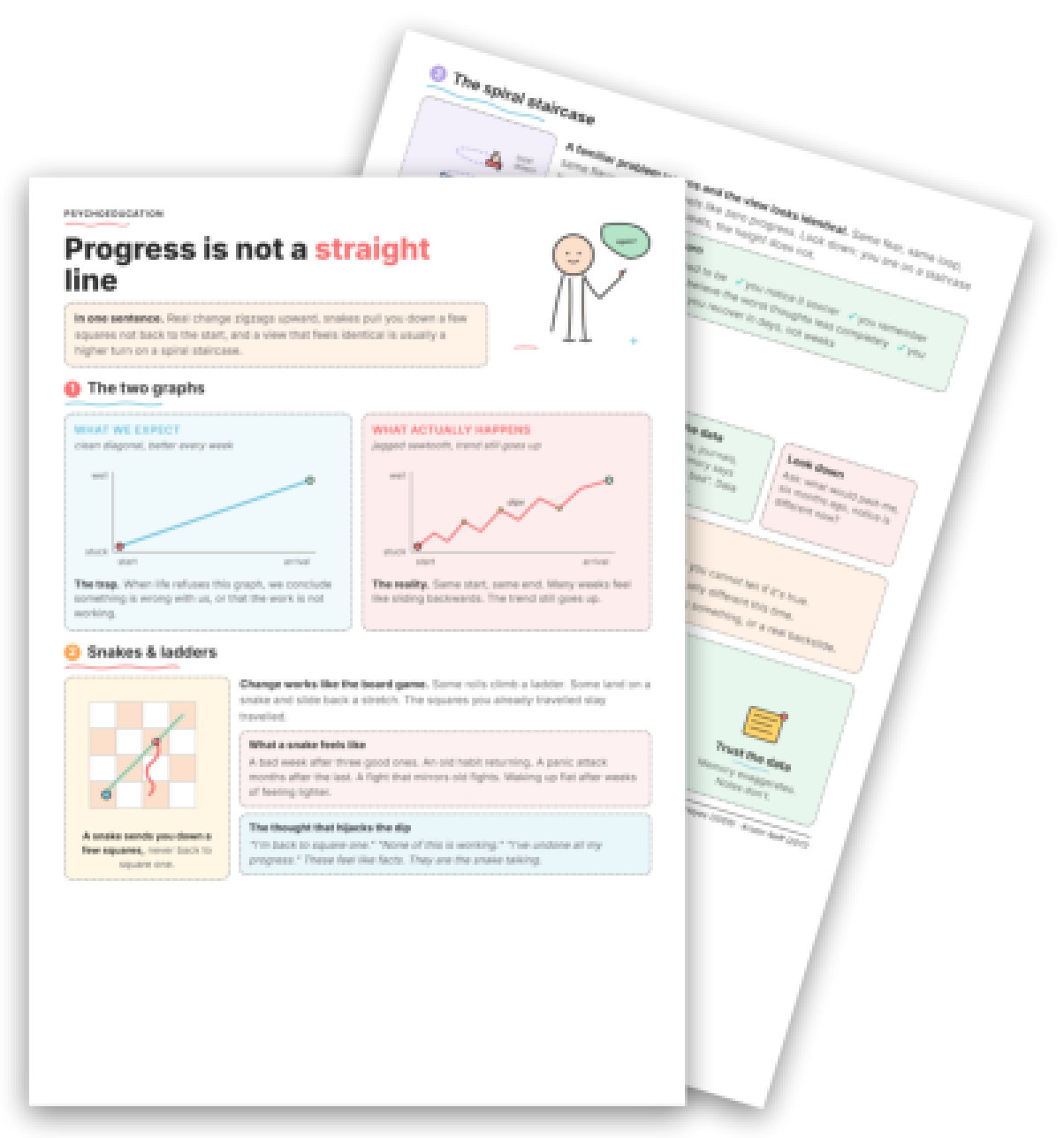
The support builds its argument around three successive panels, each addressing a different cognitive error that surfaces during setbacks.
Panel 1, "The Two Graphs," places the expected trajectory (a clean upward diagonal) alongside the actual one (a jagged sawtooth with a rising overall trend). Both share the same start and end points. The fiche names the trap directly: "When life refuses this graph, we conclude something is wrong with us, or that the work is not working." That side-by-side image communicates in five seconds what several minutes of verbal reframing rarely achieves.
Panel 2, "Snakes & Ladders," targets the catastrophic thought "I've undone all my progress." The core reframe is stated plainly: "The squares you already travelled stay travelled." This maps directly onto the lapse-versus-relapse distinction central to resources like the Lapse and Relapse Management worksheet, and it anchors the distinction in something the patient already understands without clinical jargon.
Panel 3, "The Spiral Staircase," addresses a subtler distortion: a familiar emotion returns and the patient concludes they are back at zero. The fiche offers a concrete checklist of signs indicating a higher turn on the spiral: "the dip is shorter than it used to be," "you notice it sooner," "you recover in days, not weeks." Working through this checklist with a patient prone to all-or-nothing thinking or catastrophizing makes the distortion visible without requiring you to name it as such.
A closing section, "When You Hit a Snake," gives four micro-strategies (Name it, Ask back, Check the data, Look down) and three discussion prompts explicitly marked to discuss in session, preserving the boundary between autonomous reflection and clinical work. The visual layout does what a spoken explanation cannot: it externalises the architecture of change so patient and clinician can examine it together, rather than debating it.
> Key point: This fiche is a visual support that facilitates the explanation of non-linear progress in session. The clinician walks through it with the patient; the patient keeps it as a concrete reference between appointments. It is not a self-administered questionnaire.
750+ clinical tools
A library built with and for clinicians, ready to use in session and extend between appointments.
Access all the toolsWhen and How to Introduce It
The optimal window is early in treatment, ideally in the second or third session after the initial formulation, before the first significant setback occurs. Framing matters: rather than presenting it as a prediction of failure, you might say: "A lot of people find that change doesn't feel as clean as they expect, here's a way to look at what it actually tends to look like."
The fiche is particularly well-suited to patients with a strong perfectionism profile, those with a prior history of dropout, and anyone working through depression or recurrent anxiety, where dips are expected and their misinterpretation is clinically costly. It integrates naturally with growth mindset work, with relapse prevention planning, and with maintaining hope exercises when hopelessness takes hold mid-treatment.
Debrief by asking which graph the patient has been using to measure themselves, and which checklist items under "higher turn" they would tick if they looked back honestly. The three in-session discussion prompts on the fiche give you a ready-made structure if the conversation needs direction.
One limit worth noting: patients in an acute crisis or very early in treatment may not yet have enough retrospective data to use the spiral staircase panel meaningfully. In those cases, hold the fiche until a pattern is visible, then introduce it alongside celebrating progress exercises once there is something concrete to look back on. The fiche does not replace the therapeutic frame; it makes the explanation of progress cleaner and leaves the patient with a durable, visual reminder that a snake is not the end of the road.
Use it with your patients
Share this tool in the mobile app and follow the work between sessions.
Sources
- Prochaska, J. O., DiClemente, C. C., & Norcross, J. C. (1992). In search of how people change: Applications to addictive behaviors. American Psychologist, 47(9), 1102-1114.
Your session continues in your patients' pocket
Use with a patientYour resources, available everywhere
The handouts, exercises, programs and audios above: you choose which ones to make available to your patients, in the mobile app dedicated to them.
And far more than a library
The app goes well beyond resources, to support your patients every day:
Related categories
Explore other clinical resources by category.

Anxiety
Clinical hub for anxiety disorders: CBT and ACT worksheets, psychoeducation sheets, and exercises for assessment and treatment across the anxiety spectrum.

Mood
Evidence-based worksheets and clinical tools for mood disorders: CBT, ACT, and positive psychology resources for psychologists and therapists.

Identity
Clinical resources for self-identity work in therapy: CBT, ACT, schema tools for clinicians addressing self-concept, core beliefs, and identity disruption.

Understand
Clinical hub for the therapeutic aim 'Understand': worksheets and tools to build patient insight across CBT, ACT, schema therapy and more.

Prevent relapse
Prevention as a therapeutic aim: clinical framing, risk stratification, and printable resources for relapse prevention and early intervention in mental health.

CBT
CBT worksheets, cognitive restructuring exercises & behavioral tools for clinicians. Evidence-based resources for every phase of cognitive behavioral therapy.