
Clinical picture. M., a woman in her early forties with recurrent major depressive disorder, reported in session that she had managed to prepare a meal for her children after several days of near-total withdrawal. Her therapist introduced the exercise as between-session homework, asking her to write her responses to all three questions before the next appointment. At the following session, M. read aloud that she had identified her own decision to start, rather than external pressure, as the driving factor, a reattribution she had not previously made spontaneously. She noted that the lesson she wished to retain was that beginning with a very small action could interrupt her pattern of paralysis. The therapist used her written responses as a basis for collaborative reflection, without amplifying the result beyond what the patient herself had described.
Celebrating Small Victories in Depression: A Clinical Exercise
A structured between-session homework tool helping depressed patients name a concrete win, own their role, and extract lasting lessons from it.
Clinical vignettes
Owning a Small Win in Recurrent Depression
Consolidating Agency After Social Avoidance
Clinical picture. T., a man in his late twenties presenting with a moderate depressive episode and marked social avoidance, had declined social contact for several weeks when he replied to a colleague's message. His psychologist introduced the exercise at the close of a session, framing it as a way to record the event before low mood could reframe it as trivial. T. returned with written answers noting that he had chosen to respond despite anticipating discomfort, and that this choice had been entirely his own. His stated lesson was that the anticipation of social interaction was consistently worse than the interaction itself, a formulation he generated without prompting. The written record gave the therapist concrete material to revisit in subsequent sessions when avoidance re-emerged.
Why progress in depression is so hard to hold onto
Depressed patients rarely spontaneously register their own gains. The negativity bias that sustains depression works as a filter: genuine steps forward are discounted, reattributed to luck or external circumstances, or simply forgotten by the next session. You observe progress; your patient has already erased it. This is not modesty, it is a core feature of the disorder, well documented in relation to the disqualifying-the-positive distortion and the attentional traps you likely work with regularly.
What resists verbal explanation here is not the concept of self-efficacy, but the lived appropriation of a specific success: a patient needs to slow down, name the victory precisely, and actively claim their causal role in it. A few reassuring words from you during a consultation cannot produce that. A structured written exercise, completed autonomously, can.
Use this resource with your patients
Handout, exercises and materials ready to use, right inside SessionFuel.
What this exercise contains
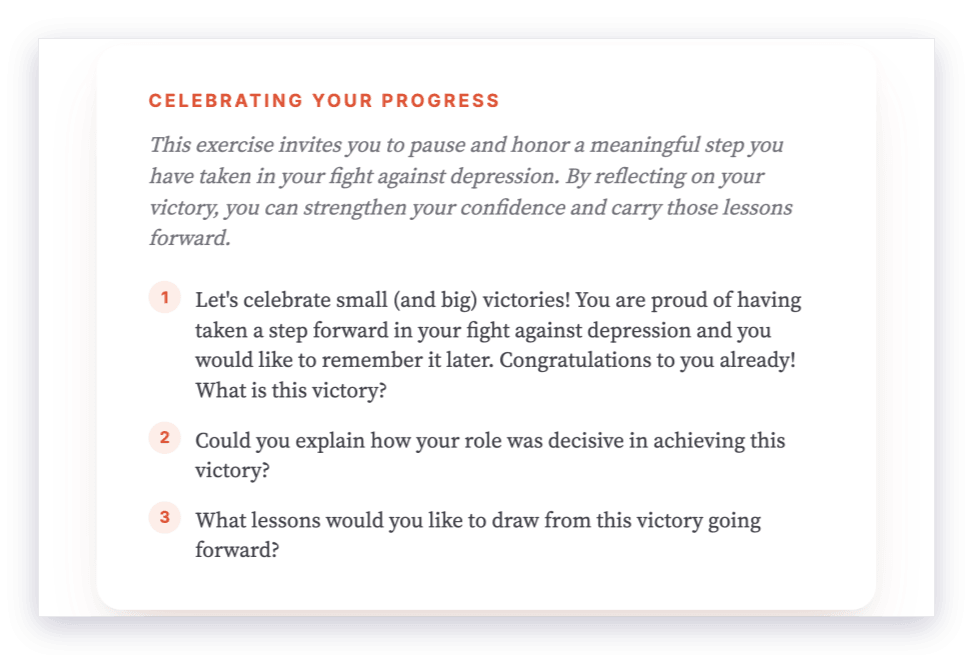
The tool follows a tight three-question arc, each question building on the one before.
Note: this image is a static preview listing the exercise questions only. The full guided exercise, with patient-facing instructions and space to write, is experienced by the patient directly in the app, not in this image.
The first question anchors the work in something concrete and personal: the patient names the victory explicitly and frames it as part of their ongoing fight against depression. The second question is clinically the most important: it asks the patient to explain how their own role was decisive, not just present, but determining. This is deliberate attribution work, countering the tendency to explain gains away. The third question pulls the lesson forward: what does this success teach about what works, and what can be carried into what comes next?
This three-step structure is lightweight enough not to overwhelm a patient who is still depleted, yet substantive enough to generate genuinely useful material. It pairs naturally with broader depression work such as the My Fight Against Depression: A Structured Progress Review exercise or a Finding Motivation for Change: A Clinical Program for Depression.
This exercise is available to patients through the mobile patient app of SessionFuel: once you assign it, your patient completes it directly on their phone, on their own, between appointments.
750+ clinical tools
A library built with and for clinicians, ready to use in session and extend between appointments.
Access all the toolsUse it with your patients
Share this tool in the mobile app and follow the work between sessions.
How to assign and use it in your practice
This exercise is designed as between-session homework, assigned at the end of a consultation and completed autonomously before the next one. It works best when a patient has recently crossed a threshold, however small: getting out of bed on a difficult morning, returning a call, completing one activity from a Weekly Activity Scheduling plan, or resisting a familiar avoidance pattern.
Which patients benefit most: those who minimise their gains, those stuck in all-or-nothing appraisals of progress, and those whose therapeutic momentum risks stalling. It is particularly useful alongside Maintaining Hope in Therapy: A Guided Clinical Exercise for patients who oscillate between brief improvement and rapid discouragement. It also complements work on Progress in Therapy and integrates naturally into any protocol addressing the Breaking Action Inertia in Depression cycle.
How to introduce it: keep the framing simple. Tell your patient that you want them to record this step before the memory fades, not for you, but so they can access it themselves later. Stress that the exercise is theirs to complete alone, in their own time, at their own pace.
What to do with what they bring back: the patient's answer to question two is where the real clinical material lives. Read it with them at the start of the next session. Notice whether the attribution is genuine or hedged ("I suppose I had a little to do with it..."). Use question three as a springboard: has the lesson translated into any intention? This connects naturally to goal-setting work such as Goal-Setting and Behavior Change: A Structured Clinical Exercise or, for patients building a broader self-image, the Positive Traits Checklist.
Key insight: The exercise does not celebrate progress in the abstract, it trains the patient to be the author of their own recovery, one named, owned, and documented victory at a time.
Over repeated cycles, these documented wins become a personal evidence base the patient can return to when hopelessness returns, a corrective to the memory gaps that depression routinely exploits.
Your session continues in your patients' pocket
Use with a patientYour resources, available everywhere
The handouts, exercises, programs and audios above: you choose which ones to make available to your patients, in the mobile app dedicated to them.
And far more than a library
The app goes well beyond resources, to support your patients every day:
Related categories
Explore other clinical resources by category.

Mood
Evidence-based worksheets and clinical tools for mood disorders: CBT, ACT, and positive psychology resources for psychologists and therapists.

Identity
Clinical resources for self-identity work in therapy: CBT, ACT, schema tools for clinicians addressing self-concept, core beliefs, and identity disruption.

Behaviours
Clinical hub for behaviors in therapy: worksheets and tools for coping, eating disorders, CBT formulation, and maladaptive behavioral patterns.

Cognition
Printable cognitive therapy worksheets and clinical tools for therapists: CBT, ACT, schema work, defusion, distortions, and belief restructuring.

Engage & motivate
Clinical hub: printable worksheets and exercises to build therapeutic engagement and motivation across ACT, CBT, and integrative practice. For clinicians.

Prevent relapse
Prevention as a therapeutic aim: clinical framing, risk stratification, and printable resources for relapse prevention and early intervention in mental health.