
Clinical picture. R., a woman in her early forties, presents with mild to moderate depression and reports longstanding fatigue she interprets as proof that exercise would only deplete her further. During a session focused on psychoeducation, the clinician introduces the informational sheet and walks through the neurobiological rationale, including the BDNF and cortisol mechanisms, without framing movement as a lifestyle correction. R. is visibly struck by the analogy of cortisol "pooling" when unspent, connecting it to the wired-but-exhausted quality she had struggled to name. She agrees to a single five-minute walk before the next appointment, not as homework but as a one-time experiment. At the following session she reports having repeated it three times spontaneously, noting a modest but noticeable shift in afternoon mood.
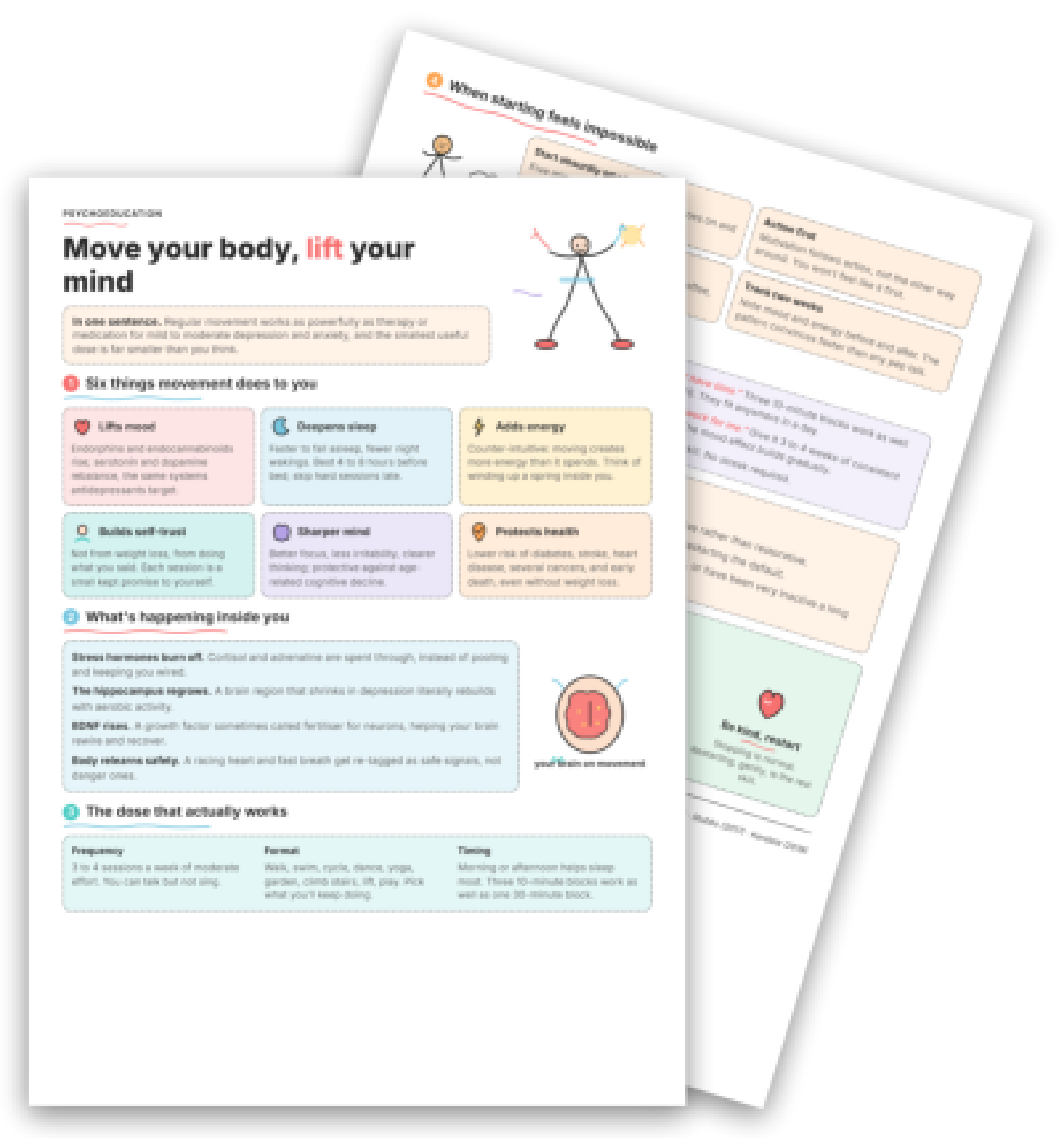
Exercise for Mental Health: PDF Worksheet, Tools and Exercises for Clinical Practice
A visual psychoeducation fiche helping clinicians explain the evidence-based mental health benefits of movement, the right dose, and practical barrier reframes, in session.
Clinical vignettes
Reframing Movement in Mild Depression
Reducing Cardiac Anxiety Through Gradual Exposure
Clinical picture. T., a man in his late thirties with generalised anxiety and prominent health-related fears, has avoided all aerobic activity for two years after misinterpreting a racing heart during a run as a cardiac event. The clinician uses the sheet's section on body relearning safety to introduce the idea that repeated, voluntary elevation of heart rate can recondition the nervous system's threat appraisal. A graded plan is negotiated: three ten-minute walks per week at conversational pace, timed for late morning to avoid interfering with sleep. Over four weeks T. reports that the physical sensations of mild exertion have become progressively less alarming, and his avoidance of stairs and inclines has reduced without that having been a stated target.
Most patients have already been told to exercise more. The advice lands flat precisely because it arrives without mechanism, without dose, and without any acknowledgment of the real barriers. This fiche PDF gives you a structured visual support to make the case properly in session: named neurobiological effects, a concrete dosage framework, and ready-made reframes for the five objections you hear most.
Use this resource with your patients
Handout, exercises and materials ready to use, right inside SessionFuel.
Why movement is harder to explain than it looks
The meta-analytic evidence (Schuch, 2018; Stubbs, 2017; Kandola, 2019, cited in the fiche) puts aerobic exercise in the same effect-size territory as pharmacotherapy for mild to moderate depression and anxiety. Your patient has probably read a version of this. What they haven't internalized is why it works, what counts as enough, and crucially, why waiting until they feel motivated is the wrong strategy entirely.
That last point is the main sticking point. Patients with depression and avoidance-driven anxiety operate on the implicit assumption that motivation precedes action. Restating that "movement helps mood" does not dislodge this assumption. Neither does a generic referral to a sport. What actually shifts it is a clear, labeled framework they can refer back to between sessions, which is exactly what a visual support provides.
The same difficulty appears with dose. "A bit of walking" means nothing clinically. Patients either over-shoot, collapse, and stop; or they set a bar so low they dismiss their own effort. The fiche names a specific, evidence-grounded target they can hold in mind.
750+ clinical tools
A library built with and for clinicians, ready to use in session and extend between appointments.
Access all the toolsWhat the fiche contains: a visual support for the full picture
The fiche PDF is organized into five sequential panels, each serving a distinct psychoeducation function.
The first two panels cover mechanism: "Six things movement does to you" (mood, sleep, energy, self-trust, cognition, physical health) and "What's happening inside you" (cortisol burnoff, hippocampal neurogenesis, BDNF rise, interoceptive re-tagging of autonomic arousal). These are not metaphors, they are named processes. Showing patients the phrase "A brain region that shrinks in depression literally rebuilds with aerobic activity" on a printed page, in their hands, carries very different weight than saying it orally. The visual layout holds the information still, so the patient can re-read, point, and ask.
The third panel specifies dose: 3 to 4 sessions per week at moderate intensity, defined as "you can talk but not sing", with the explicit note that three 10-minute blocks work as well as one 30-minute block. This single specification resolves more patient confusion than most extended conversations.
The fourth panel addresses the starting barrier directly: the "5 min, just the block" frame, the anchor principle (pair movement with an existing routine), and a two-week mood and energy tracking prompt. These map cleanly onto behavioral activation principles without requiring you to introduce that framework by name. The fifth panel lists five common objections ("I'm too tired," "I don't have time," "It won't work for me") alongside brief reframes.
> Key takeaway: The fiche is a visual support that facilitates the psychoeducation conversation in session. It is not a self-help handout the patient fills in alone, it is a reference you use to walk through the material together, then leave with the patient as a concrete anchor.
Use it with your patients
Share this tool in the mobile app and follow the work between sessions.
When and how to introduce it
This fiche fits naturally from the second or third session onward, once the formulation is sufficiently clear. It is particularly well-placed when you are working with:
- Depressive presentations where low motivation and anhedonia are blocking any behavioral engagement
- Anxious patients who avoid physical sensations and for whom reframing a racing heart as a safe signal has direct interoceptive value
- Patients plateauing in pharmacotherapy who are open to adjunctive strategies
- Patients rebuilding structure after a long period of inactivity, alongside tools like activity scheduling or new habit formation
Introduce it without framing it as a prescription: "There's a summary I use with patients that lays out what movement actually does inside the brain, it might make the idea feel less vague. Want to look at it together?" After reviewing it in session, you can combine it with a weekly activity planning exercise or a goal-setting step to move from psychoeducation to committed action.
The one contraindication worth naming: the fiche's "To discuss in session" panel flags compulsive or punishing exercise patterns explicitly. With eating disorder presentations or patients with obsessive traits, review that section together before handing the fiche over, so it does not inadvertently reinforce achievement-driven exercise schemas.
The fiche does not replace the clinical work of identifying adaptive versus maladaptive coping patterns, it sharpens one specific lever in that work, and leaves the patient with a clear, credible reference they can actually read at 7 a.m. before deciding whether to put their shoes on.
Your session continues in your patients' pocket
Use with a patientYour resources, available everywhere
The handouts, exercises, programs and audios above: you choose which ones to make available to your patients, in the mobile app dedicated to them.
And far more than a library
The app goes well beyond resources, to support your patients every day:
Related categories
Explore other clinical resources by category.
Anxiety
Clinical hub for anxiety disorders: CBT and ACT worksheets, psychoeducation sheets, and exercises for assessment and treatment across the anxiety spectrum.

Mood
Evidence-based worksheets and clinical tools for mood disorders: CBT, ACT, and positive psychology resources for psychologists and therapists.

Identity
Clinical resources for self-identity work in therapy: CBT, ACT, schema tools for clinicians addressing self-concept, core beliefs, and identity disruption.

Health
Somatic health clinical resources for practitioners: worksheets, psychoeducation, and exercises for somatic symptom disorder, chronic pain, and more.

Understand
Clinical hub for the therapeutic aim 'Understand': worksheets and tools to build patient insight across CBT, ACT, schema therapy and more.

CBT
CBT worksheets, cognitive restructuring exercises & behavioral tools for clinicians. Evidence-based resources for every phase of cognitive behavioral therapy.