
Clinical picture. T., a woman in her early forties, presented with persistent fatigue and low mood following a significant increase in professional responsibilities. She described spending evenings scrolling her phone and felt unable to "switch off," while also staying late at the office in an attempt to feel on top of things. The clinician introduced the Coping Strategies Map as a structured worksheet, inviting T. to place her current behaviours across the four families and then apply the three test questions to each one. T. quickly recognised that both the overworking and the scrolling were functioning as avoidance of a different kind, one chasing control, the other chasing relief, and that neither was moving her toward what she said mattered. By the following session she had identified one small values-aligned action she could take on Monday mornings, and reported that naming her patterns without moral weight had reduced some of the self-criticism that had been compounding her exhaustion.
Coping Strategies Map: PDF Worksheet, Tools and Exercises for Clinical Practice
A visual PDF worksheet clinicians can use in session to map the four coping families, test any strategy's cost-benefit profile, and build genuine repertoire flexibility.
Clinical vignettes
Mapping Coping After Work Overload
Distinguishing Soothing From Avoidance
Clinical picture. M., a man in his mid-thirties with generalised anxiety, reported that he had been going for long runs whenever conflict arose with his partner, and was uncertain whether this was "healthy coping or just running away." The clinician used the Coping Strategies Map worksheet to explore the immediate function of the runs alongside their longer-term costs: M. noted that the runs did reduce physiological arousal reliably, yet the conversations his partner needed never happened, and tension had been accumulating for months. Working through the third test question together, the clinician and M. distinguished the run as genuine emotion regulation when used before a conversation from avoidance when used instead of one. M. left with a small behavioural experiment: a short walk to lower activation, followed by a brief repair attempt the same evening, which he reported trying twice before the next appointment.
Most patients arrive with a rough taxonomy of their own coping: they have "good" strategies they feel they should use more, and "bad" ones they feel guilty about. That moral framing stalls the work. This PDF worksheet cuts through it by reframing every response as a functional object with a cost and a benefit, and it does so visually, in a way that a spoken explanation rarely achieves.
Use this resource with your patients
Handout, exercises and materials ready to use, right inside SessionFuel.
Why Coping Flexibility Resists Being Taught Verbally
The core clinical problem is repertoire rigidity. Patients do not fail to cope because they lack strategies; they fail because they reach for the same family of response regardless of whether the current situation actually calls for it. A patient who problem-solves compulsively never regulates first; a patient who soothes chronically never acts; a patient whose dominant mode is avoidance loses access to every other option over time. You know this. The question is how to make it visible to the patient without triggering defensiveness.
Verbal explanation of the four coping families (problem-focused, values-based, emotion-soothing, avoidance), grounded in Lazarus and Folkman's transactional model and extended by ACT's functional behaviour analysis, lands differently for each patient. Some hear "avoidance" as a moral accusation. Others equate soothing with weakness, or mistake values-alignment for a new performance standard. The concepts slide. What is needed is a map the patient can look at alongside you, point to, and return to between sessions.
For presentations where the distinction between adaptive and maladaptive coping is already part of the formulation, or where you are working with psychological flexibility as the explicit ACT target, this fiche gives both of you a shared reference frame.
What the Coping Strategies Map Contains
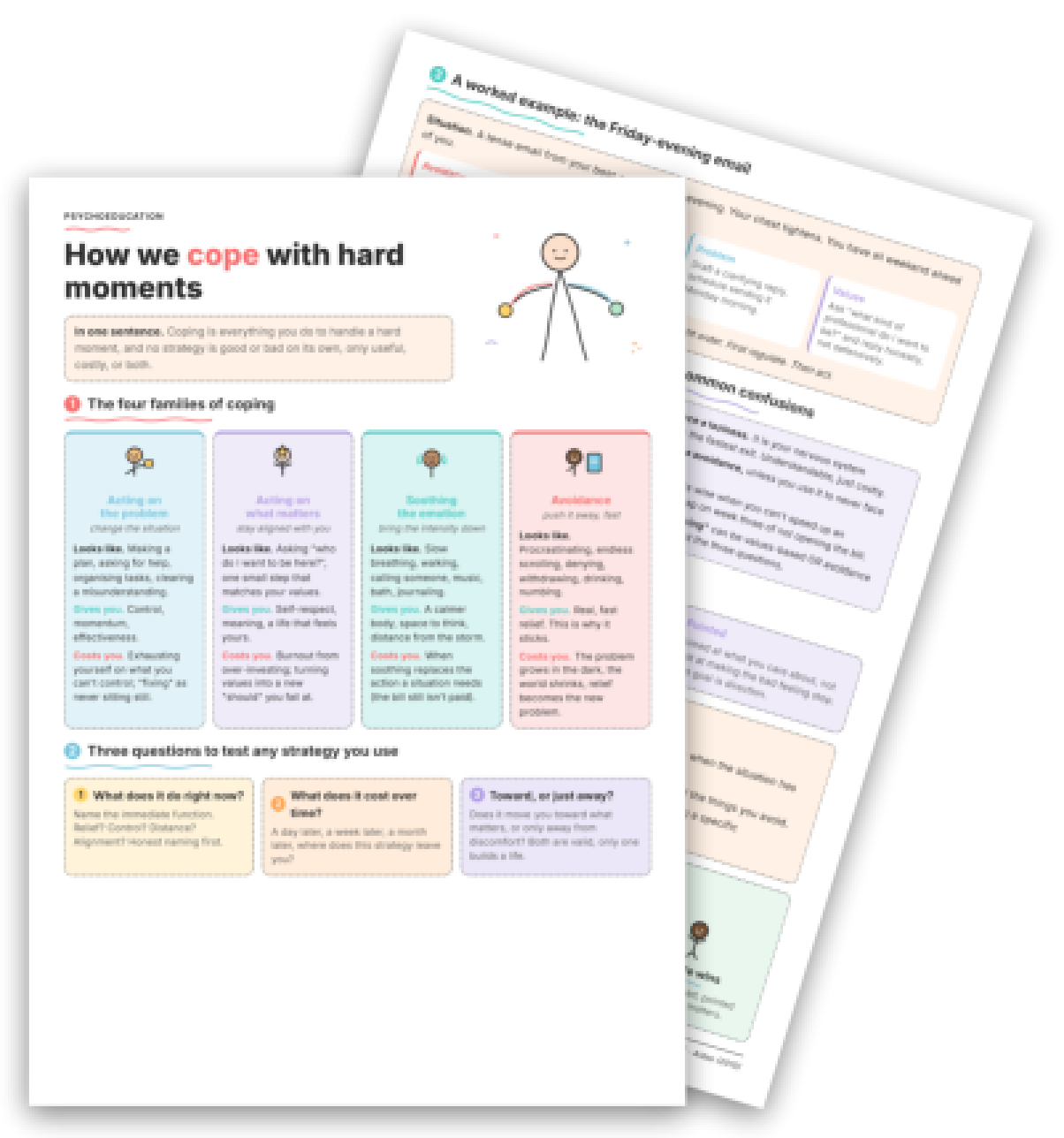
The PDF worksheet opens with one sentence the entire session can pivot around: "Coping is everything you do to handle a hard moment, and no strategy is good or bad on its own, only useful, costly, or both." Seeing that printed, rather than hearing it once, removes the moral framing before you have even spoken.
The fiche then maps the four coping families in parallel columns. Each entry names what the strategy looks like in daily life, what it gives the patient, and what it costs over time. The visual layout makes comparison instant. A patient can see, at a glance, that avoidance delivers "real, fast relief, this is why it sticks" while also producing a world that keeps shrinking. No spoken account of that trade-off lands with the same precision. For clinical work specifically targeting avoidance, this integrates naturally with tools for confronting avoidance in ACT practice and the Changing Avoidance worksheet.
The fiche's second panel introduces a three-question cost-benefit test applicable to any strategy: What does it do right now? What does it cost over time? Does it move toward what matters, or only away from discomfort? These three questions translate directly into a debrief scaffold you can run on a real situation the patient raised earlier in the same session.
A worked example follows (a tense Friday-evening email from a manager), showing how all four families apply to the same situation and why the optimal sequence is usually regulate first, then act. For patients who are ready to examine specific decision points in more depth, the Choice Point worksheet and the ACT Hexaflex extend this naturally.
The fiche also includes a "Signs your mix is off" section (five observable patterns, including "calm but stuck" and "effective at work, emotionally numb at home") and a "Common confusions" panel that directly addresses the avoidance-versus-laziness misread, the self-care-as-avoidance trap, and when distraction is wise versus when it compounds the problem. The closing section defines flexibility as the real clinical goal: varied, matched to the situation, and pointed toward what matters.
> Key takeaway: The Coping Strategies Map is a visual support that facilitates the explanation of coping flexibility in session. It is not a self-monitoring form patients complete alone. It is a psychoeducation scaffold the clinician uses to make a complex functional concept concrete, named, and memorable, and to leave the patient with a reference they can actually use between appointments.
750+ clinical tools
A library built with and for clinicians, ready to use in session and extend between appointments.
Access all the toolsWhen and How to Introduce the Worksheet
The worksheet fits early-to-mid treatment, once the presenting problem is formulated and you are moving from what is happening to what the patient is doing about it. It is broadly indicated across presentations: chronic avoidance in anxiety and depressive disorders, burnout sustained by over-investment in problem-solving at the cost of soothing, and patients who understand their pattern intellectually but cannot interrupt it behaviourally. For patients with anger dysregulation, pairing this fiche with coping tools specifically for anger and the Behavior, Emotion, Underlying Need framework sharpens the functional analysis. For acute presentations, the Coping in Crisis worksheet addresses higher-stakes regulation needs.
A low-threshold introduction: "I'd like to show you a map of the different ways people handle hard moments. It won't tell you what you should do; it'll help us see what your repertoire looks like and whether it's working for you."
Work through the four families together on screen or paper, then apply the three-question test to one real situation the patient raised earlier. Watch whether they locate themselves exclusively in one family (a sign of repertoire rigidity to address) or whether they can sequence responses (existing flexibility to reinforce). For adolescent patients, the coping strategies worksheet for children and adolescents provides a developmentally calibrated parallel. For patients whose dominant difficulty is uncertainty and control, the Control, Influence, Accept framework and the coping tools for anxiety build logically from the same foundation.
The fiche does not replace case formulation. What it does is give you and the patient a shared vocabulary for one of the most pervasive maintenance mechanisms across presenting problems, and it does so in under ten minutes of session time.
Use it with your patients
Share this tool in the mobile app and follow the work between sessions.
Sources
- Lazarus, R. S., Folkman, S. (1984). Stress, Appraisal, and Coping. Springer Publishing Company.
- Carver, C. S. (1997). COPE Inventory (Complete Version). University of Miami, Department of Psychology.
- Hayes, S. C., Strosahl, K. D., Wilson, K. G. (2012). Acceptance and Commitment Therapy: The Process and Practice of Mindful Change (2nd ed.). Guilford Press.
Your session continues in your patients' pocket
Use with a patientYour resources, available everywhere
The handouts, exercises, programs and audios above: you choose which ones to make available to your patients, in the mobile app dedicated to them.
And far more than a library
The app goes well beyond resources, to support your patients every day:
Related categories
Explore other clinical resources by category.

Anxiety
Clinical hub for anxiety disorders: CBT and ACT worksheets, psychoeducation sheets, and exercises for assessment and treatment across the anxiety spectrum.

Mood
Evidence-based worksheets and clinical tools for mood disorders: CBT, ACT, and positive psychology resources for psychologists and therapists.

Emotions
Clinical resources on emotion regulation: worksheets, coping tools, CBT, REBT, and ACT exercises for therapists working across diagnoses and age groups.

Behaviours
Clinical hub for behaviors in therapy: worksheets and tools for coping, eating disorders, CBT formulation, and maladaptive behavioral patterns.

Transitions
Clinical hub for life transitions: tools, worksheets and exercises to support psychosocial adjustment, role change and identity work in practice.

Cognition
Printable cognitive therapy worksheets and clinical tools for therapists: CBT, ACT, schema work, defusion, distortions, and belief restructuring.