
Clinical picture. T., a woman in her early thirties, presented with longstanding social anxiety and a growing pattern of cancelling plans at the last minute, which she described as the only reliable way to get through the evening. In session, the clinician introduced the two-column comparison from the worksheet, inviting T. to map her cancellation habit onto the struggle column and trace its short-term relief against the steady narrowing of her social life over the past year. T. was initially resistant, arguing that avoidance was not a choice but a necessity; the worksheet helped her name it as a move with a cost rather than a fixed limit. Over the following two weeks she attended one low-stakes social event while labelling the anxiety as a passenger rather than a stop sign. She reported the wave was unpleasant but shorter than expected, and she did not cancel.
Active Acceptance: PDF Worksheet, Tools and Exercises for ACT Practice
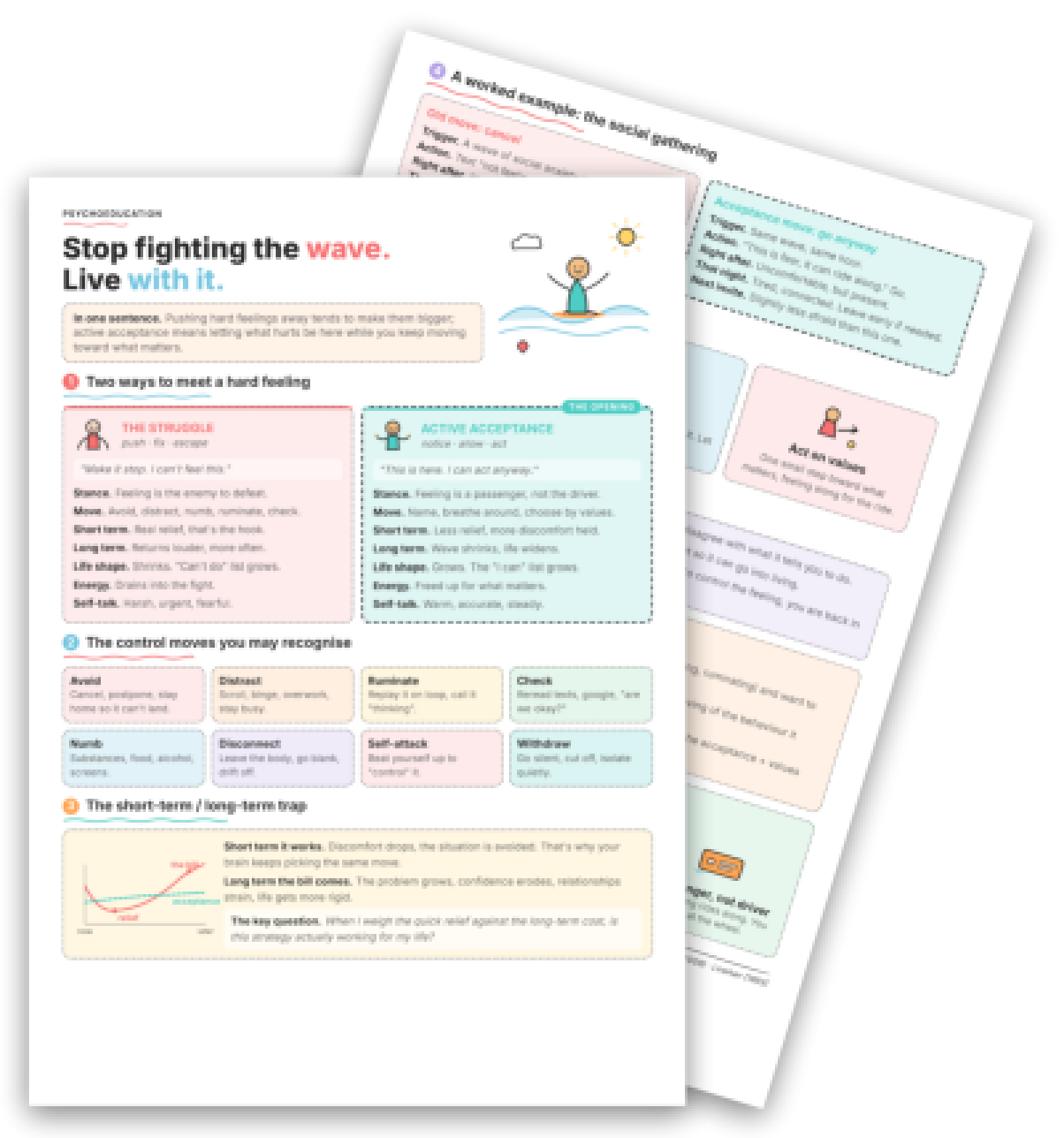
A visual psychoeducation tool helping clinicians explain the struggle-versus-acceptance distinction clearly in session, grounded in ACT and distress tolerance frameworks.
Clinical vignettes
Avoidance Cycle in Social Anxiety
Rumination Reframed as Control Move
Clinical picture. M., a man in his mid-forties referred for generalised worry, spent several hours each day mentally replaying work conversations to detect signs he had said something wrong. When the clinician introduced the concept of active acceptance, M. initially conflated it with indifference, stating he could not simply stop caring. The clinician used the worksheet's control-moves list to position rumination not as careful thinking but as a checking behaviour that provided momentary certainty at the cost of sustained distress. M. practised naming the loop when it started, noting its presence without entering it, and redirecting attention to a task tied to a stated value. At the three-week review he described the urge to replay as still present but less automatic, with slightly more cognitive energy available for his work.
Tell a patient that acceptance doesn't mean giving up, and most will nod, then cancel their next social event and call it "listening to their body." The gap between hearing the word acceptance and metabolising its clinical meaning is wider than it looks. This fiche PDF bridges that gap with a structured visual support you can walk through together in session, so the distinction lands rather than slides.
Use this resource with your patients
Handout, exercises and materials ready to use, right inside SessionFuel.
Why Active Acceptance Resists Oral Explanation
The conceptual sticking point is almost always the same: patients conflate acceptance with approval, passivity, or a clever new technique for making the feeling leave. When you explain experiential avoidance verbally, you get partial understanding at best. The patient grasps the idea in the room, then reverts to familiar control moves the moment distress spikes between sessions.
Part of the difficulty is that avoidance strategies genuinely work in the short term. Cancelling, ruminating, numbing, each delivers real relief, which is exactly why the brain keeps selecting them. Explaining why those strategies fail long-term, without a concrete visual of the cost-benefit asymmetry, rarely shifts the pattern. The cycle of avoidance needs to be seen, not just described.
There's also the values dimension. Active acceptance isn't simply tolerating distress; it's tolerating distress in the service of moving toward something. Without a shared vocabulary for that distinction, psychoeducation about psychological flexibility tends to stay abstract.
What the Fiche Contains
The sheet is built around six numbered panels, each targeting a different layer of the concept.
- Panel 1 presents a side-by-side comparison of The Struggle (push, fix, escape) and Active Acceptance (notice, allow, act) across six rows: stance, behavioural move, short-term effect, long-term effect, life shape, energy, and self-talk. The parallel layout makes the contrast immediately legible without requiring any narration.
- Panel 2 maps eight specific control moves, avoid, distract, ruminate, check, numb, disconnect, self-attack, withdraw, the same list you'd cover in work on adaptive versus maladaptive coping, now named concisely for the patient to recognise their own repertoire.
- Panel 3 visualises the short-term/long-term trap and closes with the key question the fiche itself phrases as: "When I weigh the quick relief against the long-term cost, is this strategy actually working for my life?" That single sentence is worth the whole session.
- Panel 4 offers a worked social anxiety example: the same trigger (pre-event anxiety wave), two possible moves (cancel vs. go anyway), and the downstream consequences traced over two timelines. Concrete, not hypothetical.
- Panels 5 and 6 give patients three actionable moves (name it gently, stay with it, act on values) and clarify the three most common confusions: acceptance as approval, acceptance as passivity, acceptance as a disguised control strategy.
> Key point: this fiche is a visual support that facilitates the explanation in session. It is not a self-administered questionnaire. You use it to structure the psychoeducation conversation, share a vocabulary, and give the patient something concrete to take home. The "To discuss in session" prompts printed on the sheet make debriefing straightforward.
750+ clinical tools
A library built with and for clinicians, ready to use in session and extend between appointments.
Access all the toolsWhen and How to Propose It
The fiche fits naturally in early-to-mid treatment, once the therapeutic alliance is solid enough to name avoidance patterns without triggering defensiveness. It works particularly well after an ACT defusion sequence or when introducing the Choice Point model, since it operationalises the same hexaflex logic in plain language.
For patients with social anxiety or generalised anxiety, Panel 4's worked example lands quickly. For patients in whom avoidance is ego-syntonic (perfectionism, emotional inhibition), start with Panel 3's cost-benefit question before touching the struggle-versus-acceptance contrast.
A workable introduction: "I'd like to show you a diagram that captures something we've been circling around. Look at these two columns and tell me which one feels more familiar." That question does more clinical work than five minutes of explanation. After the patient identifies their dominant column, move to Panel 2 and ask them to mark the control moves they recognise in their own week.
Pair the fiche with values clarification work or committed action exercises to give the acceptance piece a direction. Without that anchor, patients sometimes read active acceptance as endurance for its own sake.
The fiche doesn't replace formulation or exposure work; it makes the underlying rationale of both legible, and leaves the patient a reference point between sessions rather than a blank to fill in alone.
Use it with your patients
Share this tool in the mobile app and follow the work between sessions.
Sources
- Hayes, S. C., Strosahl, K. D., & Wilson, K. G. (1999). Acceptance and Commitment Therapy: An experiential approach to behavior change. Guilford Press.
- Hayes, S. C., Strosahl, K. D., & Wilson, K. G. (2012). Acceptance and Commitment Therapy: The process and practice of mindful change (2nd ed.). Guilford Press.
- Harris, R. (2007). The Happiness Trap: Stop Struggling, Start Living. Exisle Publishing.
- Association for Contextual Behavioral Science (ACBS). The Six Core Processes of ACT.
Your session continues in your patients' pocket
Use with a patientYour resources, available everywhere
The handouts, exercises, programs and audios above: you choose which ones to make available to your patients, in the mobile app dedicated to them.
And far more than a library
The app goes well beyond resources, to support your patients every day:
Related categories
Explore other clinical resources by category.

Anxiety
Clinical hub for anxiety disorders: CBT and ACT worksheets, psychoeducation sheets, and exercises for assessment and treatment across the anxiety spectrum.

Mood
Evidence-based worksheets and clinical tools for mood disorders: CBT, ACT, and positive psychology resources for psychologists and therapists.

Identity
Clinical resources for self-identity work in therapy: CBT, ACT, schema tools for clinicians addressing self-concept, core beliefs, and identity disruption.

Emotions
Clinical resources on emotion regulation: worksheets, coping tools, CBT, REBT, and ACT exercises for therapists working across diagnoses and age groups.

Behaviours
Clinical hub for behaviors in therapy: worksheets and tools for coping, eating disorders, CBT formulation, and maladaptive behavioral patterns.

Cognition
Printable cognitive therapy worksheets and clinical tools for therapists: CBT, ACT, schema work, defusion, distortions, and belief restructuring.