
Clinical picture. M., a woman in her late thirties, presented with acute distress following an unexpected redundancy; she described ruminating for hours each evening on the unfairness of the decision and found herself unable to move past the initial shock three weeks after the event. Her therapist introduced the radical acceptance framework, drawing a clear distinction between acknowledging the reality of what had occurred and endorsing it as just. During the session M. practised articulating the facts out loud: the role no longer existed, the decision had been made, and her distress was a proportionate response to a real loss. By the following appointment she reported that the nightly rumination had shortened, though she remained understandably disheartened, and she had submitted two job applications.
DBT Distress Tolerance Skills: PDF Worksheet, Tools and Exercises
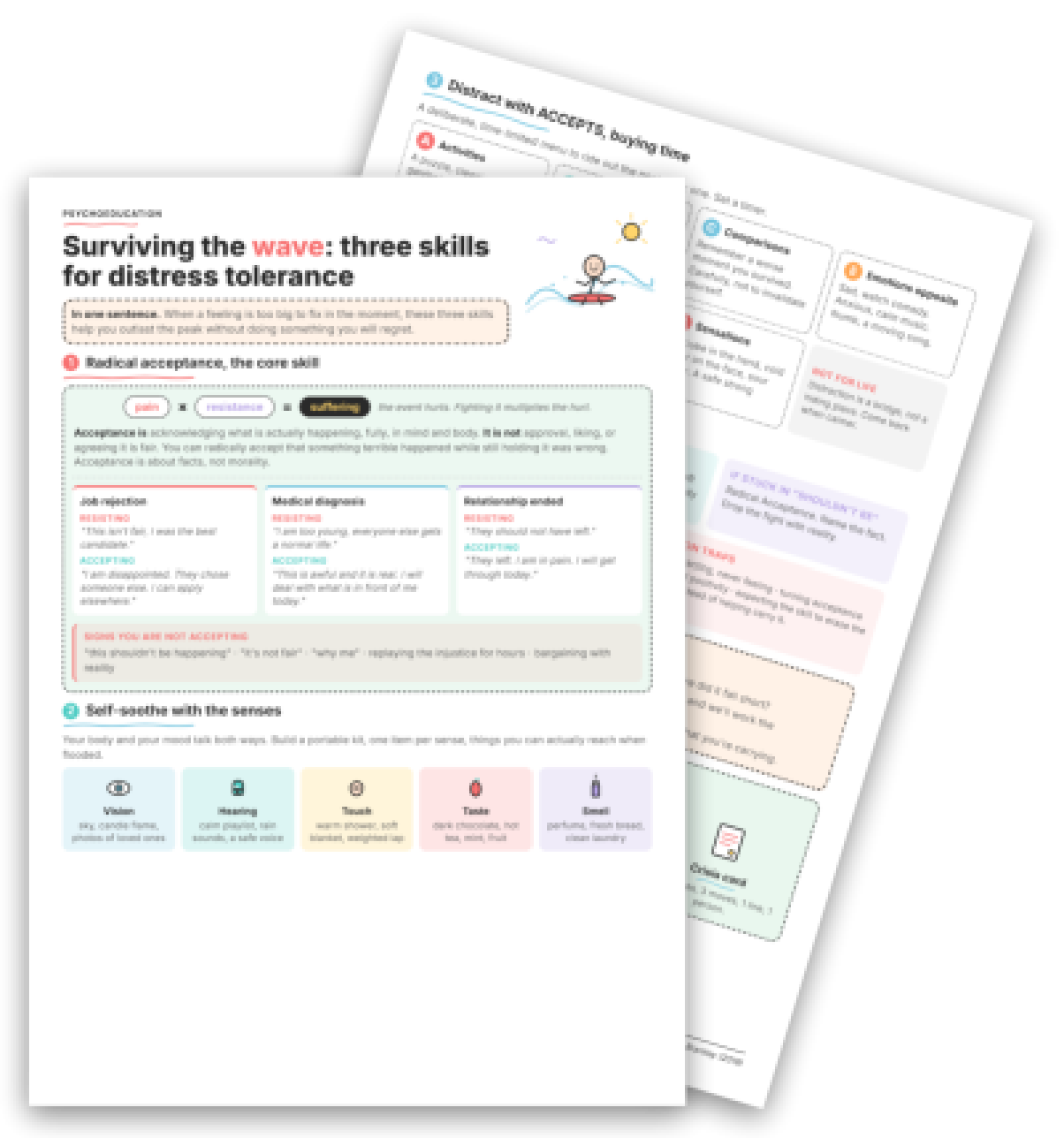
A visual in-session reference for Linehan's three core distress tolerance skills, radical acceptance, sensory self-soothing, and ACCEPTS, to make psychoeducation concrete and portable for patients.
Clinical vignettes
Radical Acceptance After Sudden Job Loss
Sensory Soothing Kit for Crisis Peaks
Clinical picture. T., a young adult man with a diagnosis of borderline personality disorder, disclosed a pattern of self-injurious urges that arose quickly and intensely during interpersonal conflicts, typically in the late evening when he was alone. His clinician introduced the self-soothe component of distress tolerance, and together they assembled a concrete kit he could keep accessible: a specific rain-sound playlist, a weighted blanket, and a single-serve portion of dark chocolate. The goal was framed explicitly as outlasting the peak of the urge rather than resolving the underlying conflict. Over four weeks T. reported using the kit on three occasions; urges did not disappear, but he did not act on them, and this shift gave the therapeutic work a small but stable foothold.
When a patient arrives at session in the acute phase of an emotional crisis, verbal psychoeducation about distress tolerance produces recognition at best, integration almost never. Explaining radical acceptance at intensity 8/10 is one of the more reliably frustrating moments in clinical work. This fiche PDF is built to solve exactly that problem: it functions as a visual support you use in session to make Linehan's three core distress tolerance skills concrete, negotiable, and retrievable, leaving the patient with something they can actually open when flooded.
Use this resource with your patients
Handout, exercises and materials ready to use, right inside SessionFuel.
Why Distress Tolerance Is Hard to Teach Verbally
Three sticking points recur across clinical presentations. The first is the radical acceptance misread. Patients almost universally hear "acceptance" as approval, consent, or capitulation. Countering that misread without a visual anchor eats session time and often entrenches resistance. The second is the ACCEPTS mnemonic: it works only if the patient has rehearsed it before the crisis. Under acute dysregulation, the seven letters collapse into noise. The third is skill-selection logic: knowing which technique to reach for at which distress intensity is almost impossible to convey through description alone, because the instruction itself requires calm to process.
None of this reflects patient motivation or intelligence. It reflects the well-documented narrowing of cognitive bandwidth under emotional flooding. A visual structure externalizes the decision tree so the patient doesn't have to hold it in working memory during the moments that matter most. This is where the fiche earns its place in the consultation room.
750+ clinical tools
A library built with and for clinicians, ready to use in session and extend between appointments.
Access all the toolsWhat the Fiche Contains
The fiche maps three skills in sequence, then closes with a skill-selection decision guide and a short set of debrief prompts.
- Radical acceptance is anchored by the formula pain × resistance = suffering, displayed explicitly, followed by three side-by-side scenario panels (job rejection, medical diagnosis, relationship ending) showing resisting versus accepting responses verbatim. Patients who struggle with the concept often grasp it within seconds when they see the contrast laid out this way, because the accepting column is not minimising language: it names the pain plainly.
- Self-soothe with the senses is organized as a five-row grid (vision, hearing, touch, taste, smell) with concrete, ordinary examples in each cell. This is the section to annotate in session: you can work through it together and circle what the patient actually has access to.
- ACCEPTS breaks down each of the seven letters (Activities, Contributing, Comparisons, Emotions opposite, Pushing away, Thoughts, Sensations) with a one-line description and a practical example. The closing note, "distraction is a bridge, not a hiding place," is worth reading aloud with patients who present with maladaptive avoidance patterns.
- The skill-selection guide maps three clinical states (urge to act above 8/10, body activation, stuck in "shouldn't be") to a recommended first skill, giving the patient a triage logic they can apply autonomously.
- The fiche closes with "To discuss in session" prompts, including "if distraction is starting to feel like permanent avoidance, name it." These are not homework questions; they are your debrief scaffold for the following appointment.
> Key point: the fiche is a visual support that facilitates the explanation of distress tolerance in session; it is not a self-administered questionnaire. The schemas, scenarios, and decision grids do the explanatory work that verbal description rarely completes, and the patient leaves with a concrete, printable reference rather than a memory of what you said.
Use it with your patients
Share this tool in the mobile app and follow the work between sessions.
When and How to Introduce the Fiche in Session
This fiche fits best once the therapeutic alliance is established and you have completed an initial functional assessment of the patient's current crisis coping repertoire. It is particularly indicated for patients with borderline personality organisation, chronic suicidal ideation, impulsive behavioral responses to distress, or any presentation where avoidance cycles are the dominant maintenance mechanism.
A low-threshold introduction: "I want to show you three techniques that help when a feeling is too big to resolve in the moment. Let's look at them together, then you keep this and we'll review next time which one you actually reached for." This framing positions the fiche as a field tool, not a test.
In session, work through the radical acceptance panel first if the patient presents with prominent non-acceptance cognitions. For patients with high somatic arousal, start with the self-soothe grid and co-construct their personal sensory kit on the page. The ACCEPTS framework is worth pairing with the frustration tolerance exercise when patients need to differentiate time-limited distraction from chronic emotional suppression. For adolescent presentations, the fiche also cross-references usefully with coping strategies for younger patients.
Debrief at the next session using the fiche's own prompts as your opening: which skill did they reach for, where did it help, where did it fail. The "practise before the crisis" instruction printed on the fiche, "a skill you have never tried will not appear at intensity 9/10," gives you a natural entry into between-session rehearsal planning.
One limit worth naming: for patients in an active avoidance pattern who use distraction to bypass all emotional processing, present the "distraction is a bridge" framing explicitly before handing the sheet over, otherwise the ACCEPTS section risks reinforcing what you are working to reduce. The fiche does not replace the formulation; it makes one part of it far easier to teach.
Your session continues in your patients' pocket
Use with a patientYour resources, available everywhere
The handouts, exercises, programs and audios above: you choose which ones to make available to your patients, in the mobile app dedicated to them.
And far more than a library
The app goes well beyond resources, to support your patients every day:
Related categories
Explore other clinical resources by category.

Emotions
Clinical resources on emotion regulation: worksheets, coping tools, CBT, REBT, and ACT exercises for therapists working across diagnoses and age groups.

Behaviours
Clinical hub for behaviors in therapy: worksheets and tools for coping, eating disorders, CBT formulation, and maladaptive behavioral patterns.

Regulate
Clinical resources for emotion regulation: worksheets, ACT exercises, and psychoeducation tools for affect regulation across diagnoses. For clinicians.

Build skills
Skill-building resources for clinicians: printable worksheets and exercises for coping, assertiveness, and communication skills training in therapy.

DBT
DBT worksheets and exercises for clinicians: distress tolerance, emotion regulation, and interpersonal skills tools for dialectical behavior therapy practice.

Anxiety
Clinical hub for anxiety disorders: CBT and ACT worksheets, psychoeducation sheets, and exercises for assessment and treatment across the anxiety spectrum.