
Clinical picture. A patient in her late twenties, referred to here as L., presented with borderline personality disorder and a pattern of sending regretted messages to an ex-partner during acute distress spikes. During a session reviewing a recent incident, the clinician introduced the ACCEPTS informational sheet and walked through the wave model, noting that her urge to contact him typically peaked within ten minutes. L. selected two anchors she felt were plausible at that intensity: holding an ice cube (Sensations) and counting backwards from 1000 by sevens (Thoughts). At the following session she reported using the ice cube once after an intrusive photograph appeared on her feed; the urge subsided before she reached her phone's messaging app. No single skill resolved the underlying relational pain, but the window it created was sufficient to interrupt the behavioural pattern on that occasion.
ACCEPTS Distress Tolerance: PDF Worksheet, Tools and Exercises
A visual PDF worksheet clinicians can use in session to teach the seven ACCEPTS skills, build a personalised crisis plan, and give patients a concrete distress tolerance tool to take home.
Clinical vignettes
ACCEPTS During Interpersonal Crisis
Workplace Flooding in Generalised Anxiety
Clinical picture. M., a man in his mid-forties with generalised anxiety disorder, described shutting down during high-stakes meetings when anticipatory dread reached what he rated as nine out of ten. He had found standard breathing techniques unhelpful at that intensity, consistent with the clinician's psychoeducation that cognitive strategies require a lower arousal floor to function. The clinician used the ACCEPTS sheet to identify two discrete skills compatible with a meeting context: silently naming visible objects by colour (Thoughts) and rehearsed Pushing Away, scheduling the worry for a fixed slot at 6 p.m. rather than engaging it in real time. Over four weeks M. applied the colour-naming technique in two meetings and reported that it reduced the sense of imminent catastrophe enough for him to remain present. He remained anxious in those situations; the skill did not eliminate the anxiety but reduced the probability of early withdrawal.
When a patient describes the moment they sent the text they regret, drank after three months sober, or screamed at a partner mid-argument, the clinical gap is rarely insight. It is crisis-management skill. Explaining ACCEPTS verbally in that moment rarely sticks; this PDF worksheet works as a shared visual object you walk through together, building a concrete, personalised plan the patient actually leaves with.
Use this resource with your patients
Handout, exercises and materials ready to use, right inside SessionFuel.
Why ACCEPTS Is Hard to Convey Without a Visual Support
The central clinical difficulty with distress tolerance in DBT practice is timing. Patients in acute emotional dysregulation are, by definition, outside their window of tolerance: prefrontal access is compromised, and abstract coaching disappears before the next session. The wave metaphor that underpins ACCEPTS is intuitive once seen, but it lands poorly when described in words alone. Patients also routinely conflate distraction with avoidance, a conceptual confusion that undermines skill uptake before it begins.
Whether you are working with patients managing acute anger episodes, those with crisis-level dysregulation, or patients approaching panic thresholds, the shared problem is identical: the patient needs a pre-loaded behavioural plan, not an in-crisis explanation. The fiche externalises the framework so both of you are looking at the same object, which is what makes the psychoeducation actually work.
What the ACCEPTS Fiche Contains
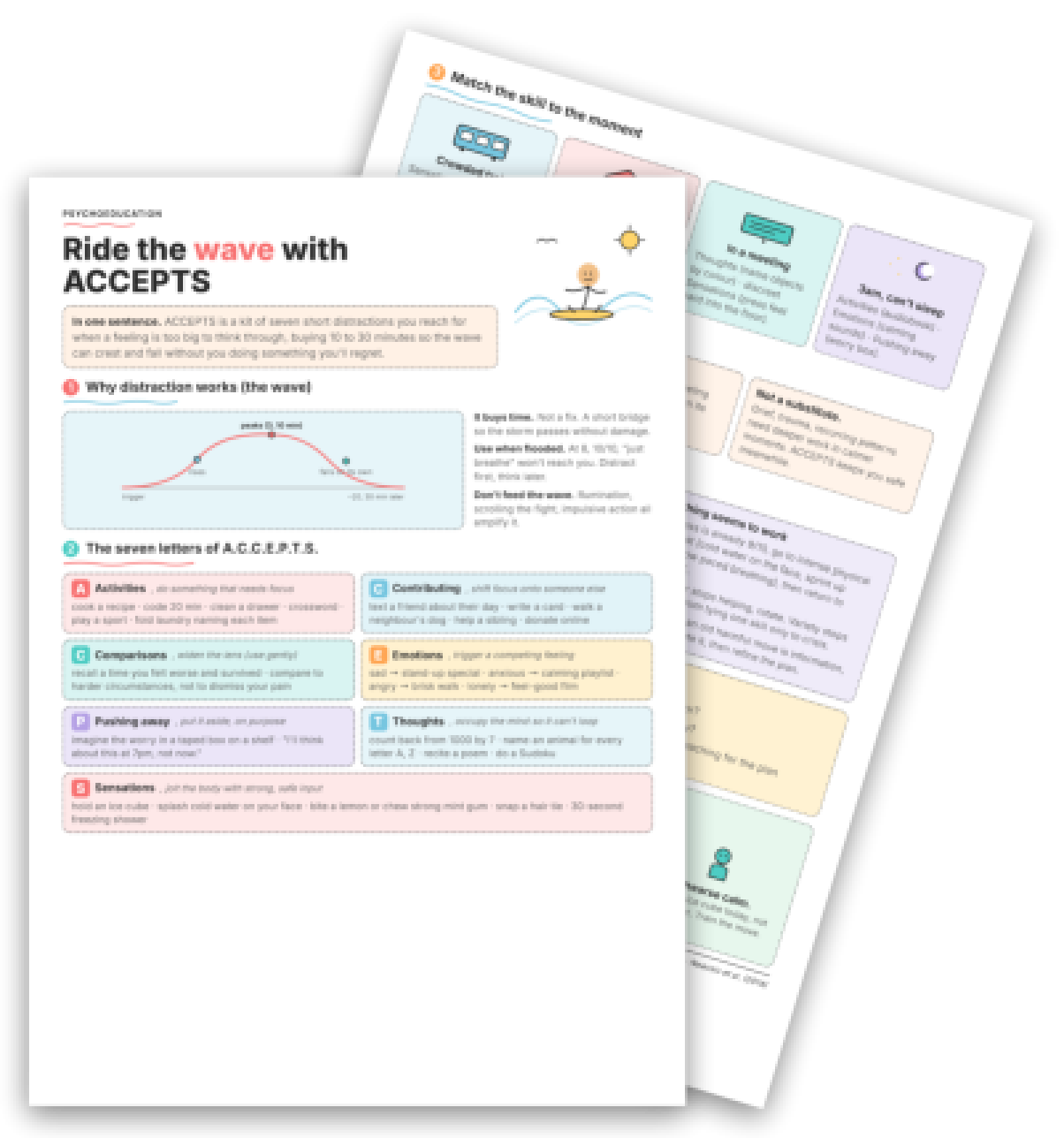
The worksheet opens with a one-sentence orientation: "ACCEPTS is a kit of seven short distractions you reach for when a feeling is too big to think through, buying 10 to 30 minutes so the wave can crest and fall without you doing something you'll regret." That framing is deliberate: it names the time-limited function, reframes distraction as strategic rather than avoidant, and introduces the wave before the skills.
The visual layout then moves through five panels:
- The wave diagram: a curve that rises, peaks, and falls, with the explicit note that most peaks pass in 3-10 minutes if you do not feed them. What the graph shows, and speech cannot, is that the patient's job is to surf the wave, not stop it.
- The seven ACCEPTS letters: each maps a skill category (Activities, Contributing, Comparisons, Emotions, Pushing away, Thoughts, Sensations) to three to five concrete behavioural examples. "Count back from 1000 by 7" under Thoughts; "hold an ice cube · splash cold water on your face" under Sensations. The specificity is rehearsable, which is the point.
- Situation matching: four common crisis contexts (crowded train, alone and spiralling, in a meeting, 3am) mapped to the most viable letter combinations. Patients leave with a pre-sorted plan for their most likely moments, not a generic list.
- What ACCEPTS is not: a panel that distinguishes distraction from avoidance, from suppression, and from a substitute for deeper therapeutic work. This is the panel that resolves the clinical confusion most directly.
- Self-statements and troubleshooting: verbatim phrases ("I'm riding the wave, not stopping it") plus guidance for when distress is already at 9/10 (intense physical input first, then ACCEPTS). Three session discussion prompts close the sheet, making debrief structured rather than open-ended.
> Key takeaway: The fiche is a visual support that facilitates the explanation of ACCEPTS in session. It is not a questionnaire patients complete alone; it is a shared reference that builds a concrete crisis plan the patient keeps.
750+ clinical tools
A library built with and for clinicians, ready to use in session and extend between appointments.
Access all the toolsWhen and How to Introduce the Fiche in Session
This worksheet fits best from the second or third session onward, once the formulation has identified impulsivity or harmful coping as a maintaining factor. It is not a first-contact tool; it requires enough alliance to hold a behavioural conversation without the patient reading it as a dismissal of their distress.
A simple introduction: "I want to show you something that maps a specific set of skills for the moments when emotion is too intense to think through. We'll go through it together and figure out which parts actually fit your life." This framing avoids labelling and positions the patient as an active contributor.
Walk through the seven letters collaboratively, using the discussion prompt at the bottom: which letter feels natural, and which one feels foreign or uncomfortable to try? For patients whose avoidance patterns are entrenched, the Pushing Away and Sensations skills often need explicit rehearsal before crisis, not just description. The fiche itself names this: "Hold the ice cube today, not mid-panic. Train the move." For younger patients, the concrete activity lists per letter tend to be more engaging than the conceptual framing.
Pair the worksheet with adaptive versus maladaptive coping work for patients still attached to harmful moves, with emotion regulation psychoeducation if the tolerance baseline is very low, or with a frustration tolerance exercise to build the same window-widening skills in a lower-stakes context. For patients whose dysregulation runs through rumination loops, the Pushing Away and Thoughts letters deserve particular attention.
The fiche does not replace the deeper work that recurring patterns require. It buys time. That is its precise, and genuinely useful, clinical function.
Use it with your patients
Share this tool in the mobile app and follow the work between sessions.
Sources
- Linehan, M. M. (2015). DBT Skills Training Manual, Second Edition. Guilford Press.
- Linehan, M. M. (2015). DBT Skills Training Handouts and Worksheets, Second Edition. Guilford Press.
- Schaich, A., Braakmann, D., Rogg, M., Meine, C., Ambrosch, J., Assmann, N., Borgwardt, S., Schweiger, U., Fassbinder, E. (2021). How do patients with borderline personality disorder experience Distress Tolerance Skills in the context of dialectical behavioral therapy? A qualitative study. PLOS ONE.
Your session continues in your patients' pocket
Use with a patientYour resources, available everywhere
The handouts, exercises, programs and audios above: you choose which ones to make available to your patients, in the mobile app dedicated to them.
And far more than a library
The app goes well beyond resources, to support your patients every day:
Related categories
Explore other clinical resources by category.

Anxiety
Clinical hub for anxiety disorders: CBT and ACT worksheets, psychoeducation sheets, and exercises for assessment and treatment across the anxiety spectrum.

Emotions
Clinical resources on emotion regulation: worksheets, coping tools, CBT, REBT, and ACT exercises for therapists working across diagnoses and age groups.

Build awareness
Clinical worksheets and tools to build awareness in therapy: cognitive distortions, schemas, emotions, ACT and CBT resources for practitioners.

Regulate
Clinical resources for emotion regulation: worksheets, ACT exercises, and psychoeducation tools for affect regulation across diagnoses. For clinicians.

Build skills
Skill-building resources for clinicians: printable worksheets and exercises for coping, assertiveness, and communication skills training in therapy.

DBT
DBT worksheets and exercises for clinicians: distress tolerance, emotion regulation, and interpersonal skills tools for dialectical behavior therapy practice.