
Clinical picture. R., a 24-year-old with borderline personality disorder and a recent history of self-cutting, presented in outpatient DBT reporting near-daily urges to harm following conflict with her flatmate. The clinician introduced the ACCEPTS worksheet and worked with R. to pre-select two strategies she would actually use: holding an ice cube (Sensations) and counting backward from 300 by sevens (Thoughts). Over the following two weeks, R. used the ice cube on three occasions and reported that the urge had dropped from roughly 9/10 to a manageable 4/10 before the 20-minute window closed. She did not self-harm during that period, though she noted the skill felt mechanical and required repeated practice before it felt credible.
DBT ACCEPTS Distress Tolerance: PDF Worksheet, Tools and Exercises
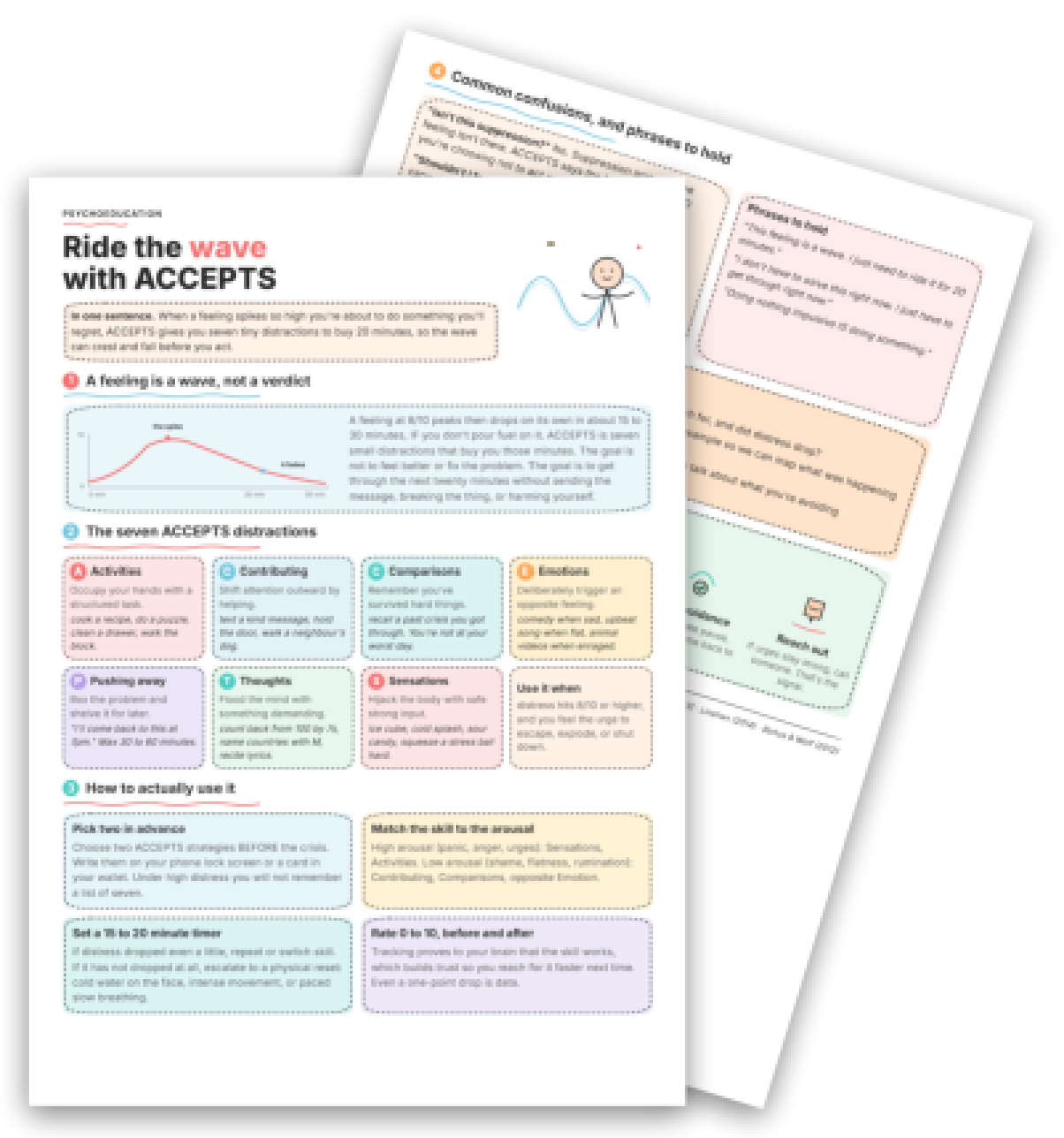
A visual fiche PDF built on Linehan's protocol, with concrete tools and exercises to help patients ride the emotional wave without acting impulsively in acute crisis.
Clinical vignettes
ACCEPTS in Acute Self-Harm Urge
Managing Explosive Anger Before a Regretted Message
Clinical picture. T., a 38-year-old with a history of impulsive outbursts and recurrent relationship ruptures, described a pattern of sending hostile text messages during arguments that he consistently regretted. In session the clinician framed ACCEPTS as a 20-minute bridge rather than a cure, normalising that the anger itself did not need to be resolved for the skill to be useful. T. selected Activities (walking one block) and Pushing Away (scheduling a deliberate time to reply no sooner than 30 minutes later) as his two advance strategies, writing them on his phone lock screen. At a two-week review he reported one instance in which he had walked the block and then replied in a noticeably different tone, though he acknowledged the urge to respond immediately had required active effort to override.
Explaining ACCEPTS verbally in session tends to produce the same result: the patient nods, sometimes writes down the acronym, and then reaches for their most destructive coping pattern the moment distress spikes to 9/10. The mnemonic alone is not enough. This fiche PDF is a structured visual support designed to be used in session to make the skill genuinely teachable, then left with the patient as a portable reference for their hardest moments.
Use this resource with your patients
Handout, exercises and materials ready to use, right inside SessionFuel.
Why ACCEPTS Is Hard to Teach Without a Visual Anchor
The core mechanism of ACCEPTS is behaviorally simple but cognitively counterintuitive: at peak emotional arousal, the prefrontal cortex is the last resource available. Asking a patient to recall and choose between seven strategies while in emotional flooding is asking them to perform executive reasoning at precisely the moment executive function is most compromised. What collapses first under high arousal is not motivation, but working memory and decision-making speed.
The second obstacle is conceptual. Patients frequently confuse distress tolerance with avoidance or suppression. Without a clear visual distinction, this misattribution becomes a therapeutic sticking point. The same confusion arises around distinguishing adaptive from maladaptive coping: the category matters, and oral explanation alone rarely resolves it.
A third difficulty is calibration. Patients who have not been taught to rate emotional intensity on a 0-to-10 scale lack the internal signal to know when ACCEPTS is the appropriate tool, as opposed to processing, problem-solving, or simply reaching out. Without that signal, the skill gets deployed inconsistently or abandoned after the first failed attempt.
What the Fiche Contains: A Visual Support for In-Session Explanation
The fiche is organised into four clearly differentiated panels, which you can walk through with the patient in a single session without relying on any additional material.
Panel 1 presents the wave metaphor with a simple graph: emotional intensity rises to a peak of roughly 8/10, then naturally decays over 15 to 30 minutes "IF you don't pour fuel on it". This single visual does more to normalise the transience of acute affect than several minutes of oral psychoeducation on emotion regulation. It also reframes the therapeutic goal: not resolution, but bridge behaviour.
Panel 2 maps the seven ACCEPTS categories (Activities, Contributing, Comparisons, Emotions, Pushing away, Thoughts, Sensations) with concrete behavioural examples under each. For patients with poor frustration tolerance or those stuck in avoidance cycles, the Sensations category (ice cube, cold splash, sour candy) and the Activities category anchor the skill somatically before any cognitive engagement is required.
Panel 3 gives three implementation rules: pick two strategies in advance, match arousal level to skill category (high arousal points toward Sensations and Activities; low arousal or shame-adjacent flatness toward Contributing and Comparisons), and set a 15-to-20-minute timer before re-rating. The 0-to-10 rating before and after is explicit: "Even a one-point drop is data."
Panel 4 addresses the most common confusions directly: the suppression objection, the "shouldn't I face my feelings?" question, and the escalation threshold. It closes with three short holding phrases the patient can internalise, and a "To discuss in session" block with three clinician-facing prompts you can use to debrief the homework.
> Key point: The fiche is a visual support that facilitates the in-session explanation of ACCEPTS. You work through it with the patient; it is not a self-guided questionnaire to complete alone. The patient leaves with a concrete, readable reference, not an abstract acronym.
Clinical library
750+ clinical tools
A library built with and for clinicians, ready to use in session and extend between appointments.
Access all the toolsSeveral resource types
Psychoeducation handouts
Understand at a glance
Interactive exercises
To do and fill in
Interactive programs
A structured path
Audios
Meditation and relaxation
Psychometric tests
Automatic scoring
When and How to Propose It
ACCEPTS is indicated as soon as crisis behaviour is in the clinical picture: self-harm urges, explosive anger, binge-purge cycles, substance use to exit affect, or impulsive relational ruptures. It pairs naturally with broader anger management skills, crisis coping tools, and the emotional safety valve technique for patients who need somatic discharge before any cognitive approach lands.
Introduce it early in the treatment, ideally once you have established a shared language around emotional intensity. A low-threshold opening formulation: "When distress gets to around an 8 out of 10, it's very hard for any cognitive work to land. This fiche gives you a set of small strategies whose only job is to get you through the next 20 minutes without acting. Let's look at it together."
For patients with prominent avoidance patterns or chronic emotion dysregulation, spend extra time on Panel 3's pre-selection step: ask them to write their two chosen strategies on their phone lock screen before leaving the session. For adolescents, the Sensations category typically has the highest initial buy-in. For patients with depression-adjacent flatness, point them toward Contributing and Comparisons first.
One limit to flag: for patients with significant dissociative responses, Sensations-category techniques need to be introduced carefully and in context of your overall stabilisation plan.
The fiche does not replace your clinical formulation or the broader skills module it sits within. It makes one specific skill explicit, visual, and portable, which is precisely what patients need when the wave is at its peak.
Use it with your patients
Share this tool in the mobile app and follow the work between sessions.
Sources
- Linehan, M. M. (1993). Cognitive-Behavioral Treatment of Borderline Personality Disorder. Guilford Press.
- Linehan, M. M. (2015). DBT Skills Training Manual, Second Edition. Guilford Press.
- National Institute for Health and Care Excellence (NICE) (2009). Borderline Personality Disorder: Recognition and Management (CG78).
Patient mobile app
Your session continues in your patients' pocket
Use with a patientYour resources, available everywhere
The handouts, exercises, programs and audios above: you choose which ones to make available to your patients, in the mobile app dedicated to them.
Psychoeducation handoutsInteractive exercisesInteractive programsAudiosPsychometric tests
And far more than a library
The app goes well beyond resources, to support your patients every day:
Standardized tests
Therapy journal
Gamification
Wellbeing challenges
Introspection prompts
Therapist homework
Related categories
Explore other clinical resources by category.

Emotions
Clinical resources on emotion regulation: worksheets, coping tools, CBT, REBT, and ACT exercises for therapists working across diagnoses and age groups.

Behaviours
Clinical hub for behaviors in therapy: worksheets and tools for coping, eating disorders, CBT formulation, and maladaptive behavioral patterns.

Build awareness
Clinical worksheets and tools to build awareness in therapy: cognitive distortions, schemas, emotions, ACT and CBT resources for practitioners.

Regulate
Clinical resources for emotion regulation: worksheets, ACT exercises, and psychoeducation tools for affect regulation across diagnoses. For clinicians.

Build skills
Skill-building resources for clinicians: printable worksheets and exercises for coping, assertiveness, and communication skills training in therapy.

DBT
DBT worksheets and exercises for clinicians: distress tolerance, emotion regulation, and interpersonal skills tools for dialectical behavior therapy practice.