
Clinical picture. M., a woman in her late twenties with a diagnosis of borderline personality disorder, presented with recurrent self-harm urges that intensified on weekday nights after her outpatient appointments ended. During a session focused on crisis planning, the clinician introduced the informational sheet on coping in crisis and walked through the wave principle, noting that most peaks resolve within 20 to 90 minutes regardless of any action taken. Together they drafted a short written plan listing two solitary-toolbox steps, a bowl of iced water followed by five minutes of stair climbing, and taped a copy inside her bedside drawer. At the following appointment M. reported having retrieved the card on two occasions; on one of them she completed both steps and the urge subsided enough that she fell asleep without incident. The outcome was modest and she acknowledged the second night had been harder, which opened a useful conversation about commitment duration and early skill use.
Coping in Crisis: PDF Worksheet, Tools and Exercises for Clinical Practice
A visual PDF worksheet grounded in DBT distress tolerance, giving clinicians a concrete in-session tool to explain the wave principle and build a personalised crisis plan.
Clinical vignettes
Written Plan Bridging a Night Crisis
Rupture Scenario and Urge to Send Message
Clinical picture. T., a man in his mid-thirties attending weekly sessions for recurrent depressive episodes and marked interpersonal sensitivity, described a pattern of sending accusatory messages to his partner during arguments, which reliably escalated conflicts and left him with intense shame the following day. The clinician used the rupture-with-someone section of the coping-in-crisis sheet to name the body cues he recognised, heat in the face and hands buzzing, as early-rise signals rather than proof that immediate action was required. A brief written rule was added to his crisis card: phone face-down, paced breathing for two minutes, then re-read the draft message before sending. Over the next three weeks T. reported one partial success, he delayed sending for fifteen minutes and then deleted the message, and one relapse where he sent before consulting the card. The relapse provided concrete material for reviewing where the card was stored and why accessibility had failed.
Crisis tolerance is one of the hardest psychoeducation conversations to have in a standard 50-minute slot. Patients in high arousal cannot retrieve a verbal explanation from memory when they need it most, and clinicians working within DBT or third-wave CBT frameworks know exactly how quickly distress tolerance rationale evaporates between sessions. This fiche PDF is built to close that gap: a visual, printable support that clinicians use in session to explain the wave principle, map two distinct crisis profiles, and co-construct a personalised plan the patient can actually reach for at 2 a.m.
Use this resource with your patients
Handout, exercises and materials ready to use, right inside SessionFuel.
Why Crisis Tolerance Resists Oral Explanation
The core problem is neurobiological. Under high sympathetic arousal, the prefrontal cortex is largely offline, precisely when the patient would need to recall a therapeutic explanation. Telling a patient in session that peaks pass is necessary but insufficient: they will not generate that thought on their own during a crisis. This is what Linehan's distress tolerance module was built around, and it is also what makes written, visual supports so clinically important in this population.
A second obstacle is the conflation of two phenomenologically distinct crisis types. Patients with abandonment fear and relational sensitivity experience a completely different arousal profile from patients whose crises are solitary and driven by rumination, flashbacks, or self-hatred. Without a clear typology, the coping toolbox feels generic, and uptake is poor. The fiche addresses both problems directly.
750+ clinical tools
A library built with and for clinicians, ready to use in session and extend between appointments.
Access all the toolsWhat the Fiche Contains: A Visual Anchor for In-Session Explanation
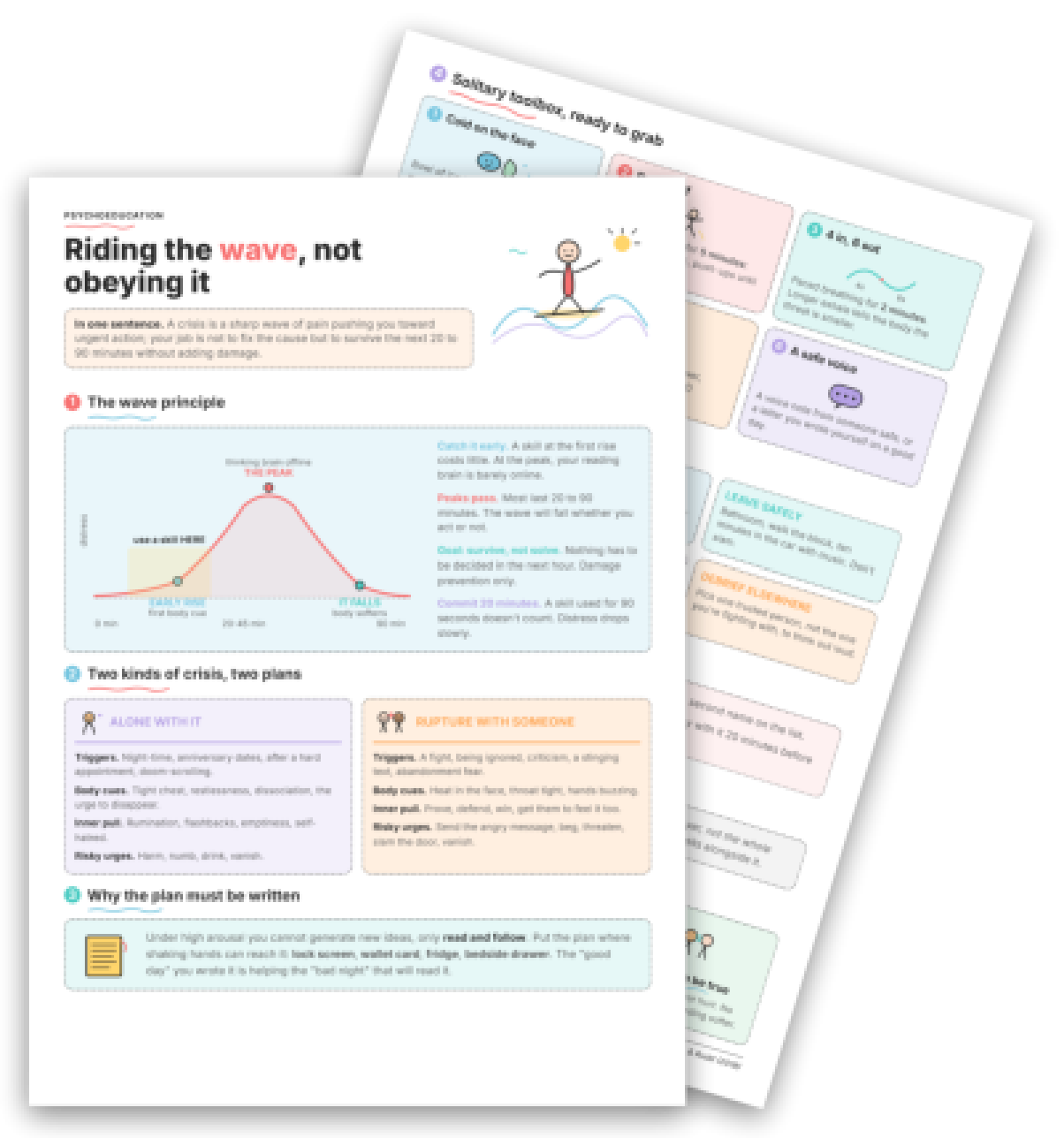
The fiche PDF opens with a single-sentence clinical frame ("A crisis is a sharp wave of pain pushing you toward urgent action; your job is not to fix the cause but to survive the next 20 to 90 minutes without adding damage") and immediately renders the wave principle as a timeline diagram: early rise, peak, fall, with explicit markers for when to deploy a skill, when cognitive access is lowest, and when the body begins to soften. What that diagram shows that oral explanation alone does not is the shape of tolerable distress. Patients tend to believe peaks are permanent; seeing the 20-to-90-minute arc as a curve changes the appraisal.
The fiche then splits into two structured crisis profiles: "Alone with it" (night-time triggers, dissociation, emptiness, self-harm urges) and "Rupture with someone" (interpersonal conflict, abandonment activation, the urge to send the angry message). Each profile lists body cues, inner pull, and risky urges, making it easy for the clinician to map the patient's own presentation during the session. This typology is directly relevant to patients working on emotion regulation, managing anger warning signs, or recognising trauma reactions.
The solitary toolbox covers six somatic and behavioural tools: cold water to the face, intense movement, paced 4-in-6-out breathing, five-senses grounding (adjacent to the sensory grounding exercise you may already be assigning), hands-busy tasks, and a safe voice. The relational toolbox offers six strategies, including the "Write, don't send" draft technique, the pause line ("I care about this and I'm too activated to do it well"), and the "Both/and" validation frame rooted in DBT dialectics. Alongside these, a Plan B section anticipates practical failures: phone dead, friend unavailable, skill "not working" after 90 seconds.
> Key point: the fiche is a visual support that facilitates in-session explanation of crisis tolerance; it is not a form the patient fills out alone, but a psychoeducation map the clinician walks through with them, leaving them a concrete, readable reference for the next acute episode.
A closing panel draws a clean distinction between distress tolerance and a suicide safety plan, a clinically important boundary given that patients with PTSD or high emotional dysregulation often present both levels simultaneously.
Use it with your patients
Share this tool in the mobile app and follow the work between sessions.
When and How to Introduce the Fiche
This fiche fits naturally after the initial assessment phase, once the formulation is clear enough to identify the patient's dominant crisis profile. For patients with a relational crisis pattern, you might frame it as: "I'd like us to look at a map of what happens in your system when things escalate with someone, so we can plan ahead rather than improvise." For patients whose crises are solitary, the wave diagram alone is often the most useful entry point.
Work through the two toolboxes collaboratively in session, crossing out what will not work for this patient and circling what might. Then guide the patient to write the plan on paper before leaving: the fiche explicitly cues this, noting that "the good day you wrote it is helping the bad night that will read it." Suggest placing a copy on the lock screen, in the wallet, or on the fridge.
The Plan B grid is worth debriefing explicitly: patients who over-rely on one strategy (typically, calling one specific person) are at higher risk when that strategy fails. Pair the fiche with adaptive versus maladaptive coping work if the patient's existing repertoire leans heavily avoidant, or with anger management skills for patients whose relational crises include explosive outbursts. For those whose inner pull includes rumination, the fiche's explicit naming of that pattern as a crisis driver can reduce shame around what feels like a cognitive failure. You might also link the physiological grounding tools to your psychoeducation on the autonomic nervous system if that module is already part of the treatment.
One clinical limit: the fiche is a distress tolerance tool, not a relapse prevention plan and not a substitute for a formal suicide safety plan where indicated. The fiche itself names this boundary clearly, which makes it easier to raise with the patient without it feeling like a shift in agenda.
Your session continues in your patients' pocket
Use with a patientYour resources, available everywhere
The handouts, exercises, programs and audios above: you choose which ones to make available to your patients, in the mobile app dedicated to them.
And far more than a library
The app goes well beyond resources, to support your patients every day:
Related categories
Explore other clinical resources by category.

Anxiety
Clinical hub for anxiety disorders: CBT and ACT worksheets, psychoeducation sheets, and exercises for assessment and treatment across the anxiety spectrum.

Trauma
Clinical hub on trauma and PTSD: assessment, differential diagnosis, treatment phases, and printable resources for practitioners. 155 chars.

Mood
Evidence-based worksheets and clinical tools for mood disorders: CBT, ACT, and positive psychology resources for psychologists and therapists.

Emotions
Clinical resources on emotion regulation: worksheets, coping tools, CBT, REBT, and ACT exercises for therapists working across diagnoses and age groups.

Regulate
Clinical resources for emotion regulation: worksheets, ACT exercises, and psychoeducation tools for affect regulation across diagnoses. For clinicians.

Build skills
Skill-building resources for clinicians: printable worksheets and exercises for coping, assertiveness, and communication skills training in therapy.