
Clinical picture. M., a 38-year-old man referred after a workplace conflict, described recurring episodes in which he would say things he later regretted before he had any sense that his anger had escalated. In session, the clinician introduced the anger-wave model and worked with M. to map his personal early warning signs: jaw tightening and a narrowing of attention that he had previously overlooked. Over the following two weeks, M. used the "catch it" and timeout skills during two heated exchanges with a colleague, leaving the room briefly on each occasion and returning once physiological arousal had subsided. He reported that the conflicts resolved with less damage than usual, though he noted the timeout still felt awkward to explain.
Anger Management Skills: PDF Worksheet, Tools and Exercises
A visual PDF worksheet with seven concrete skills clinicians can use to explain anger regulation in session and give patients a lasting reference between appointments.
Clinical vignettes
Catching the Wave Before the Peak
Shifting from Confrontational to Assertive Language
Clinical picture. P., a 45-year-old woman presenting with relationship difficulties, described a pattern of suppressing anger for days until it discharged in outbursts that frightened her partner and left her feeling ashamed. The clinician used the handout to distinguish between swallowing anger and timing its expression, focusing on the post-cool-down "speak" skill and the contrast between confrontational and assertive phrasing. P. practised reframing a specific grievance in session, replacing accusatory "you never" statements with "I felt" language. At the following appointment she reported one conversation with her partner that stayed regulated throughout, adding that the approach required more effort than she had anticipated and that she would need continued practice.
Patients who struggle with anger regulation can follow a verbal explanation of the arousal curve in session and still arrive the following week having acted at peak activation, with no skill applied. The gap between understanding a concept and using it under physiological load is exactly where this fiche PDF earns its place: as a visual support the clinician uses in session to make the model concrete, then hands over as a durable reference.
Use this resource with your patients
Handout, exercises and materials ready to use, right inside SessionFuel.
Why Anger Regulation Resists Verbal Explanation
The core clinical problem with anger management psychoeducation is timing. By the time the patient's arousal has reached the point of no return, the verbal instruction delivered in session is neurologically inaccessible. What patients need is not a smarter explanation; they need early-warning detection rehearsed before the event, and a clear map of which skill applies at which arousal level.
Explaining this sequence orally produces acquiescence, not encoding. Patients hear the logic, agree with it, and then rediscover at the next incident that they "didn't think of it in time." The problem is not motivation or intelligence; it is the absence of a concrete spatial reference that anchors the sequence visually before the demand arises. A checklist of personal anger warning signs can support this early-detection work alongside the fiche, and the Anger Iceberg complements it well when secondary emotions are driving the reactivity.
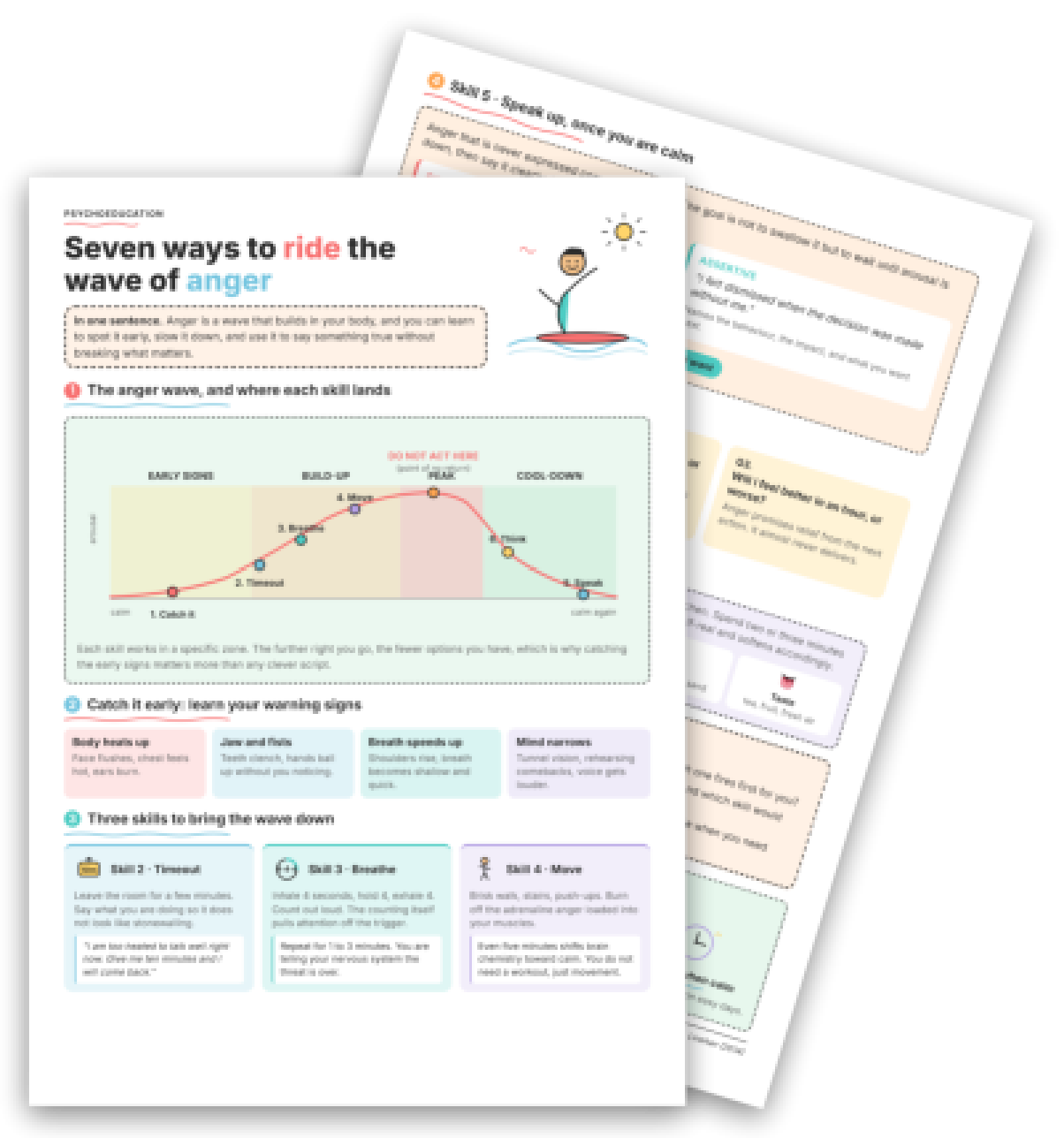
Inside the Fiche: A Visual Support for the Anger Wave Model
The fiche opens with a one-sentence frame: "Anger is a wave that builds in your body, and you can learn to spot it early, slow it down, and use it to say something true without breaking what matters." That framing, read aloud with the patient, immediately repositions anger as a manageable physiological process rather than a character defect.
The centrepiece is Panel 1, a wave diagram mapping four phases: early signs, build-up, peak, and cool-down. Each of the seven skills is plotted directly onto the wave, making it visually obvious that "the further right you go, the fewer options you have." This single image does more to build buy-in for early intervention than several minutes of verbal explanation.
The subsequent panels break down each skill concretely:
- Panel 2 lists four somatic and cognitive warning signs (jaw and fists, breath speeding up, mind narrowing) that patients can cross-reference against their own profile.
- Panel 3 covers the timeout script ("I am too heated to talk well right now. Give me ten minutes and I will come back."), the 4-4-4 breath cycle, and movement as adrenaline discharge. Each is brief enough to scan at arousal onset.
- Panel 4 addresses assertive expression, contrasting a confrontational opener with an "I" statement structured around: the behaviour, its impact, and the request. This panel pairs directly with assertiveness skills work and can inform the discussion of aggressive communication patterns the patient is trying to shift.
- Panel 5 offers three pre-action questions (including "Will arguing convince them, or harden them?") as a brief cognitive brake. Patients working on frustration tolerance will recognise the same logic.
- Panel 6 describes multi-sensory visualisation as a cool-down tool, engaging all five senses to shift brain state.
A closing "To discuss in session" block provides three debriefing prompts the clinician can use without preparation.
> Key takeaway: this fiche is a visual support that facilitates the explanation of anger regulation in session; it is not a questionnaire to fill out alone, but a shared reference the clinician and patient build meaning around together, then the patient keeps.
Clinical library
750+ clinical tools
A library built with and for clinicians, ready to use in session and extend between appointments.
Access all the toolsSeveral resource types
Psychoeducation handouts
Understand at a glance
Interactive exercises
To do and fill in
Interactive programs
A structured path
Audios
Meditation and relaxation
Psychometric tests
Automatic scoring
When and How to Introduce the Fiche
The fiche fits naturally from the second or third session, once the initial formulation is in place and the patient has described at least one recent anger episode. A low-threshold introduction: "I'd like to show you a diagram that maps out what happens in your body and mind during anger, so we can work out where you tend to lose traction."
It works particularly well with patients whose emotion regulation deficits are driving relational conflict, and with those presenting aggressive communication patterns they are motivated to change. For adolescents or patients with limited psychological-mindedness, the wave diagram alone is often sufficient to generate an immediate "that's exactly what happens to me" moment.
Debrief by using the fiche's own prompts: which warning sign fires first, where on the wave the patient was before their last difficult interaction, and which two skills they are willing to practise on ordinary days. That last question matters: as the fiche itself notes, "practise when calm, build the reflex on easy days."
Between sessions, the Anger Self-Reflection guided exercise and the Anger Regulation guided meditation audio extend the work the fiche opens. For patients needing a more structured programme, the six-lesson Anger Psychoeducation program builds directly on the same model. The fiche does not replace the therapeutic frame; it makes the explanation precise, gives the patient a reference they can actually locate at 11 p.m. before a difficult conversation, and saves session time for the clinical work that follows.
Use it with your patients
Share this tool in the mobile app and follow the work between sessions.
Sources
- Novaco, R. W. (1975). Anger Control: The Development and Evaluation of an Experimental Treatment. Lexington Books.
- DiGiuseppe, R., Tafrate, R. C. (2007). Understanding Anger Disorders. Oxford University Press.
- Saini, M. (2009). A Meta-analysis of the Psychological Treatment of Anger: Developing Guidelines for Evidence-Based Practice. Journal of the American Academy of Psychiatry and the Law.
- Kassinove, H., Tafrate, R. C. (2002). Anger Management: The Complete Treatment Guidebook for Practitioners. Impact Publishers.
Patient mobile app
Your session continues in your patients' pocket
Use with a patientYour resources, available everywhere
The handouts, exercises, programs and audios above: you choose which ones to make available to your patients, in the mobile app dedicated to them.
Psychoeducation handoutsInteractive exercisesInteractive programsAudiosPsychometric tests
And far more than a library
The app goes well beyond resources, to support your patients every day:
Standardized tests
Therapy journal
Gamification
Wellbeing challenges
Introspection prompts
Therapist homework
Related categories
Explore other clinical resources by category.

Emotions
Clinical resources on emotion regulation: worksheets, coping tools, CBT, REBT, and ACT exercises for therapists working across diagnoses and age groups.

Build awareness
Clinical worksheets and tools to build awareness in therapy: cognitive distortions, schemas, emotions, ACT and CBT resources for practitioners.

Regulate
Clinical resources for emotion regulation: worksheets, ACT exercises, and psychoeducation tools for affect regulation across diagnoses. For clinicians.

Build skills
Skill-building resources for clinicians: printable worksheets and exercises for coping, assertiveness, and communication skills training in therapy.

CBT
CBT worksheets, cognitive restructuring exercises & behavioral tools for clinicians. Evidence-based resources for every phase of cognitive behavioral therapy.

Anxiety
Clinical hub for anxiety disorders: CBT and ACT worksheets, psychoeducation sheets, and exercises for assessment and treatment across the anxiety spectrum.