
Clinical picture. M., a man in his late thirties, presents with recurrent anger episodes directed at his line manager following a perceived public humiliation during a team meeting. Between sessions, the clinician introduces the five-question structured exercise as a written homework task, asking M. to work through each prompt after the next incident rather than in retrospect. At the following appointment, M. reports that completing questions three and four prompted him to notice that his anger had sustained two days of rumination and had not changed his manager's behaviour at all. This observation opened a productive discussion about the gap between the emotional intensity he experienced and the actual leverage that anger gave him over the situation.
Guided Anger Self-Reflection: A Structured Clinical Exercise
Help patients examine the origin, consequences, and real utility of their anger through a five-question structured homework exercise.
Clinical vignettes
Recurring Anger After a Workplace Conflict
Anger Driving Avoidance in a Couple
Clinical picture. A., a woman in her mid-forties seen in individual therapy for relational difficulties, describes repeated arguments with her partner that consistently end with her leaving the room and refusing contact for several hours. The clinician offers the structured exercise as a self-monitoring tool, inviting A. to write her answers to each of the five questions within an hour of the next heated exchange. When she returned the completed worksheet, her response to question two revealed that her withdrawal had been interpreted by her partner as indifference, which had then escalated the conflict rather than containing it. Sitting with that answer proved a more useful entry point for behaviour change than any in-session discussion had been up to that point.
Anger is one of the most clinically dense emotions you will encounter. Patients arrive having acted on it, suppressed it, or cycled through it, and yet the moment you try to slow it down in conversation, the emotion itself resists examination. Words alone rarely get there. A structured exercise that patients complete on their own, away from the pressure of the consultation room, can open something a direct conversation cannot.
Use this resource with your patients
Handout, exercises and materials ready to use, right inside SessionFuel.
What Makes Anger So Difficult to Work With
Anger moves fast. By the time a patient can describe what happened, the reactive chain has already run its course: trigger, escalation, behavior, consequence. What gets lost in that speed is any reflective distance. Clinicians know this: psychoeducation about the anger cycle lands well in session, but the real test is whether patients can pause and observe their own pattern when it happens in daily life.
A second difficulty is that anger is often a secondary emotion. The anger iceberg model captures this well: what shows as rage frequently sits on top of fear, shame, or injustice. Without a structured prompt to slow the patient down, these layers stay invisible. The behavior, emotion, and underlying need framework makes the same clinical point: surface behavior and its deeper driver rarely announce themselves together.
Finally, there is the question of functional utility. Patients rarely spontaneously ask themselves whether their anger is actually moving the situation forward. That fifth gear of self-reflection, does this anger help me resolve anything?, is almost never reached without a deliberate prompt.
This exercise is available to patients through the patient app of SessionFuel: the clinician assigns it directly from their SessionFuel account, and the patient completes it autonomously on their phone between appointments, with guided instructions and space to write their answers.
750+ clinical tools
A library built with and for clinicians, ready to use in session and extend between appointments.
Access all the toolsWhat the Exercise Contains
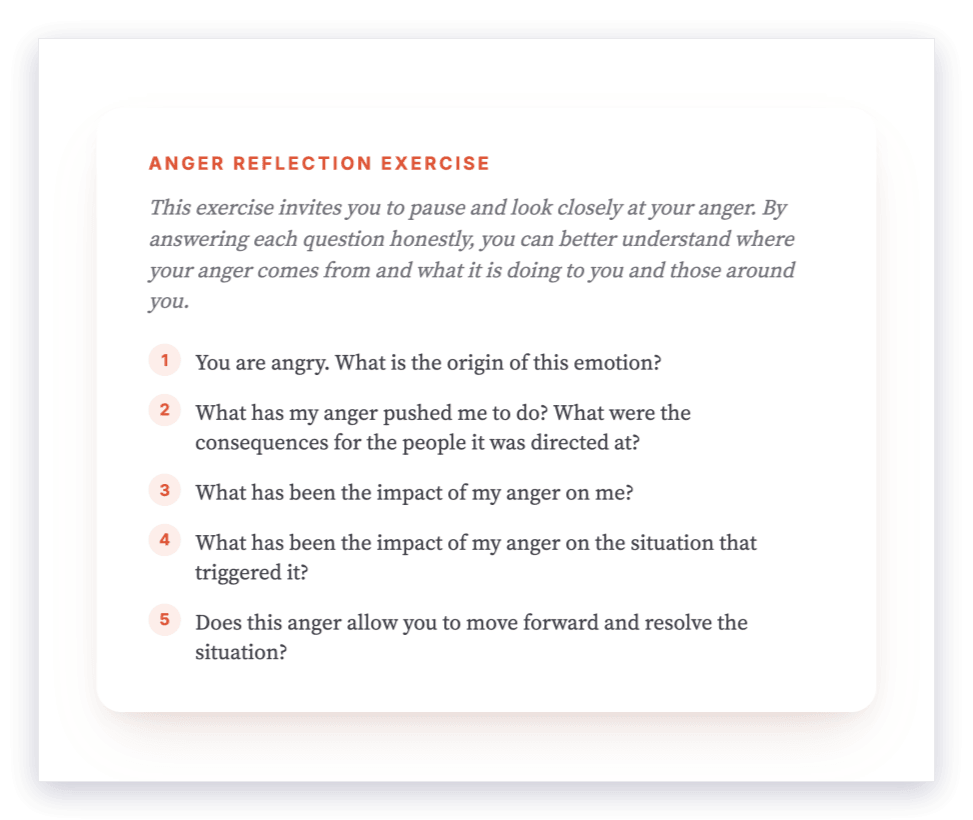
The image above lists the five questions patients work through. Note that this is a static preview of the question structure only, the full guided experience, with patient-facing instructions and dedicated writing space, exists inside the SessionFuel patient app, not in this image.
The sequence is deliberate. It opens with origin (question 1), asking the patient to locate the trigger before evaluating anything, which mirrors trigger mapping work you may have introduced with tools like Identifying Emotional Triggers or the Anger Warning Signs worksheet. Questions 2, 3, and 4 then turn the lens outward and inward in parallel: what did the anger do to others, what did it do to the patient, and what did it do to the situation itself. This triple-axis audit is something verbal psychoeducation rarely achieves in one pass. Question 5 is the clinically decisive one: it asks whether anger, in this specific instance, is adaptive or maintaining. That is exactly the question at the heart of Coping Strategy Effectiveness work, and it is one patients almost never ask themselves without a structured prompt.
Key insight: The exercise does not ask patients to suppress or justify their anger, it asks them to observe its actual consequences and utility, which is a fundamentally different clinical move.
Use it with your patients
Share this tool in the mobile app and follow the work between sessions.
Integrating This as Between-Session Homework
This exercise works best as between-session homework assigned immediately after a session in which anger has surfaced: a conflict the patient described, an escalation they regret, or a relational pattern you have begun mapping together. Assign it while the emotion is still fresh enough to be informative.
Patient profile fit is broad. The exercise is suitable for adults working on emotion regulation, patients with impulsive anger responses, and anyone whose anger tends toward aggressive communication patterns or cycles of blame. It also pairs well with the Anger Psychoeducation 6-Lesson Program if you are running a more structured arc of anger work. For patients who struggle with frustration specifically, consider sequencing it alongside the Frustration Tolerance exercise.
How to introduce it: Frame the exercise as a way to slow down a moment the patient has already lived through, not a judgment of the anger, but a closer look at what it did. You might say: "Before our next session, I'd like you to revisit one moment when you felt angry this week and work through these questions on your phone."
What to do with what the patient brings back: Question 5 is the richest debriefing entry point. If the patient concludes their anger did not resolve the situation, that opens the path toward Feel, Reflect, Act Differently work or a direct conversation about Coping Skills for Anger. If the patient is unsure, the answers to questions 2 through 4 give you granular material: relational impact, personal cost, and situational effect, concrete enough to guide a cognitive restructuring conversation or introduce the Perceived Injustice exercise when the anger is entangled with a sense of unfairness.
The exercise does not solve anger. It creates the reflective foothold from which clinical work on emotion regulation and behavioral choice can actually gain traction.
Your session continues in your patients' pocket
Use with a patientYour resources, available everywhere
The handouts, exercises, programs and audios above: you choose which ones to make available to your patients, in the mobile app dedicated to them.
And far more than a library
The app goes well beyond resources, to support your patients every day:
Related categories
Explore other clinical resources by category.

Anxiety
Clinical hub for anxiety disorders: CBT and ACT worksheets, psychoeducation sheets, and exercises for assessment and treatment across the anxiety spectrum.

Mood
Evidence-based worksheets and clinical tools for mood disorders: CBT, ACT, and positive psychology resources for psychologists and therapists.

Identity
Clinical resources for self-identity work in therapy: CBT, ACT, schema tools for clinicians addressing self-concept, core beliefs, and identity disruption.

Emotions
Clinical resources on emotion regulation: worksheets, coping tools, CBT, REBT, and ACT exercises for therapists working across diagnoses and age groups.

Behaviours
Clinical hub for behaviors in therapy: worksheets and tools for coping, eating disorders, CBT formulation, and maladaptive behavioral patterns.

Cognition
Printable cognitive therapy worksheets and clinical tools for therapists: CBT, ACT, schema work, defusion, distortions, and belief restructuring.