
Clinical picture. T., a man in his early forties, was referred following a series of escalating arguments with his partner that had twice ended with him leaving the home for the night. He described his anger as arriving "out of nowhere" and reported feeling ashamed but unable to account for the sequence of events. The clinician introduced the five-link cycle as a shared reference point, working through a recent incident in which T.'s partner had commented on his tone at dinner. Together they traced the chain: the comment (trigger), the automatic reading of it as contempt (thought), a layered surge of humiliation beneath the surface rage (emotion), flushing and jaw tension that he had never consciously registered (body), and the abrupt door slam that ended the evening (action). By the third session T. was using the body link as his earliest reliable signal, buying enough time to name the softer feeling before acting, which reduced the frequency of walk-outs noticeably over the following fortnight.
The Cycle of Anger: PDF Worksheet, Tools and Exercises
A printable CBT handout clinicians can use in session to make the five-link anger chain visible, name each intervention point, and build a durable shared vocabulary with patients.
Clinical vignettes
Mapping the Chain in a Couples Context
Psychoeducation Before Skills Work
Clinical picture. R., a woman in her mid-thirties presenting with occupational burnout, described recurrent anger directed at junior colleagues that she found disproportionate and ego-dystonic. She had previously attempted breathing exercises without sustained effect and expressed scepticism about relaxation-based approaches. The clinician offered the cycle handout not as a skill but as an explanatory frame, noting that physiological regulation alone is difficult to sustain when the thought link goes unexamined. R. identified a recurrent automatic thought, specifically that requests for clarification from colleagues signalled disrespect for her expertise, as the hidden engine behind reactions she had attributed to stress overload. Reframing the worksheet as diagnostic rather than prescriptive appeared to lower her resistance; she began self-monitoring between sessions using the five links as a loose scaffold, and reported in supervision that naming the thought link reduced the intensity of the subsequent emotional surge on several occasions.
Anger is one of the easiest emotions to misattribute and one of the hardest to map in real time. Patients arrive convinced they "just snapped," and oral explanations of triggers and appraisals rarely dislodge that conviction quickly. This fiche PDF gives that explanation a visible structure, anchoring the mechanism in a diagram the patient can trace with their finger during the session itself.
Use this resource with your patients
Handout, exercises and materials ready to use, right inside SessionFuel.
Why the Anger Cycle Resists Explanation in Session
The core clinical difficulty is not complexity. It is speed. From the patient's subjective experience, anger feels instantaneous: the trigger and the outburst blur into a single event, with no legible middle. Asking them to introspect on what happened between the two often draws a blank, or a rationalisation after the fact.
A second obstacle is the layered emotion problem. Beneath overt rage sits hurt, humiliation, or a sense of injustice. Naming that layer verbally, mid-session, is possible; but without a visual scaffold, the patient's working memory is occupied holding the narrative of the incident rather than observing the structure beneath it. The result: the cognitive appraisal step, which is the actual leverage point, stays invisible.
Clinicians working in CBT or DBT frameworks will recognise this as the challenge of making the ABC model tangible enough to use outside the session, and of preventing adaptive vs. maladaptive coping responses from being conflated with suppression.
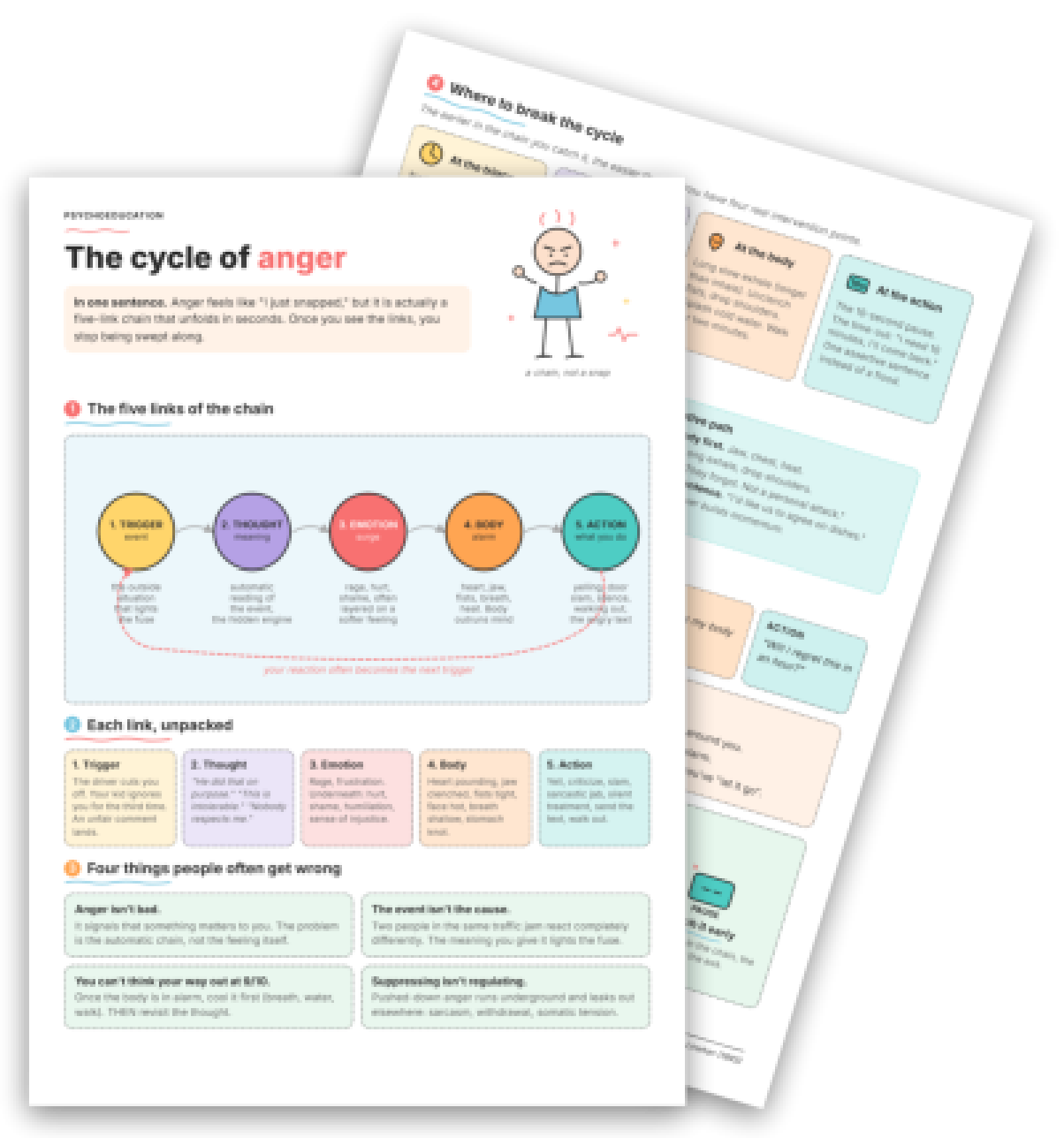
What the Fiche Contains: A Visual Map of Five Linked Steps
The fiche is organised across six panels, all grounded in the models of Beck (1999), Novaco (1975), Deffenbacher (2002), and Linehan (1993).
The first two panels present the five-link chain: Trigger, Thought, Emotion, Body, Action. The visual layout places each link in sequence with a short label and a concrete example, making explicit that "your reaction often becomes the next trigger" for those around the patient. This loop structure, shown graphically, is what oral explanation rarely conveys: the chain is circular, not linear.
Panel three addresses four common misconceptions, including the clinically important point that "you can't think your way out at 9/10" and that suppression is not regulation. These are the exact confusions that sustain maladaptive anger cycles, and seeing them listed corrects them without the patient feeling lectured.
Panel four maps four intervention points along the chain, one per link (trigger management, cognitive reframing, somatic regulation, behavioural pause), with concrete techniques under each. This is where the fiche earns its clinical weight: a patient who has absorbed the chain can now point to where, specifically, they could have exited it last week.
Panel five walks through a worked example (a domestic trigger, automatic path versus alternative path), and panel six offers five mid-episode questions aligned to each link, from "What just happened?" to "Will I regret this in an hour?"
> Key takeaway: the fiche is a visual support that facilitates the explanation of the anger cycle in session. It is not a questionnaire to complete alone at home. You use it with the patient, point to the links, and leave them a concrete reference to take away.
The six-panel structure complements the longer Anger Psychoeducation: A 6-Lesson Clinical Program if you are working across multiple sessions, and pairs naturally with the Anger Thermometer for patients who need to calibrate intensity before they can locate themselves in the chain.
750+ clinical tools
A library built with and for clinicians, ready to use in session and extend between appointments.
Access all the toolsWhen and How to Propose the Fiche
Introduce it once the working alliance is established and the patient has described at least one anger episode in enough detail to populate the five links together. Second or third session is often right; earlier risks feeling didactic before the patient sees the relevance.
Frame it clinically, not prescriptively: "I'd like to show you a map of what's happening when anger fires. Let's use what you described just now and trace it step by step." Then walk the links using their own words, not the fiche's examples.
The somatic link (panel four, body regulation) is a natural bridge to between-session tools: the Anger Regulation guided audio for somatic settling, the Anger Warning Signs checklist to train early detection, and the Anger Self-Reflection guided exercise as structured homework after the session.
For patients where the anger is predominantly relational, the Anger Iceberg handout and the Perceived Injustice reappraisal exercise extend the work into the layered-emotion territory the fiche introduces. Patients who exit anger through passive communication rather than outburst benefit from pairing the chain with Assertive Communication tools and the Frustration Tolerance guided exercise.
One limit to flag: patients in acute crisis or with an active intermittent explosive disorder presentation may need the somatic regulation work prioritised before the fiche's cognitive panels can land. The Anger Management Skills handout and the Anger Stop Signs resource offer more immediate de-escalation anchors in that context.
The fiche does not replace case formulation or the relational work of the session. What it does is make "a five-link chain that unfolds in seconds" visible enough that the patient leaves with a map, not just a conversation.
Use it with your patients
Share this tool in the mobile app and follow the work between sessions.
Sources
- Novaco, R. W. (1975). Anger Control: The Development and Evaluation of an Experimental Treatment. Lexington Books, D.C. Heath.
- DiGiuseppe, R., Tafrate, R. C. (2007). Understanding Anger Disorders. Oxford University Press.
- Beck, R., Fernandez, E. (1998). Cognitive-Behavioral Therapy in the Treatment of Anger: A Meta-Analysis. Cognitive Therapy and Research, 22(1), 63-74.
Your session continues in your patients' pocket
Use with a patientYour resources, available everywhere
The handouts, exercises, programs and audios above: you choose which ones to make available to your patients, in the mobile app dedicated to them.
And far more than a library
The app goes well beyond resources, to support your patients every day:
Related categories
Explore other clinical resources by category.

Emotions
Clinical resources on emotion regulation: worksheets, coping tools, CBT, REBT, and ACT exercises for therapists working across diagnoses and age groups.

Understand
Clinical hub for the therapeutic aim 'Understand': worksheets and tools to build patient insight across CBT, ACT, schema therapy and more.

Build awareness
Clinical worksheets and tools to build awareness in therapy: cognitive distortions, schemas, emotions, ACT and CBT resources for practitioners.

CBT
CBT worksheets, cognitive restructuring exercises & behavioral tools for clinicians. Evidence-based resources for every phase of cognitive behavioral therapy.
Anxiety
Clinical hub for anxiety disorders: CBT and ACT worksheets, psychoeducation sheets, and exercises for assessment and treatment across the anxiety spectrum.
Trauma
Clinical hub on trauma and PTSD: assessment, differential diagnosis, treatment phases, and printable resources for practitioners. 155 chars.