
Clinical picture. J., a 14-year-old referred for recurrent aggressive outbursts at school, reported that his anger felt sudden and uncontrollable, describing it as "just happening" without warning. During a structured session, the clinician introduced the Anger Stop Signs sheet and walked through the four-stage escalation model, inviting J. to map his own recent incidents onto the scale. J. identified jaw tightening and a specific racing thought pattern ("this is totally unfair") as signs that typically appeared around a 4 or 5 out of 10, well before physical escalation. Over the following two weeks he tracked these cues on a brief daily log; he reported one incident where he noticed the jaw tension early and left the classroom before reaching crisis point. The episode did not resolve without difficulty, but it represented a first self-initiated de-escalation attempt the team could build on.
Anger Stop Signs: PDF Worksheet, Tools and Exercises for Clinical Practice
A visual PDF worksheet with concrete tools and exercises to help young patients detect anger escalation early and apply effective brakes before the window of opportunity closes.
Clinical vignettes
Early Signals in an Adolescent with Conduct Difficulties
Anger Awareness Work with a Parent in Family Therapy
Clinical picture. M., a father in his late thirties, was seen conjointly following concerns about harsh verbal responses toward his children during homework conflicts; he acknowledged a pattern of sudden yelling that he later regretted. The clinician used the Anger Stop Signs sheet as a shared reference, normalising the neurobiological basis of escalation and framing early cues as actionable rather than shameful. M. initially struggled to identify body-level signals but, through collaborative review of a recent incident, recognised that his voice going louder and a tight sensation across his chest were consistent precursors, both falling in the rolling stage. He agreed to use these two personalised stop signs as a prompt to request a short break before continuing the homework task. At the next session he reported one successful application, noting that naming the signal aloud to himself reduced its intensity slightly, a modest but clinically meaningful shift in self-monitoring capacity.
For young patients working on anger regulation, verbal explanations of escalation rarely stick: they nod, then arrive the following week having "just exploded" again with no sense of where things went wrong. This PDF worksheet gives the escalation curve a concrete visual shape, making anger stop signs something patients can name, locate in their body, and use as a genuine early-warning system in and between sessions.
Use this resource with your patients
Handout, exercises and materials ready to use, right inside SessionFuel.
Why Anger Escalation Is Hard to Explain Without a Visual
The core clinical difficulty here is not motivation. Children and adolescents who struggle with anger dysregulation rarely lack the desire to behave differently. What they lack is a clear internal signal that the window of opportunity is closing. By the time they register that something is happening, they are already at 7 or 8 out of 10, and as the fiche states plainly, "the thinking brain is offline." Prefrontal inhibitory capacity is no longer reliably available; the moment for choice has passed.
Explained verbally, this feels abstract to most young patients. Clinicians working within a CBT or DBT framework will recognize the parallel to Linehan's biosocial model: the patient is not being difficult, they genuinely did not perceive the earlier signals as actionable. The problem is one of detection, not intention. A visual that maps escalation across stages, assigns it a number, and anchors it in observable bodily, vocal, cognitive, and behavioral markers gives both clinician and patient a shared language that a spoken description cannot produce on its own.
This is also where anger warning signs tools for clinical practice complement a broader anger regulation plan, and where the foundational work on adaptive versus maladaptive coping becomes far more concrete once a patient can name their personal cues.
What the Anger Stop Signs Worksheet Contains
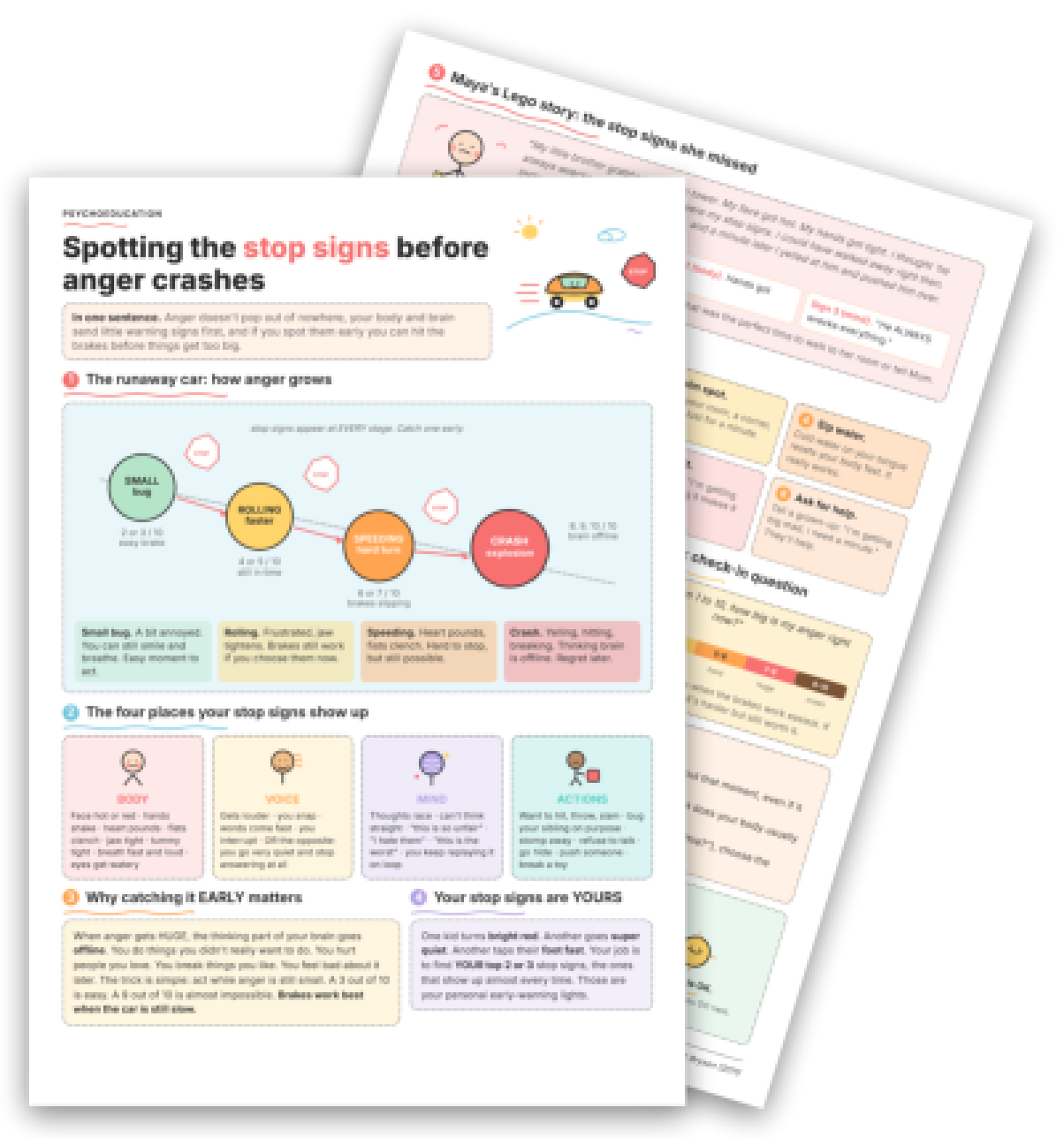
The fiche PDF is organized around eight sections, each serving a distinct psychoeducational function.
The visual anchor is the "runaway car" metaphor: four escalation stages (small bug, rolling, speeding, crash) each paired with a 0-to-10 intensity rating and a clear brake-availability signal. The layout makes the window of opportunity visible at a glance. A patient looking at the diagram grasps immediately that "brakes work best when the car is still slow" and that the target intervention zone is 3 to 4 out of 10.
The worksheet then maps four stop-sign domains across body, voice, mind, and actions, with concrete examples in each: face hot or red, jaw tightening, thoughts racing, the urge to throw or slam. Section 4 shifts from generic description to personalization: "Your job is to find YOUR top 2 or 3 stop signs." This is clinically the more useful task, and the visual layout makes it easy to circle or annotate in session.
Sections 6 and 7 present eight concrete brake strategies (pause, belly breath, calm spot, sip water, squeeze, count to 10, name it, ask for help) alongside a real-brakes-versus-fake-brakes contrast that patients find immediately legible. The final section closes with a quick check-in question (a 1-to-10 scale with a built-in decision rule) and three discussion prompts framed explicitly as things to "talk about together," signaling that this is a clinician-facilitated tool, not autonomous self-help.
For broader anger psychoeducation, this fiche pairs naturally with the Anger Psychoeducation: A 6-Lesson Clinical Program and with coping strategies resources specifically designed for children and adolescents.
> Key takeaway: The Anger Stop Signs fiche is a visual support that facilitates the explanation of escalation in session; it is not a worksheet patients complete alone, but a shared map the clinician uses to make the escalation curve visible, establish a common vocabulary, and leave the patient with a concrete reference between appointments.
750+ clinical tools
A library built with and for clinicians, ready to use in session and extend between appointments.
Access all the toolsWhen and How to Introduce the Worksheet
This fiche works best from the second or third session onward, once the anamnesis is complete and there is enough alliance to frame the exercise as a collaborative investigation. It is particularly indicated for:
- Children aged 7 to 12 presenting with anger outbursts, sibling conflict, or school aggression
- Adolescents who report frustration but struggle to locate it somatically before it peaks
- Parents in psychoeducation sessions, as the four-domain model gives them an observable vocabulary to use at home
To introduce it, you might say: "I'd like to show you a drawing of how anger usually grows. Let's figure out together which of these signs your body sends you first." This frames the fiche as discovery, not correction, which tends to reduce defensiveness in younger patients.
Debrief the personalization section actively: ask the patient to mark their own top stop signs across the body, voice, mind, and actions panels before the session closes. The Anger Self-Reflection guided exercise works well as follow-up homework once those signs have been identified. The 1-to-10 check-in question can also serve as a standing opening ritual at the start of subsequent sessions, connecting to emotion regulation work more broadly.
For patients with marked somatic dysregulation, the anger regulation guided meditation audio can be assigned alongside the fiche to build a between-session practice. Where alexithymia is prominent, begin with the voice and actions panels rather than the body panel; those signals are more observable and require less interoceptive access. The grounding exercise for patients who flood cognitively can scaffold that work when needed.
The fiche does not replace the therapeutic frame. It gives the explanation a shape the patient can actually hold, and leaves them with a map they can return to on their own.
Use it with your patients
Share this tool in the mobile app and follow the work between sessions.
Sources
- Novaco, R. W. (1975). Anger Control: The Development and Evaluation of an Experimental Treatment. Lexington Books.
- Feindler, E. L., Ecton, R. B. (1986). Adolescent Anger Control: Cognitive-Behavioral Techniques. Pergamon Press.
- Sukhodolsky, D. G., Scahill, L. (2012). Cognitive-Behavioral Therapy for Anger and Aggression in Children. Guilford Press.
Your session continues in your patients' pocket
Use with a patientYour resources, available everywhere
The handouts, exercises, programs and audios above: you choose which ones to make available to your patients, in the mobile app dedicated to them.
And far more than a library
The app goes well beyond resources, to support your patients every day:
Related categories
Explore other clinical resources by category.

Emotions
Clinical resources on emotion regulation: worksheets, coping tools, CBT, REBT, and ACT exercises for therapists working across diagnoses and age groups.

Understand
Clinical hub for the therapeutic aim 'Understand': worksheets and tools to build patient insight across CBT, ACT, schema therapy and more.

Build awareness
Clinical worksheets and tools to build awareness in therapy: cognitive distortions, schemas, emotions, ACT and CBT resources for practitioners.

Prevent relapse
Prevention as a therapeutic aim: clinical framing, risk stratification, and printable resources for relapse prevention and early intervention in mental health.

CBT
CBT worksheets, cognitive restructuring exercises & behavioral tools for clinicians. Evidence-based resources for every phase of cognitive behavioral therapy.

Anxiety
Clinical hub for anxiety disorders: CBT and ACT worksheets, psychoeducation sheets, and exercises for assessment and treatment across the anxiety spectrum.