
Clinical picture. M., a man in his early forties referred for work-related burnout, described a nightly routine of two to three glasses of wine and hours of passive scrolling to wind down after demanding shifts. In session, the clinician introduced the informational sheet on adaptive and maladaptive coping, framing it around timelines rather than moral judgement: each strategy M. used was achieving the goal of relief, but on a timeline that compounded his exhaustion by morning. M. identified his pattern clearly on the maladaptive column and, without prompting, noted that the scroll sessions left him feeling "numb, then drained, then guilty," wording that mirrored the sheet almost verbatim. As a modest first step, he agreed to trial a ten-minute walk before opening his phone in the evenings, keeping the goal small enough to test rather than commit.
Adaptive vs Maladaptive Coping: PDF Worksheet, Tools and Exercises
A visual psychoeducation worksheet with tools and exercises to explain coping timelines, the relief-cost loop, and build function-matched replacements with patients in session.
Clinical vignettes
Recognising the Cost of Fast Relief
Shifting From Avoidance to Paced Problem-Solving
Clinical picture. T., a graduate student in her late twenties, presented with persistent low mood and mounting academic arrears she attributed to procrastination. The clinician used the worksheet to externalise the pattern: T. could see that avoiding her dissertation brought genuine calm in the moment, yet each delay narrowed her options and amplified the next wave of anxiety, a cycle the sheet captures as "today's calm, tomorrow's panic." T. had not previously considered journalling or breaking the task into a single small step as coping strategies at all, having reserved that label for emotion-focused activities. She left the session with one defined action, drafting a single paragraph before the next appointment, framing it as an experiment in the adaptive timeline rather than a test of her competence. At follow-up she reported completing the paragraph and noted a modest but tangible reduction in the background dread she had described as constant.
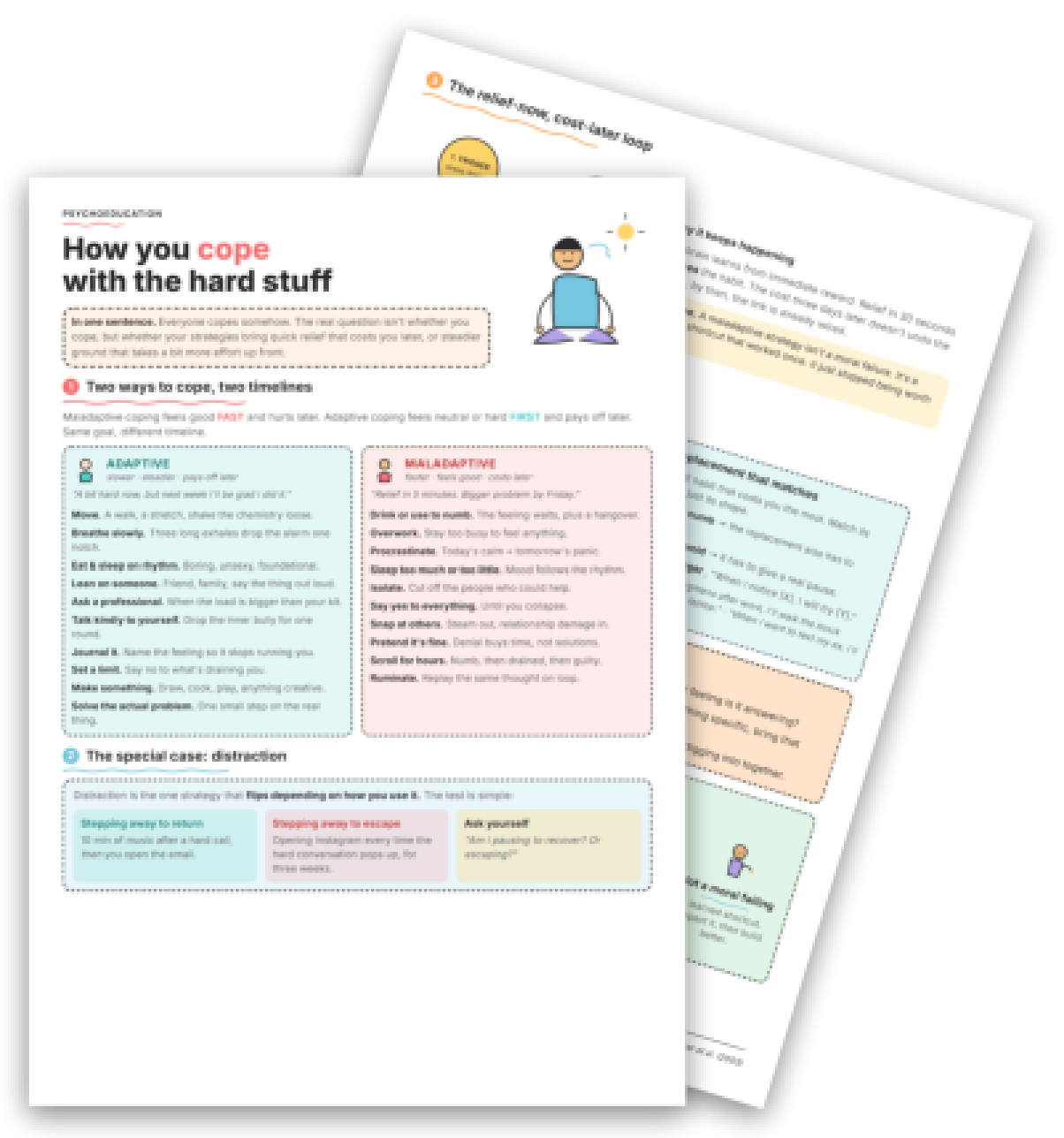
In session, most patients can name a strategy they know "doesn't help" and keep using it anyway. Explaining the adaptive/maladaptive distinction verbally rarely closes that gap; the concept lands intellectually and stays abstract. This fiche PDF gives you a visual scaffold to make the distinction concrete, explain the maintenance mechanism, and co-build a replacement strategy within a single session.
Use this resource with your patients
Handout, exercises and materials ready to use, right inside SessionFuel.
Why Coping Patterns Resist Explanation in Session
The core clinical difficulty isn't the taxonomy itself. It's the reinforcement logic. Maladaptive coping works: it delivers real, fast relief. From an operant conditioning standpoint, the brain doesn't weigh the three-day cost against the five-minute fix. Patients know this, but hearing it once doesn't shift behavior.
Add to this that patients presenting with depression, anxiety, or chronic stress already carry shame about their coping habits. Framing automatic maintaining behaviors like isolation, overwork, or rumination as moral failures in an oral explanation activates defensiveness rather than curiosity. You need a way to name the mechanism without naming the patient as the problem.
The fiche handles this from the first panel: "A maladaptive strategy isn't a moral failure. It's a learned shortcut that worked once." Starting from that premise on a printed page changes the register of the conversation immediately.
What the Fiche Contains: Four Panels, One Visual Argument
The resource is organized across four structured panels, each building on the last.
Panel 1 places adaptive and maladaptive strategies in a direct side-by-side comparison anchored on timelines: adaptive coping is "slower, steadier, pays off later"; maladaptive coping is "faster, feels good, costs later." The parallel layout makes the tradeoff visible in a way that oral description rarely achieves. Each column lists ten concrete examples across both registers, from journaling and setting a limit to isolation and scrolling for hours, giving you an immediate shared vocabulary with the patient.
Panel 2 handles distraction as a special case: the one strategy that shifts category depending on use. The fiche proposes a single diagnostic question: "Am I pausing to recover? Or escaping?" This is clinically precise and directly useful for presentations involving problematic screen use, compulsive reassurance-seeking, or avoidance masquerading as self-care.
Panel 3 maps the relief-now, cost-later loop as a four-step cycle: trigger, quick action, fast relief, delayed cost, restart. Seeing the loop laid out visually, rather than described, often produces the "that's exactly what I do" recognition that shifts the patient's posture in the room.
Panel 4 provides a self-diagnostic with two scores: the patient names a recent stressor, rates how good the coping felt in the moment (1-10), then rates how helpful it actually was a day later (1-10). The fiche is direct: "The gap between those two numbers IS the diagnostic." A large gap identifies maladaptive function without requiring you to label it first. The panel closes with a "match the function" principle for building replacements and three structured prompts explicitly framed as "to discuss in session," making the fiche a bridge between appointments rather than a one-off handout.
> Key takeaway: this fiche is a visual support that facilitates the explanation of adaptive and maladaptive coping in session; the patient leaves with a concrete reference and a self-monitoring framework, not a worksheet to complete alone.
750+ clinical tools
A library built with and for clinicians, ready to use in session and extend between appointments.
Access all the toolsWhen and How to Introduce the Fiche in Your Practice
This resource fits naturally from the second or third session onward, once you have a working formulation and have identified at least one maintaining behavior. It applies across a wide range of presentations: chronic anxiety, depressive avoidance, adjustment disorders, and any case where emotion regulation deficits are central. It pairs naturally with mental health literacy work in the early phase of a care plan, and with the ABC model when you want to map the cognitive layer sitting underneath the coping response.
A workable introduction: "I'd like to show you something that might explain why some of what you've tried hasn't stuck." Present the two timelines first, invite the patient to locate their own habits on the page, then move to the loop in Panel 3. Reserve the two-score diagnostic for in-session use rather than sending the fiche home blank: the gap between the scores is most clinically usable when you can debrief it together and move directly to Panel 4's replacement logic.
The "match the function" principle is where the fiche earns its clinical weight. A patient who drinks to numb needs a replacement that also soothes, not a generic exercise; a patient who procrastinates to escape discomfort needs something that genuinely provides a pause. Working through that logic on the page, explicitly, saves you from prescribing strategies that look healthy but don't serve the same function, and prevents the frustration of replacements that keep failing.
For adolescent and young adult presentations, the coping strategies worksheet for children and teens covers the same framework at a developmentally adjusted level. In resilience-focused work, this fiche pairs well with a structured resilience program to ground habit-building in values rather than symptom reduction alone. If rumination is the primary maladaptive pattern, pairing Panel 3's loop with a dedicated self-monitoring tool reinforces the between-session observation work.
The fiche doesn't replace the case formulation; it makes the psychoeducational piece of that formulation visible, shareable, and workable in real time.
Use it with your patients
Share this tool in the mobile app and follow the work between sessions.
Sources
- Lazarus, R. S., & Folkman, S. (1984). Stress, Appraisal, and Coping. Springer Publishing Company.
- Carver, C. S. (1997). You want to measure coping but your protocol's too long: Consider the Brief COPE.
- Ziadeh, A., Saikali, L., Fahed, G., Haddad, C., Haddad, G., & Soufia, M. (2025). Adaptive versus maladaptive coping strategies: insight from Lebanese young adults navigating multiple crises.
Your session continues in your patients' pocket
Use with a patientYour resources, available everywhere
The handouts, exercises, programs and audios above: you choose which ones to make available to your patients, in the mobile app dedicated to them.
And far more than a library
The app goes well beyond resources, to support your patients every day:
Related categories
Explore other clinical resources by category.
Anxiety
Clinical hub for anxiety disorders: CBT and ACT worksheets, psychoeducation sheets, and exercises for assessment and treatment across the anxiety spectrum.

Mood
Evidence-based worksheets and clinical tools for mood disorders: CBT, ACT, and positive psychology resources for psychologists and therapists.

Emotions
Clinical resources on emotion regulation: worksheets, coping tools, CBT, REBT, and ACT exercises for therapists working across diagnoses and age groups.

Behaviours
Clinical hub for behaviors in therapy: worksheets and tools for coping, eating disorders, CBT formulation, and maladaptive behavioral patterns.

Understand
Clinical hub for the therapeutic aim 'Understand': worksheets and tools to build patient insight across CBT, ACT, schema therapy and more.

Build awareness
Clinical worksheets and tools to build awareness in therapy: cognitive distortions, schemas, emotions, ACT and CBT resources for practitioners.