
Clinical picture. A patient in her late twenties, referred to here as M., presented with borderline personality disorder and recurrent episodes of intense shame that escalated rapidly to self-harm urges. During one session, she described arriving home after a perceived social failure and feeling her distress spike to what she rated as nine out of ten within minutes, at which point she reported her thinking became fragmented and she could not use any cognitive strategy she had previously learned. Her clinician introduced the Temperature component of the TIPP skills, asking her to keep a bowl and ice packs accessible at home and to submerge her face for twenty seconds while holding her breath at the first sign of a red-zone escalation. At her next appointment M. reported using the technique twice during the week; on both occasions she described the physiological shift as sufficient to bring her distress to a level where she could then apply a behavioural coping plan. She did not self-harm during that interval, though her clinician noted this as a preliminary observation rather than a stable outcome.
DBT TIPP Skills: PDF Worksheet, Tools and Exercises for Distress Tolerance
A visual fiche PDF presenting the four body-based distress tolerance techniques from DBT, with clinical exercises and implementation tools for session use.
Clinical vignettes
Temperature Skill During Acute Shame Spiral
Intense Exercise to Interrupt Rage Escalation
Clinical picture. R., a man in his mid-thirties receiving outpatient DBT for emotion dysregulation and intermittent explosive episodes, reported that conflict with his partner reliably produced an adrenaline surge he described as feeling like pressure behind his eyes, followed by verbal aggression he later regretted. His clinician explained the physiological rationale for the Intense Exercise component, framing the burst of vigorous movement as a way to metabolise the cortisol and adrenaline already circulating rather than as a distraction. R. agreed to trial ten minutes of stair climbing or jumping jacks immediately after leaving a heated exchange, before re-engaging in any conversation. Over the following two weeks he used the strategy on three occasions and reported that in two of those instances he returned to the discussion with noticeably reduced reactivity; the third occasion he did not sustain the exercise long enough and escalated again, which provided useful material for troubleshooting in the subsequent session.
At peak distress, cognitive interventions routinely fail, not because the patient isn't trying, but because the prefrontal cortex is functionally offline. Clinicians working within DBT know this, yet translating it into something a patient can actually use in a crisis requires more than a verbal explanation. This fiche PDF on DBT TIPP skills is a visual support designed for exactly that: bring it out in session, walk through it together, and hand it over as a portable reference the patient can reach for when words no longer work.
Use this resource with your patients
Handout, exercises and materials ready to use, right inside SessionFuel.
Why TIPP Is Difficult to Convey Without a Visual Support
Linehan's distress tolerance module rests on a premise that feels almost paradoxical to most patients: when emotion intensity is high enough, the path back to regulation runs through the body, not through thought. Telling a patient this verbally tends to produce polite nodding rather than genuine understanding. The sequencing matters clinically. A patient who attempts cognitive restructuring or journalling at peak dysregulation often reports that "it made things worse," which is precisely what neurobiology predicts.
The second sticking point is the four-skill architecture itself. T, I, P, P (Temperature, Intense exercise, Paced breath, Progressive Muscle Relaxation) are not interchangeable; each targets a distinct physiological mechanism, and each carries specific contraindications and timing. Delivered orally, the distinctions blur. Patients leave the session remembering "cold water" or "breathing" without the rationale, the sequencing, or the caution around cardiac conditions or eating disorders.
What the Fiche Contains: Six Panels, One Visual Logic
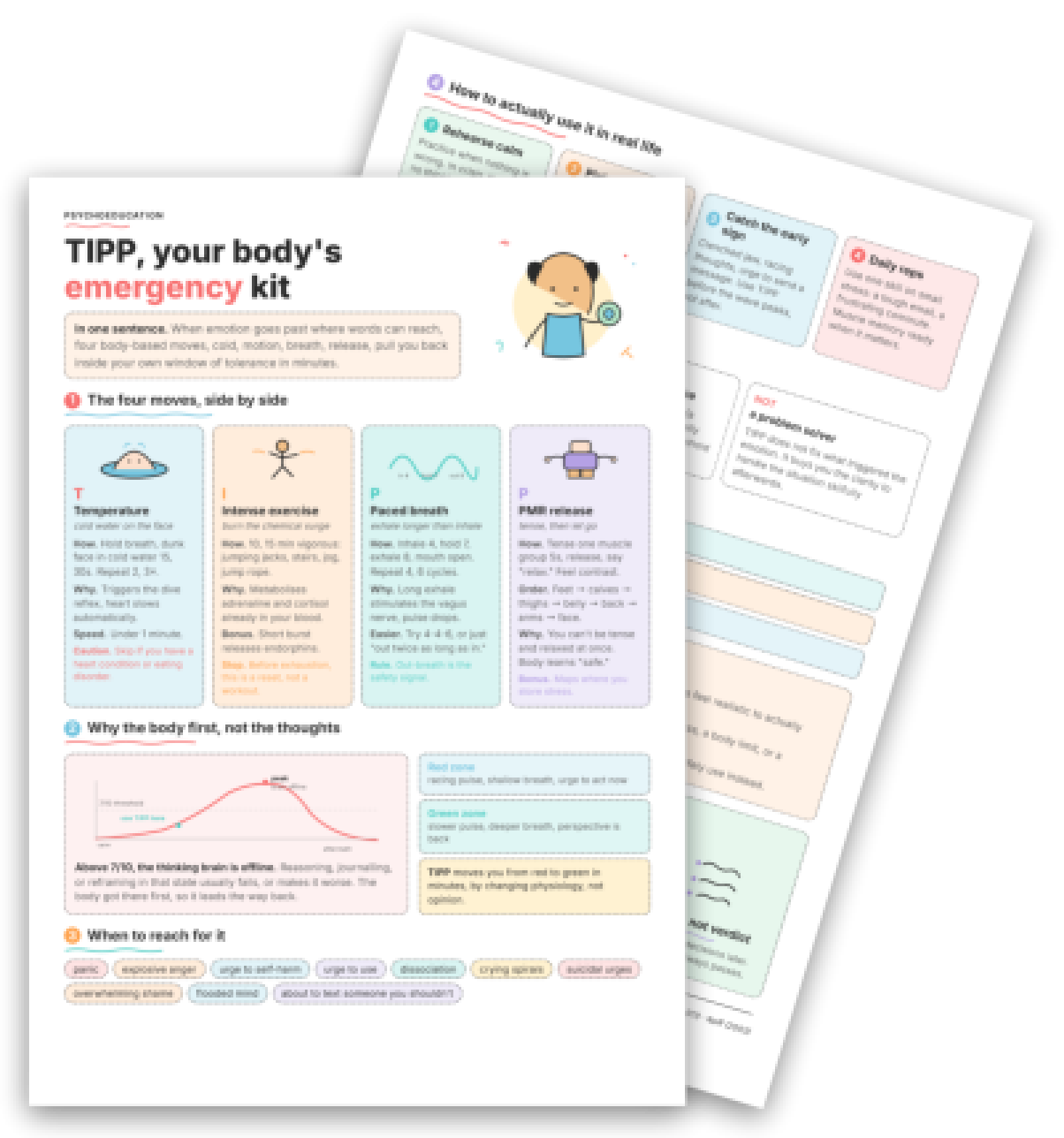
The fiche PDF organises the skill set into six discrete panels that build a coherent argument from mechanism to application. The first lays out the four moves side by side, each with a concrete How, a Why tied to the underlying physiology (the dive reflex for Temperature, vagal stimulation for Paced breath, cortisol metabolism for Intense exercise), a speed estimate, and any relevant caution. Seeing T, I, P, P lined up visually lets patients compare and identify which moves are realistic for their context before a crisis hits.
The second panel carries the conceptual spine of the whole skill: a simple threshold diagram showing a 7/10 arousal point above which, as the fiche states, "the thinking brain is offline." This is the visual that makes the oral explanation land. Patients see why coping strategies designed for moderate distress fail in the red zone, and why TIPP targets physiology first. A red-to-green zone axis makes the direction of change concrete rather than abstract.
The remaining panels address implementation: a trigger list covering panic, explosive anger, dissociation, urges to self-harm or use substances, and several others, giving patients immediate recognition of their own entry points. A four-step practice guide (rehearse calm, pick two moves, catch the early sign, daily reps) directly counters the most common clinical obstacle: patients waiting until the wave has peaked before reaching for the skill. Two panels close the loop, one clarifying what TIPP is not (avoidance, general relaxation, a problem-solver), and one offering phrases patients can internalise, including "TIPP first, decisions later." The final section, "To discuss in session," gives you three ready-made debrief prompts grounded in the patient's own experience.
> Key point: the fiche is a visual support that facilitates the explanation in session, not a self-administered questionnaire. Its layout does the cognitive work that an oral presentation cannot: it lets the patient see mechanism, contraindication, and implementation sequence all at once, and leaves them with a concrete reference for the moment skills are most needed.
750+ clinical tools
A library built with and for clinicians, ready to use in session and extend between appointments.
Access all the toolsHow and When to Introduce the Fiche in Your Practice
The fiche fits naturally once a formulation of case is in place and you are moving into the distress tolerance module, typically early in a DBT programme or when crisis management becomes a clinical priority. It is well-suited to patients presenting with panic attacks, self-harm urges, substance-related impulsivity, or the emotional flooding seen in borderline-spectrum presentations. It also works as a complement to DBT ACCEPTS Distress Tolerance skills for patients who need a physiological first step before cognitive distraction becomes viable.
A useful introduction: "I want to show you a map of four techniques your body can use when emotion gets past the point where thinking helps. Let's go through it together and figure out which two feel most realistic for you." This framing keeps the patient active in the selection process, which the fiche's "pick your two" step explicitly supports.
When debriefing, use the "To discuss in session" prompts on the fiche directly: which moves the patient actually reached for, what got in the way if TIPP failed (timing, access, a thought that overrode the impulse), and whether a contraindication such as a cardiac condition requires substituting Temperature for a different sharp-sensation cue. For patients already using progressive muscle relaxation audio between sessions, the PMR panel on the fiche integrates naturally as the familiar anchor within the four-skill set.
One clinical limit worth naming: patients with severe PTSD or somatic dissociation may find Temperature counterproductive if cold sensation triggers rather than regulates. Discuss this before assigning the fiche, and pair it with the autonomic nervous system fiche if you want to ground the physiological rationale more thoroughly. The fiche does not replace crisis safety planning; it equips the patient to stay inside their coping in crisis repertoire long enough to use it.
Use it with your patients
Share this tool in the mobile app and follow the work between sessions.
Sources
- Linehan, M. M. (2015). DBT Skills Training Manual, Second Edition. Guilford Press.
- Linehan, M. M. (2025). DBT Skills Training Handouts and Worksheets, Revised Edition. Guilford Press.
Your session continues in your patients' pocket
Use with a patientYour resources, available everywhere
The handouts, exercises, programs and audios above: you choose which ones to make available to your patients, in the mobile app dedicated to them.
And far more than a library
The app goes well beyond resources, to support your patients every day:
Related categories
Explore other clinical resources by category.
Anxiety
Clinical hub for anxiety disorders: CBT and ACT worksheets, psychoeducation sheets, and exercises for assessment and treatment across the anxiety spectrum.
Trauma
Clinical hub on trauma and PTSD: assessment, differential diagnosis, treatment phases, and printable resources for practitioners. 155 chars.

Emotions
Clinical resources on emotion regulation: worksheets, coping tools, CBT, REBT, and ACT exercises for therapists working across diagnoses and age groups.

Behaviours
Clinical hub for behaviors in therapy: worksheets and tools for coping, eating disorders, CBT formulation, and maladaptive behavioral patterns.

Regulate
Clinical resources for emotion regulation: worksheets, ACT exercises, and psychoeducation tools for affect regulation across diagnoses. For clinicians.

Build skills
Skill-building resources for clinicians: printable worksheets and exercises for coping, assertiveness, and communication skills training in therapy.