
A patient in his mid-thirties, referred to here as T., presented with alcohol use disorder and a history of impulsive texting toward an ex-partner during high-distress evenings. During session, the clinician introduced the IMPROVE worksheet and worked with T. to identify his personal top three: slow breathing (Relaxation), a brief deliberate break from his phone (Vacation), and self-encouragement drawn from past sober nights (Encourage). T. trialled the sequence at home the following week when the familiar urge arose after an unanswered message. He reported that the distress did not disappear, but that he reached morning without sending anything he would regret. The clinician noted this as a workable first application and used it to discuss the bridge function of the skill rather than framing it as a resolution.
IMPROVE the Moment: PDF Worksheet, Tools and Exercises for Distress Tolerance
A visual DBT fiche to help clinicians teach the IMPROVE skill in session, giving patients a portable, personalised menu for riding out acute distress without behavioural escalation.
Clinical vignettes
Distress Tolerance in Relapse Risk
Panic Management Without Avoidance
M., a woman in her late twenties with panic disorder and a pattern of abrupt situational avoidance, described recurring distress in confined public spaces, specifically supermarket queues. The clinician used the IMPROVE sheet to help her select two skills she could use covertly and without leaving: Imagery (briefly orienting to a personally calming scene) paired with a grounded One-thing focus using a sensory count. M. practised both in session with a brief imaginal exposure before attempting them in vivo. At the following appointment she reported completing a full shop on one occasion, noting the anxiety had peaked and then reduced without her leaving the queue. The clinician underscored that the goal had been riding the wave rather than eliminating discomfort, and M. found that reframe credible.
Seven-item acronyms collapse under acute distress. Patients who nodded along when you explained IMPROVE verbally will, in crisis, blank on five of the seven letters and reach for the most impulsive option available. This PDF fiche gives you a visual scaffold to teach the skill properly in session and hand patients something they can actually use at 11 pm.
Use this resource with your patients
Handout, exercises and materials ready to use, right inside SessionFuel.
Why IMPROVE Is Difficult to Transmit Verbally
The conceptual architecture of IMPROVE rests on one insight that patients consistently underestimate: emotional waves peak and then fall on their own, provided no fuel is added at the plateau. When you describe this verbally, most patients hear it as reassurance, not as a mechanical fact that changes what they should do in the next ten minutes. The abstract claim "feelings are temporary" rarely shifts behaviour in a crisis; a concrete decision gate does.
The second obstacle is selection. A menu of seven skills presented aurally produces choice paralysis under high emotional activation. Patients do not need to learn all seven equally; they need to pre-select two or three that fit their profile, before the spike arrives. Without a visual framework anchoring that conversation, the session stays theoretical. The DBT distress tolerance skills overview and the complementary ACCEPTS skill sheet face the same transmission problem, which is why printed visual supports matter across the distress tolerance module.
What the Fiche Contains: A Visual Framework for the Skill
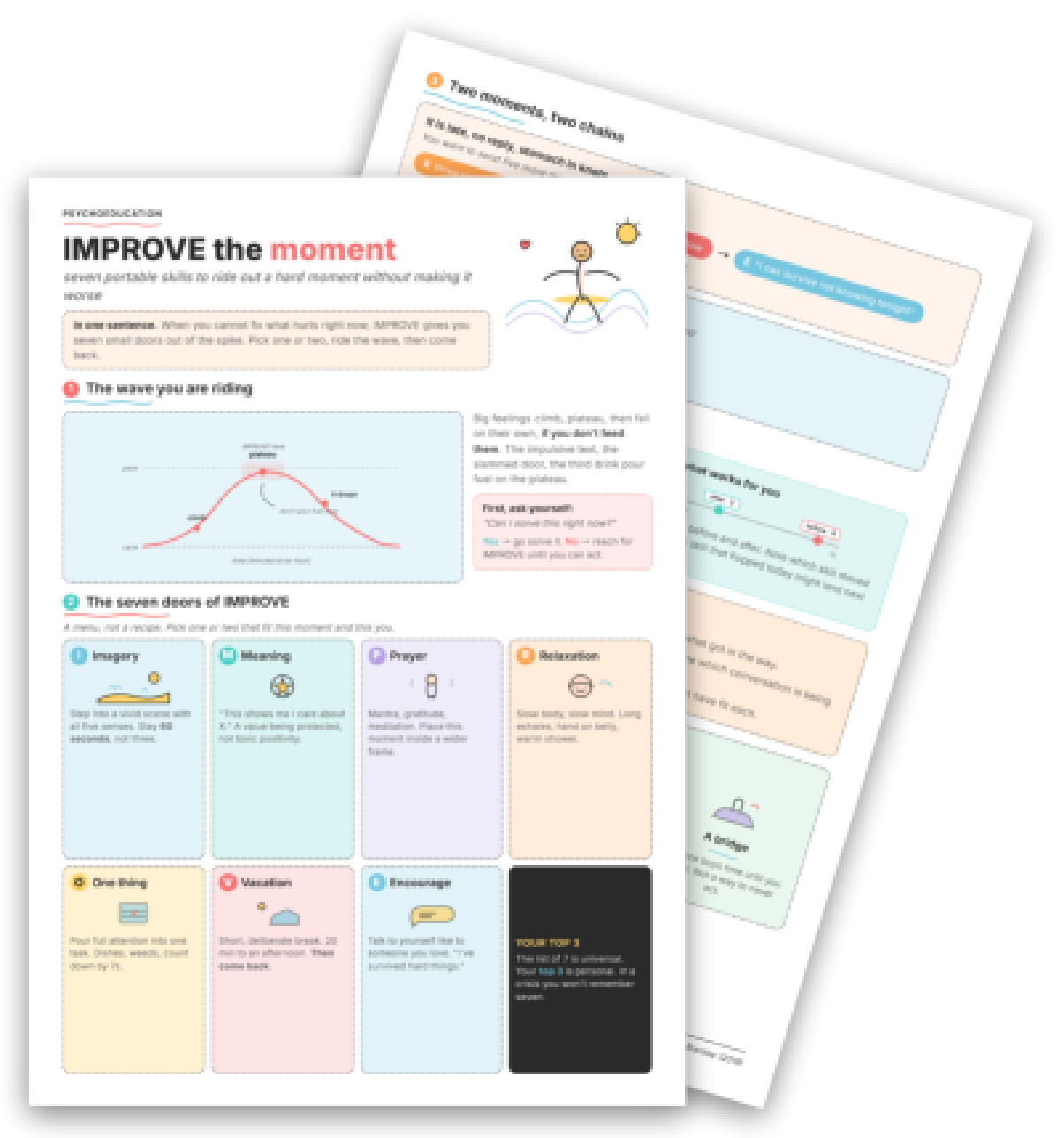
The fiche opens with the wave diagram: a curve labelled calm, climb, peak, plateau, drop, with a clear marker showing where IMPROVE sits ("IMPROVE here") and a warning at the plateau ("don't pour fuel here"). That single image does more clinical work than a paragraph of explanation. Patients can see, not just hear, that impulsive actions (the "impulsive text, the slammed door, the third drink") land precisely at the wrong moment on the curve.
Below the diagram sits a decision gate: "Can I solve this right now?" Yes leads to problem-solving; No opens the skill menu. This logical fork is the hinge the fiche makes visible.
The seven skills are then laid out as a menu with brief operational descriptors: Imagery (sixty seconds, five senses), Meaning (a value being protected, not toxic positivity), Prayer (mantra, gratitude, wider frame), Relaxation (long exhales, slow body), One thing (count down by 7s, dishes), Vacation (twenty minutes to an afternoon, then return), Encourage ("I've survived hard things"). Each entry is short enough to scan mid-distress.
Two annotated skill chains show IMPROVE applied in sequence: one for the late-night unanswered message scenario (R then V then E), one for panic in a public queue (I combined with O). These chains convert abstract concepts into observable behavioural scripts, which is precisely what an oral explanation cannot replicate.
A "Your Top 3" section, a before/after 0-to-10 rating strip, and a "Bridge, not escape" warning panel round out the fiche. The warning is clinically essential: the sheet explicitly names avoidance masquerading as tolerance ("if you keep using Vacation to dodge a conversation you actually need to have, that's avoidance, not tolerance"), which pre-empts the most common misuse. A set of "To discuss in session" prompts closes the sheet, giving you a ready debrief structure for the following appointment.
> Key takeaway: this fiche is a visual support that facilitates the explanation of IMPROVE in session, not a self-administered questionnaire. The wave diagram, the decision gate, and the skill chains show patients what a verbal explanation can only tell them.
750+ clinical tools
A library built with and for clinicians, ready to use in session and extend between appointments.
Access all the toolsWhen and How to Introduce It in Session
The fiche fits naturally into mid-treatment, once the therapeutic alliance is established and the patient has experienced at least one crisis where their go-to response made things worse. Introducing it in that context, "Last week you mentioned sending the messages anyway; let's look at what else was available in that moment", anchors the psychoeducation in lived experience rather than theory.
For patients working within a DBT framework, position the fiche alongside TIPP skills and grounding menus as part of the distress tolerance module. For patients outside a formal DBT protocol, it works equally well as a standalone tool whenever maladaptive coping patterns are a formulation focus.
A useful framing to introduce it: "This sheet maps out seven small options for when you cannot fix what is happening right now. We are going to look at it together and figure out which two or three actually fit you." Walk through the wave diagram first, then the decision gate, then let the patient identify their top three before leaving the session. The coping in crisis reference sheet and the evaluate coping strategies exercise make useful between-session complements once the patient has tried the skill in vivo.
One contraindication to flag: with patients whose primary defence is intellectualisation, the acronym structure can become an object of analysis rather than a tool. In those cases, keep the focus on the wave diagram and the two skill chains rather than the full seven-item menu.
The fiche does not replace the therapeutic frame; it makes one complex, high-stakes skill easier to explain, easier to personalise, and easier for the patient to retrieve under pressure.
Use it with your patients
Share this tool in the mobile app and follow the work between sessions.
Sources
- Linehan, M. M. (1993). Skills Training Manual for Treating Borderline Personality Disorder. Guilford Press.
- Linehan, M. M. (2015). DBT Skills Training Manual (2nd ed.). Guilford Press.
- Linehan, M. M. (2015). DBT Skills Training Handouts and Worksheets (2nd ed.). Guilford Press.
- Linehan Institute. DBT Skills Training Handouts and Worksheets.
Your session continues in your patients' pocket
Use with a patientYour resources, available everywhere
The handouts, exercises, programs and audios above: you choose which ones to make available to your patients, in the mobile app dedicated to them.
And far more than a library
The app goes well beyond resources, to support your patients every day:
Related categories
Explore other clinical resources by category.
Anxiety
Clinical hub for anxiety disorders: CBT and ACT worksheets, psychoeducation sheets, and exercises for assessment and treatment across the anxiety spectrum.

Emotions
Clinical resources on emotion regulation: worksheets, coping tools, CBT, REBT, and ACT exercises for therapists working across diagnoses and age groups.

Regulate
Clinical resources for emotion regulation: worksheets, ACT exercises, and psychoeducation tools for affect regulation across diagnoses. For clinicians.

Build skills
Skill-building resources for clinicians: printable worksheets and exercises for coping, assertiveness, and communication skills training in therapy.

DBT
DBT worksheets and exercises for clinicians: distress tolerance, emotion regulation, and interpersonal skills tools for dialectical behavior therapy practice.
Trauma
Clinical hub on trauma and PTSD: assessment, differential diagnosis, treatment phases, and printable resources for practitioners. 155 chars.