
Clinical picture. M., a man in his late thirties, presented with recurrent worry and sleep-onset difficulties; he had previously tried a meditation app and abandoned it within a week, convinced he was "doing it wrong" because his mind kept wandering. The clinician introduced the informational sheet in session, focusing on the gym-repetition metaphor: each moment of noticing a drift and returning counts as the practice, not evidence of failure. M. read the section on what mindfulness is not and said, unprompted, that he had been trying to empty his mind rather than simply observe it. By the following session he reported completing two short daily practices, describing them as "less frustrating" once he stopped expecting silence. No formal outcome measure was yet administered; the shift appeared to be largely in his expectations of the task.
What Is Mindfulness? PDF Worksheet, Tools and Exercises for Clinical Practice
A visual PDF worksheet, exercises, and tools to explain mindfulness clearly in session and give patients a concrete reference they can keep.
Clinical vignettes
Psychoeducation Before a First Formal Practice
Labelling Move With a Dysregulated Patient
Clinical picture. A., a woman in her mid-twenties with a history of emotional dysregulation, described being "taken over" by anger during conflicts and having no sense of any gap between feeling and behaviour. The clinician used the sheet's two-pillar section to introduce the labelling move, practising it briefly in session: when A. recalled a recent argument, she was invited to say aloud "I notice I am feeling angry" rather than narrating the anger as fact. She found the third-person phrasing awkward at first, though acknowledged that it produced a small but perceptible pause. Over the following weeks she began using the phrase intermittently at home, reporting that it did not reduce the anger but gave her slightly more time before responding. The clinician noted this as a modest and realistic early indicator, consistent with the sheet's framing of calm as a side effect rather than a goal.
Most patients have heard the word "mindfulness" before you say it, which makes psychoeducation harder, not easier. Pre-existing misrepresentations (emptying the mind, achieving calm, sitting for an hour) compete directly with what you are trying to establish. This PDF worksheet gives you a visual scaffold to cut through that noise and build a shared clinical vocabulary from the first time the concept comes up in session.
Use this resource with your patients
Handout, exercises and materials ready to use, right inside SessionFuel.
Why mindfulness resists verbal explanation alone
The core paradox is conceptual: you are asking a patient to stop fighting their experience while simultaneously describing a skill they need to practise. Orally, that tends to land as either trivially obvious ("just pay attention?") or frustratingly circular. Two misunderstandings are especially common in practice.
First, patients conflate awareness with suppression. When you say "notice your thoughts," many hear "push them away." Second, and more clinically costly, they interpret mind-wandering as failure, which means each attempted practice ends in self-criticism and dropout. Without a visual corrective, these two misreadings survive the session intact.
The fiche is a support visuel that externalises the concept during your explanation. You are not handing the patient a questionnaire; you are using a printed layout to point, annotate, and anchor your spoken words to something they can look at and take home.
What the worksheet contains
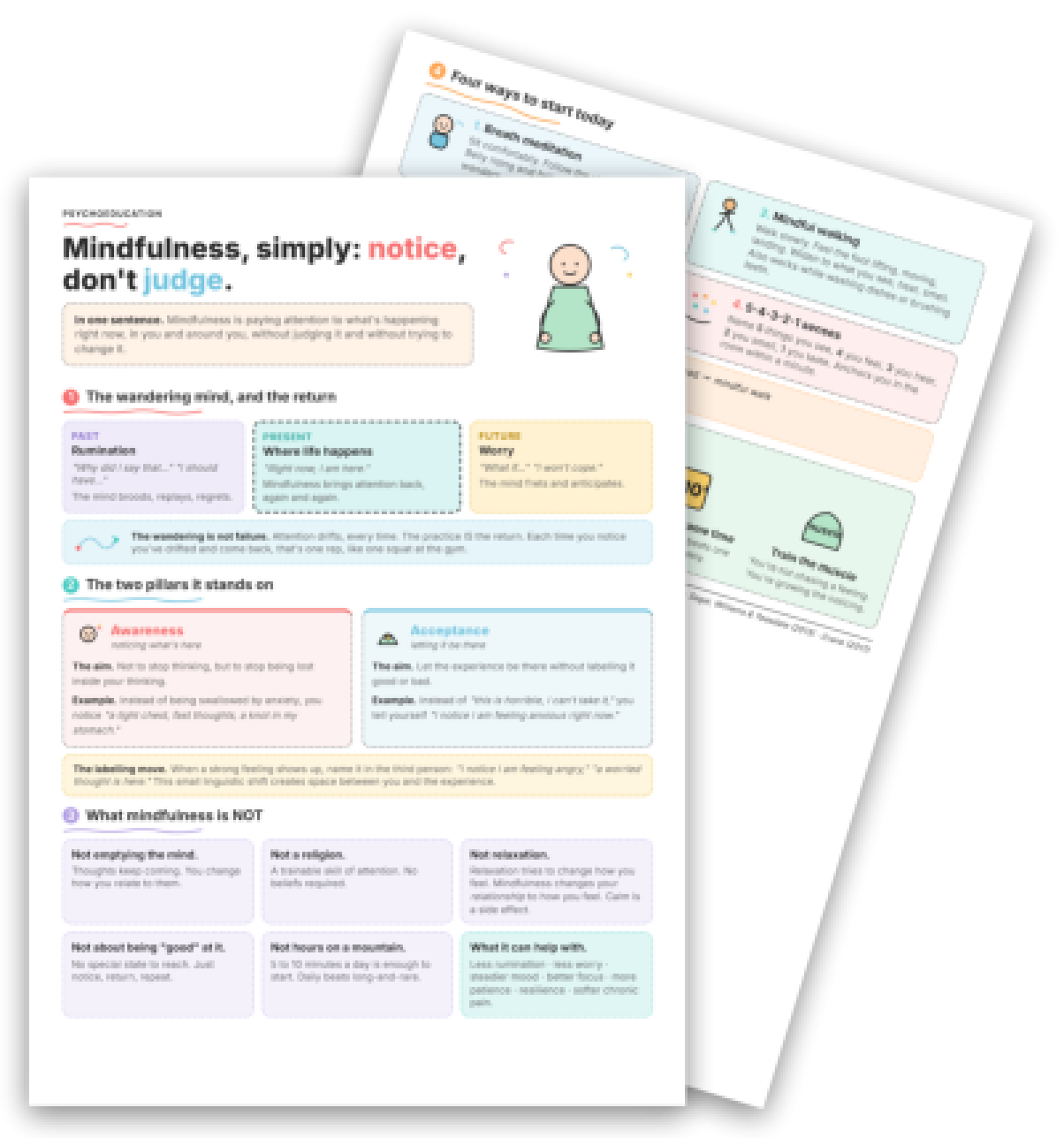
The fiche opens with a single-sentence definition: "Mindfulness is paying attention to what's happening right now, in you and around you, without judging it and without trying to change it." That sentence stays visible throughout, which matters when patients lose the thread.
Panel 1 presents a three-column diagram of the wandering mind: rumination pulling toward the past, worry projecting into the future, and present-moment awareness in the centre. The visual geometry makes the return concrete: "The practice IS the return. Each time you notice you've drifted and come back, that's one rep, like one squat at the gym." For patients prone to self-criticism, seeing this on paper, rather than just hearing it, carries more weight.
Panel 2 maps the two pillars: awareness (noticing what is here, without being lost inside the experience) and acceptance (letting the experience exist without labelling it good or bad). A brief note on the labelling move is included: naming a feeling in the third person ("I notice I am feeling angry") as a way to create distance from the experience. You can tie this directly to your work on cognitive defusion techniques in ACT or distancing and decentering without needing to restate the mechanism.
Panel 3 addresses five common misconceptions explicitly (not emptying the mind, not a religion, not relaxation, not requiring a special state, not hours on a cushion). This panel alone saves several minutes of reframing per session.
Panel 4 offers four concrete starting exercises, breath meditation, mindful walking, body scan, and the 5-4-3-2-1 senses technique, with a matching guide: "tense body → body scan / stuck in head → mindful walk / panic, overwhelm → 5-4-3-2-1 / daily training → breath." For patients continuing work at home, you can pair this with a short present-moment anchoring audio or the 5-4-3-2-1 sensory grounding exercise.
> Key takeaway: this fiche is a visual support that facilitates the explanation of mindfulness during the session itself. It is not a self-administered questionnaire; it is a clinical tool you use to make a complex concept visible, pointing to each panel as you speak.
750+ clinical tools
A library built with and for clinicians, ready to use in session and extend between appointments.
Access all the toolsWhen and how to introduce it
The fiche fits naturally at the psychoeducation stage, once the presenting problem has been formulated and you are building the treatment rationale. It is particularly well-suited to patients where rumination or worry patterns are central maintaining processes, and to any protocol with an ACT component, where psychological flexibility is an explicit goal. It also works as a primer before introducing DBT mindfulness what and how skills or the RAIN mindfulness technique.
A neutral way to introduce it: "Before we go further, I want to show you a quick overview of what mindfulness actually means clinically, because the word often comes pre-loaded with ideas that get in the way." Open the fiche on Panel 3 first if your patient seems sceptical; starting with what it is not removes resistance before it escalates.
Debrief by asking which panel surprised them most. Patients who point to the wandering-mind diagram typically have the highest dropout risk from formal practice: that is your cue to emphasise the repetition metaphor before any home assignment. Patients who focus on the misconceptions panel often need more time on the acceptance pillar before exposure or defusion work proceeds.
The fiche does not replace the therapeutic frame; it makes your explanation more precise and leaves the patient with a reference they can consult between sessions.
Use it with your patients
Share this tool in the mobile app and follow the work between sessions.
Sources
- Kabat-Zinn, J. (2013). Full Catastrophe Living: Using the Wisdom of Your Body and Mind to Face Stress, Pain, and Illness (Revised Edition). Bantam Books.
- Kabat-Zinn, J. (1994). Wherever You Go, There You Are: Mindfulness Meditation in Everyday Life. Hyperion.
Your session continues in your patients' pocket
Use with a patientYour resources, available everywhere
The handouts, exercises, programs and audios above: you choose which ones to make available to your patients, in the mobile app dedicated to them.
And far more than a library
The app goes well beyond resources, to support your patients every day:
Related categories
Explore other clinical resources by category.
Anxiety
Clinical hub for anxiety disorders: CBT and ACT worksheets, psychoeducation sheets, and exercises for assessment and treatment across the anxiety spectrum.

Mood
Evidence-based worksheets and clinical tools for mood disorders: CBT, ACT, and positive psychology resources for psychologists and therapists.

Emotions
Clinical resources on emotion regulation: worksheets, coping tools, CBT, REBT, and ACT exercises for therapists working across diagnoses and age groups.

Cognition
Printable cognitive therapy worksheets and clinical tools for therapists: CBT, ACT, schema work, defusion, distortions, and belief restructuring.

Health
Somatic health clinical resources for practitioners: worksheets, psychoeducation, and exercises for somatic symptom disorder, chronic pain, and more.

Understand
Clinical hub for the therapeutic aim 'Understand': worksheets and tools to build patient insight across CBT, ACT, schema therapy and more.