
Understand: Clinical Resources to Build Patient Insight
The therapeutic aim to understand, encompassing psychoeducation, insight cultivation, and self-knowledge, sits at the foundation of most evidence-based approaches: before a patient can change a pattern, they must first be able to name it. This category brings together printable worksheets, structured exercises, and conceptual models designed to help clinicians facilitate that foundational work across a broad range of presentations. Whether you work within CBT, ACT, schema therapy, or an integrative framework, the resources collected here support the moment in treatment when understanding becomes a clinical lever. The page is aimed at practitioners looking for structured, session-ready tools to deepen their patients' awareness of cognitive, emotional, relational, and behavioural mechanisms.

Why insight is a mechanism of change, not merely a goal
Psychoeducation and insight-building are not preparatory steps that precede "real" therapy. A robust body of research across CBT, ACT, and interpersonal approaches consistently positions patient understanding as an active ingredient of change rather than a neutral backdrop. When a patient grasps the function of a behaviour, the logic of a belief, or the developmental origin of a relational pattern, the therapeutic alliance deepens, resistance decreases, and self-monitoring becomes possible.
This does not mean delivering lectures. Effective understanding work is collaborative and Socratic: the clinician offers a framework, the patient populates it with their own experience, and the fit between model and lived reality is negotiated together. Printable tools support this exchange by giving both parties a shared referent.
The spectrum of understanding targeted in clinical work
The therapeutic aim to understand covers several distinct, though overlapping, registers. At the cognitive level, patients learn to identify automatic thoughts, cognitive distortions, and the beliefs that organise them. At the emotional level, they develop the vocabulary and bodily awareness to distinguish affect from behaviour. At the relational and developmental level, they begin to recognise how early attachment patterns and schemas shape current functioning. At the behavioural level, they map the function of coping responses, adaptive or otherwise.
These registers rarely operate in isolation. A session focused on understanding a relational conflict will often touch all four simultaneously, which is why the resources in this category span models: some are grounded in cognitive restructuring, others in schema-focused work, others in ACT's functional contextual approach.
Cognitive Models and Distortions: Core Understanding Tools
Identifying faulty inferential processes
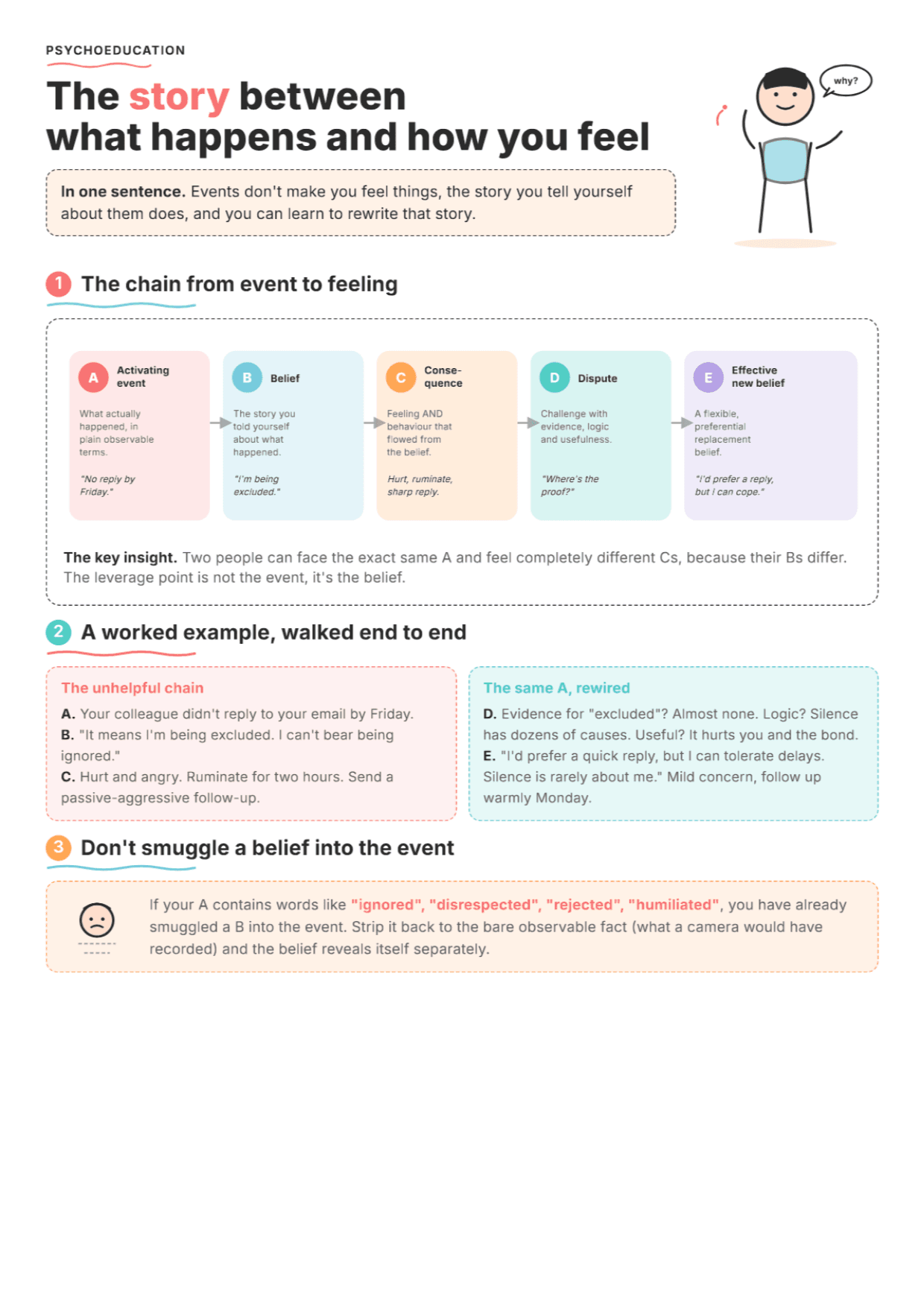
Cognitive distortions are among the most frequently targeted constructs in outpatient work, and for good reason: they are accessible, observable in session, and strongly linked to emotional dysregulation. The ABC Model (REBT): PDF Worksheet, Tools and Exercises for Clinical Practice provides a structured entry point, helping patients distinguish the activating event from the belief that mediates emotional and behavioural consequences. It is particularly useful early in treatment, when the concept of cognitive mediation is still unfamiliar.
For dichotomous reasoning specifically, the All-or-Nothing Thinking: PDF Worksheet, Tools and Exercises for Clinical Practice maps the clinical presentation of this distortion and offers guided questions to challenge its rigidity. Similarly, Mind Reading: PDF Worksheet, Tools and Exercises for Clinical Practice targets the inferential error of assuming another person's mental state, which is pervasive in social anxiety, couple conflict, and paranoid presentations.
Beliefs, schemas, and relational damage
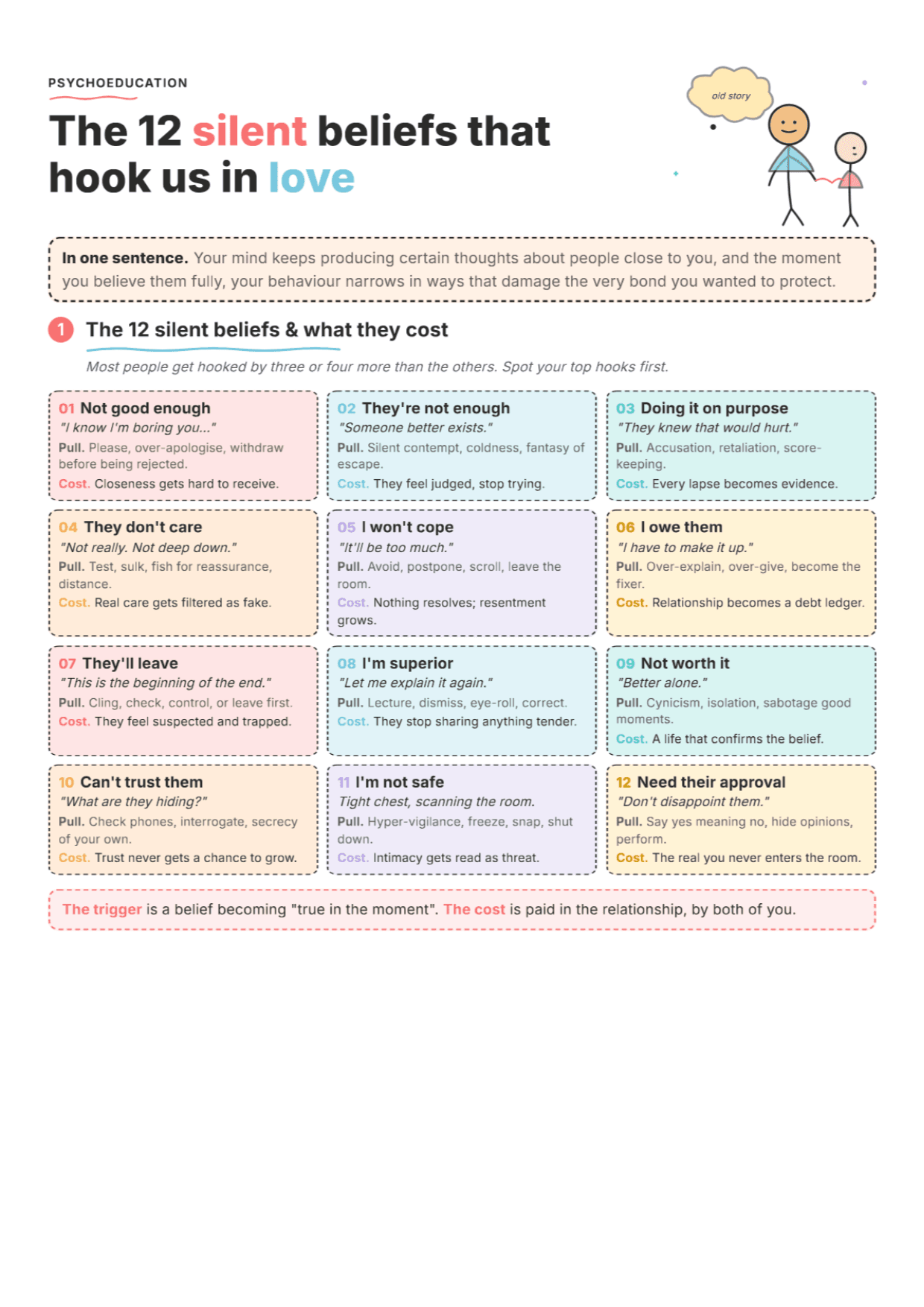
Maladaptive core beliefs are rarely articulated spontaneously. The 12 Beliefs That Damage Relationships: PDF Worksheet, Tools and Exercises supports the elicitation of deeply held interpersonal beliefs that patients often treat as unexamined facts. Paired with the The Abandonment Schema: PDF Worksheet, Tools and Exercises for Clinical Practice, which traces the phenomenology and maintenance cycle of the abandonment schema, these tools allow the clinician to move efficiently from surface complaint to core organisational structure.
ACT Frameworks: Understanding Psychological Processes
The hexaflex and schema modes as maps
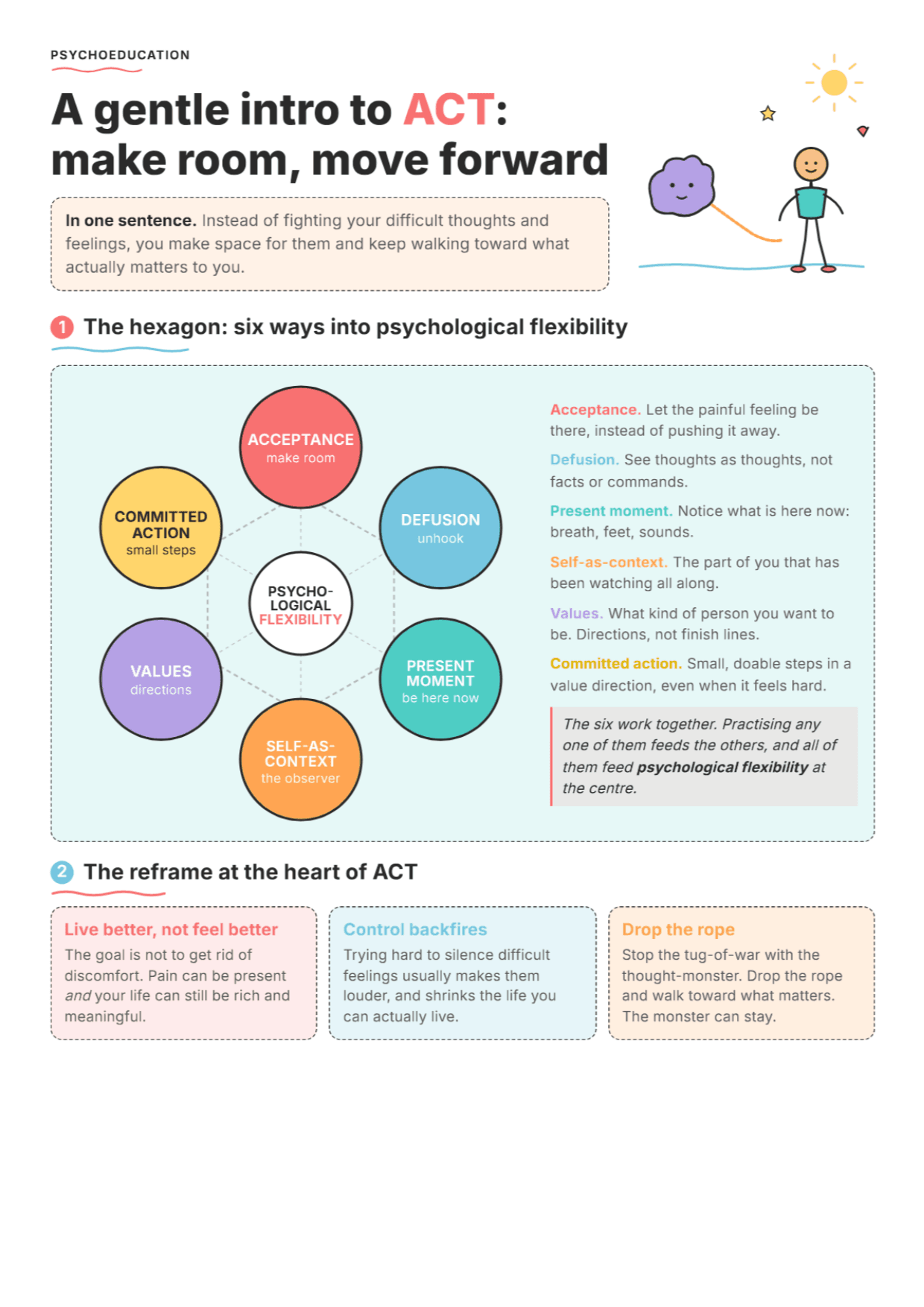
Within Acceptance and Commitment Therapy, understanding is oriented less toward content (what the thought says) and more toward function (what the thought does, and at what cost). The The ACT Hexaflex: PDF Worksheet, Tools and Exercises for Clinical Practice offers a complete visual map of the six processes targeted by ACT, making it an ideal psychoeducational anchor at any point in treatment. Patients who understand the hexaflex can begin to locate their own patterns within it, which often accelerates the transition to defusion and acceptance work.
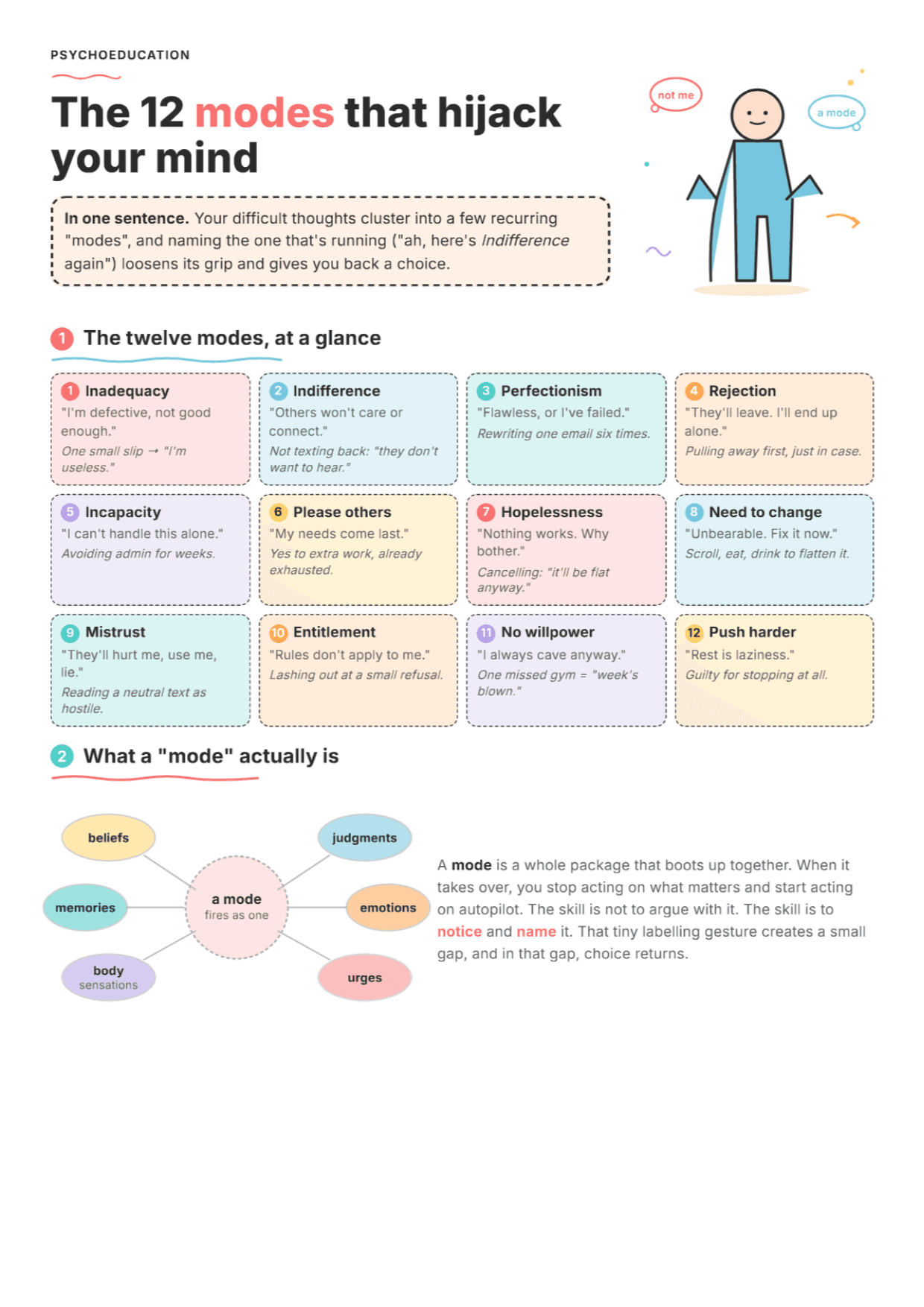
The 12 ACT Schemas and Modes of Thinking: PDF Worksheet, Tools and Exercises extends this by cataloguing the thinking modes most likely to undermine psychological flexibility. On the topic of flexibility itself, Psychological Flexibility: PDF Worksheet, Tools and Exercises for ACT Practice operationalises the construct in terms patients can engage with directly, without requiring prior familiarity with ACT theory.
Decision-making and values clarification
A less commonly emphasised facet of understanding is awareness of one's own decision-making processes, particularly at high-stakes moments. The The Choice Point: PDF Worksheet, Tools and Exercises for ACT Practice structures this reflection, helping patients identify whether a behavioural choice moves them toward or away from their stated values. This tool works well mid-treatment, once a patient has sufficient self-awareness to engage productively with the question.
Understanding Relational and Attachment Patterns
Attachment styles as clinical organising concepts
Attachment theory offers clinicians a generative framework for understanding the interpersonal difficulties that bring many patients into treatment. The Attachment Styles in Romantic Relationships: PDF Worksheet, Tools and Exercises translates attachment typology into accessible, clinically grounded language, supporting the patient in recognising their own relational style and its consequences in intimate partnerships. This fiche pairs well with work on the abandonment schema, particularly in presentations where anxious attachment and chronic reassurance-seeking are prominent.
Communication and assertiveness: understanding the interpersonal self
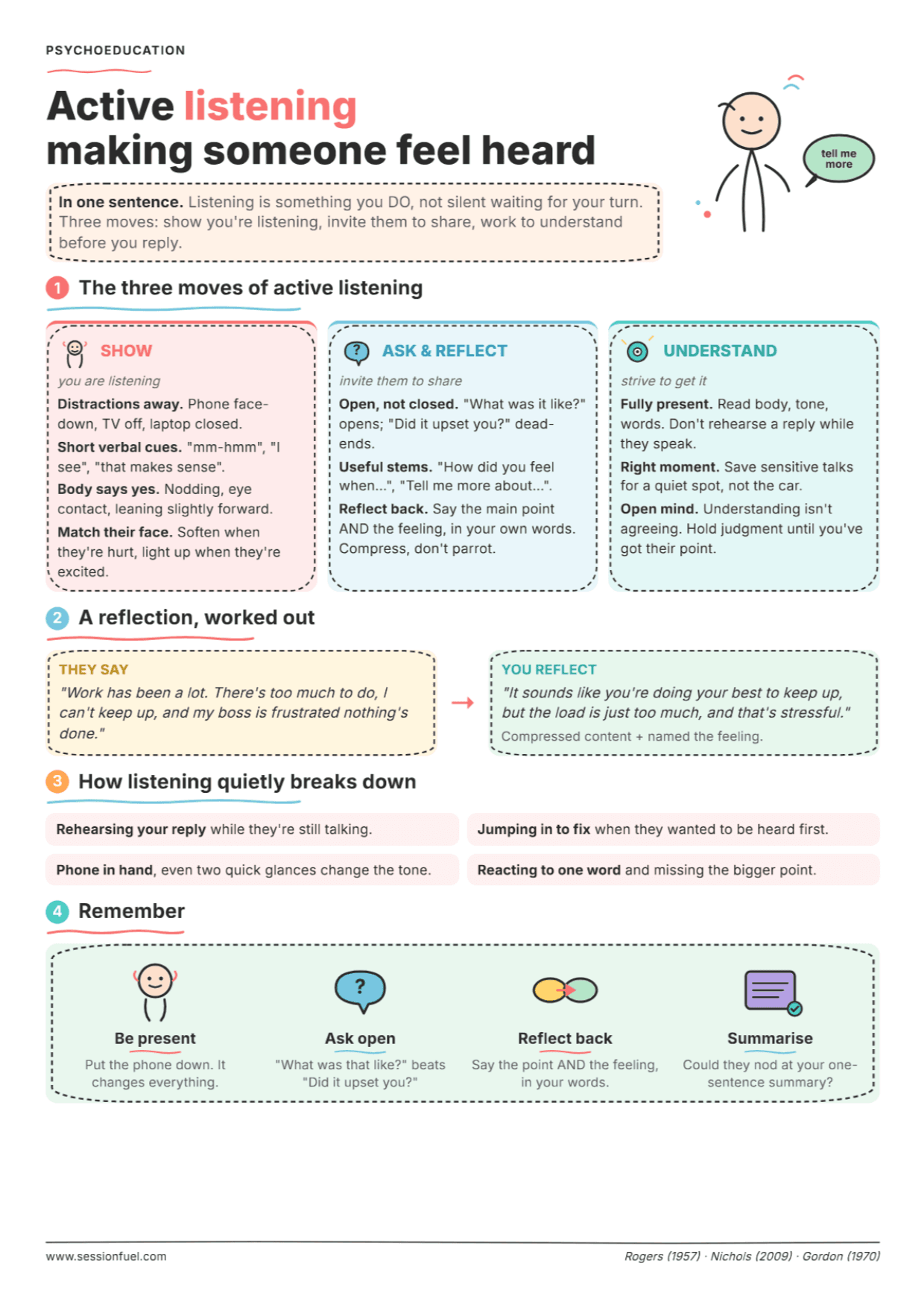
Understanding one's relational position also involves examining one's own communicative behaviour. The Assertiveness: PDF Worksheet, Tools and Exercises for Clinical Practice and the Assertive Rights: PDF Worksheet, Tools and Exercises for Clinical Practice are often most effective when introduced as psychoeducational tools before any behavioural rehearsal begins: patients need to understand what assertive behaviour actually is, and why they are entitled to it, before attempting to practise it. The Reflections: A Communication Skill, PDF Worksheet, Tools and Exercises adds a complementary lens, helping patients understand reflective listening as both a skill and an interpersonal stance.
Understanding Coping: Adaptive and Maladaptive Responses
Mapping the patient's coping repertoire
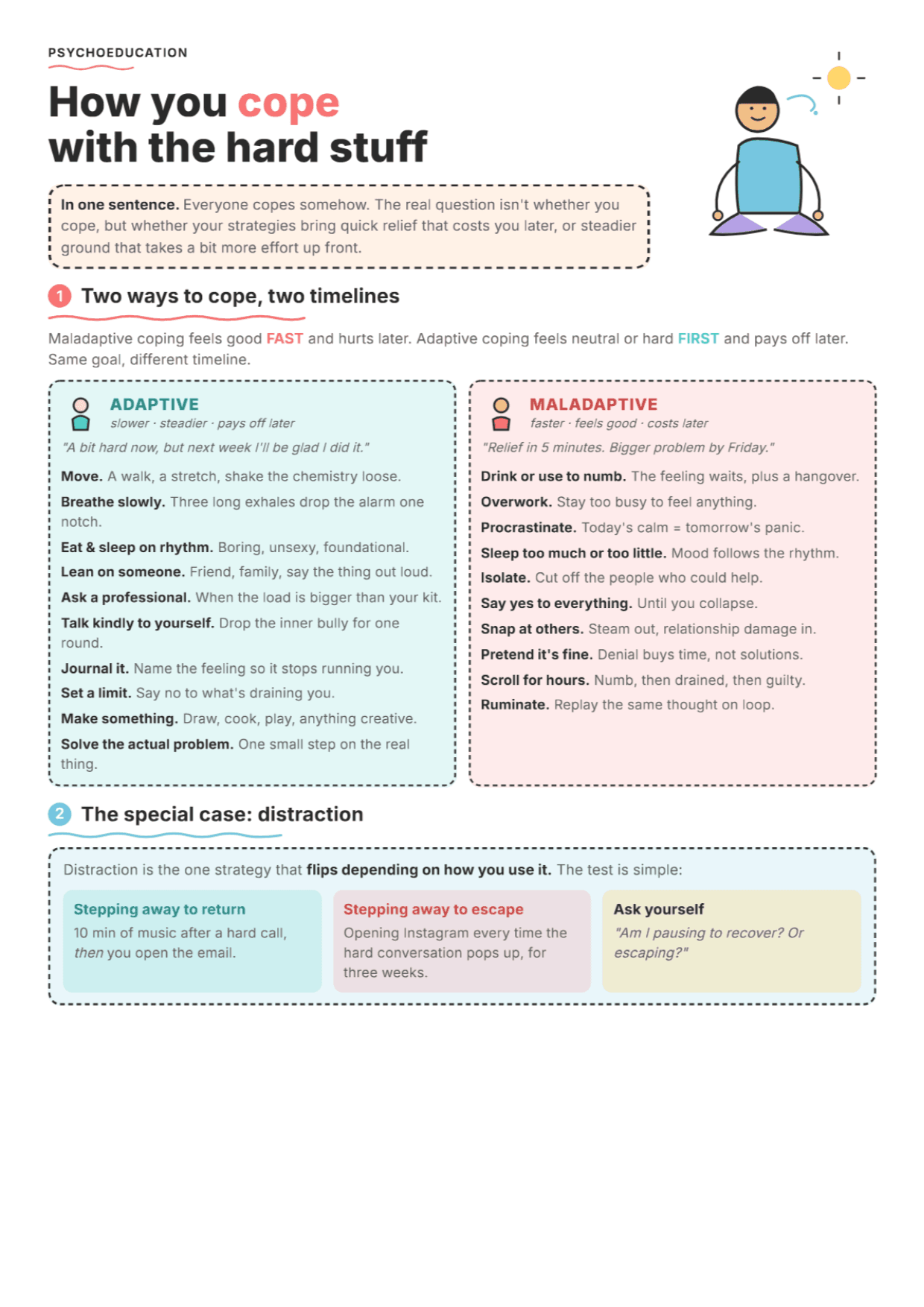
A nuanced understanding of one's own coping strategies is a prerequisite for any meaningful behaviour change. The Adaptive vs Maladaptive Coping: PDF Worksheet, Tools and Exercises supports a structured functional analysis of the strategies a patient habitually uses, distinguishing between those that regulate distress effectively and those that maintain symptom cycles. This worksheet is particularly valuable in presentations involving substance use, avoidance-based anxiety, or emotional dysregulation.
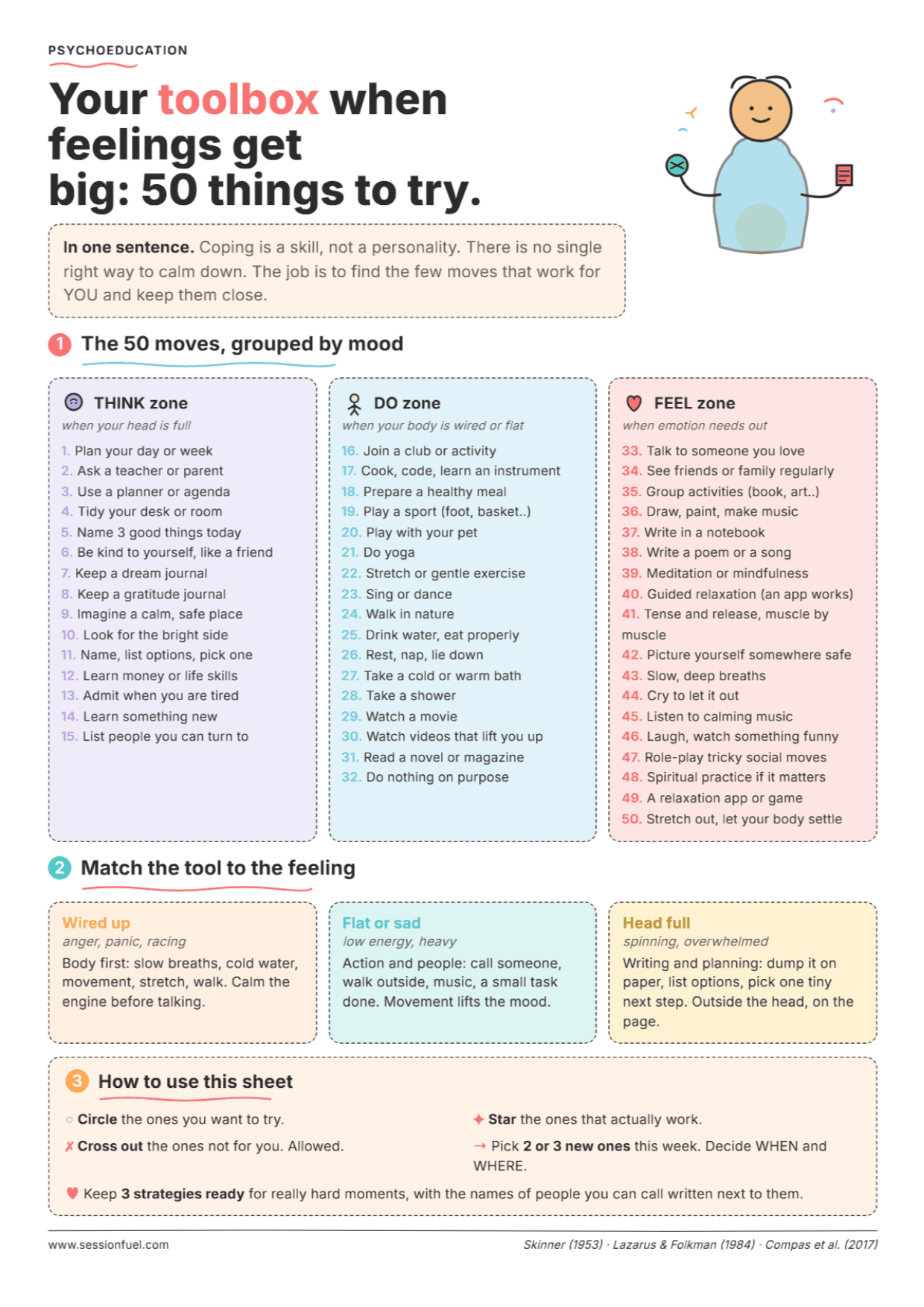
For work with younger populations, the 50 Coping Strategies for Children and Adolescents: PDF Worksheet, Tools and Exercises fulfils the same function with age-appropriate framing. Psychoeducation on coping in this population often benefits from parental involvement, and the worksheet can serve as a shared reference across individual, group, and family modalities.
Understanding anger, eating disorders, and symptom recognition
Some resources in this category target understanding at the symptom level, supporting the patient in recognising clinical presentations from the inside. The Anger Warning Signs: PDF Worksheet, Tools and Exercises for Clinical Practice addresses the somatic and cognitive prodrome of anger episodes, a frequently underexplored area in anger management work. The Anorexia: PDF Worksheet, Tools and Exercises for Clinical Practice and the CBT Model of Bulimia Nervosa: PDF Worksheet, Tools and Exercises support psychoeducation about disordered eating, using different levels of entry: the anorexia fiche emphasises recognition and phenomenology, while the bulimia model details the cognitive-behavioural maintenance cycle in a format directly usable in session.
Integrating Understanding-Focused Resources into the Care Plan
Sequencing across the treatment arc
Understanding-oriented tools are not confined to early treatment. They resurface at inflection points: when a patient encounters a new symptom domain, when treatment stalls and formulation needs revisiting, or when gains need to be consolidated before termination. The following sequence describes one common integration logic:
- Formulation phase: introduce a model fiche (ABC, hexaflex, attachment styles) to co-construct a shared framework.
- Insight deepening: use schema and belief worksheets to move from surface cognitions to organising structures.
- Functional analysis: deploy coping and anger tools to map the patient's behavioural repertoire.
- Valued directions: use choice-point and growth mindset resources to connect understanding to motivational work.
- Consolidation: revisit early psychoeducation materials to measure distance travelled and reinforce metacognitive gains.
The Adopting a Growth Mindset: PDF Worksheet, Tools and Exercises for Clinical Practice fits naturally into this final consolidation phase, helping patients frame their developing self-knowledge as an ongoing capacity rather than a static endpoint.
A brief clinical vignette
> A 34-year-old patient presents with chronic couple conflict and a history of early relational loss. In the third session, after completing the attachment styles worksheet together, she pauses and says: "So I've been reacting to my partner as if he were my father. I didn't know that was something that had a name." The clinician notes that nothing behavioural has changed yet. The understanding itself has shifted the therapeutic frame.
Clinical Limits and Points of Vigilance
When insight becomes intellectualisation
The therapeutic aim to understand carries a known risk: intellectualisation can function as avoidance. A patient who can name every cognitive distortion in their profile and still refuses to confront feared situations has not achieved change-enabling insight. Clinicians should monitor whether understanding is being used to approach experience or to substitute for it.
The answer is rarely to abandon psychoeducation, but to shift the modality: from explaining to experiencing, from naming to tracking in real time. Tools that focus on somatic awareness or in-session emotional activation complement understanding-focused resources and guard against this drift.
Pacing and readiness
Not every patient is ready for insight work at the same point in treatment. Premature psychoeducation about schemas or attachment in the context of acute crisis, active dissociation, or severe executive dysfunction can overwhelm rather than orient. The resources here are most effective when the therapeutic alliance is established, the patient has sufficient affect regulation capacity, and the clinical framing has been co-constructed rather than delivered unilaterally.
Tools in this category
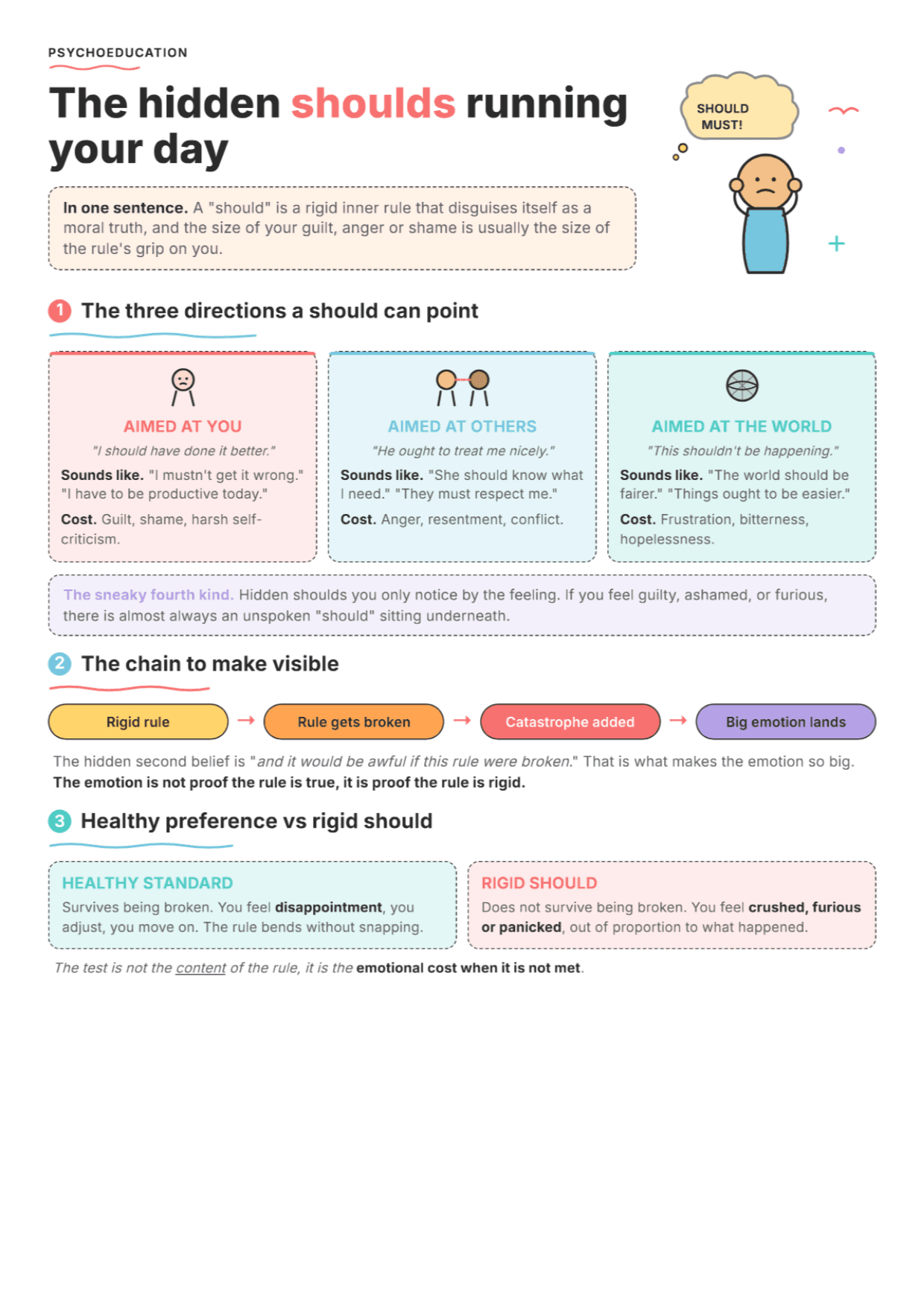
Handout
"Should" Statements: PDF Worksheet, Tools and Exercises
A printable PDF fiche to help clinicians explain rigid inner rules in session, giving patients a visual framework to identify, challenge, and soften "should" thinking.
Thoughts & cognitionAnxiety
Handout
12 ACT Schemas and Modes: PDF Worksheet, Tools and Exercises
A visual PDF worksheet with tools and exercises to help clinicians teach patients to name and defuse from their most entrenched cognitive-emotional modes in session.
Self & identityThoughts & cognition
Handout
12 Beliefs That Damage Relationships: PDF Worksheet, Tools and Exercises
A visual PDF worksheet with clinical exercises to help patients identify the silent relational beliefs driving avoidance, conflict, and emotional withdrawal in session.
RelationshipsThoughts & cognition
Handout
50 Coping Strategies for Children and Adolescents: PDF Worksheet, Tools and Exercises
A structured visual PDF worksheet with 50 coping tools organized by emotional state, to use in session with children and adolescents as a concrete psychoeducation support.
Emotions & stressAnxiety
Handout
ABC Model (REBT): PDF Worksheet, Tools and Exercises
A visual PDF worksheet presenting the full A-B-C-D-E chain to explain REBT in session: practical tools, disputation exercises, and a downward-arrow technique for cognitive restructuring.
Thoughts & cognitionEmotions & stress
Handout
Acceptance and Commitment Therapy: PDF Worksheet, Tools and Exercises
A printable psychoeducation sheet introducing the ACT model to patients: the hexaflex, key reframes, stuck patterns, and six concrete exercises to try between sessions.
Self & identityEmotions & stress
Handout
Active Listening Skills: PDF Worksheet, Tools and Exercises
A visual psychoeducation worksheet helping clinicians teach the three concrete moves of active listening, from behavioral cues to reflective responses, in session.
Relationships
Handout
Adaptive vs Maladaptive Coping: PDF Worksheet, Tools and Exercises
A visual psychoeducation worksheet with tools and exercises to explain coping timelines, the relief-cost loop, and build function-matched replacements with patients in session.
AnxietyMood & depression
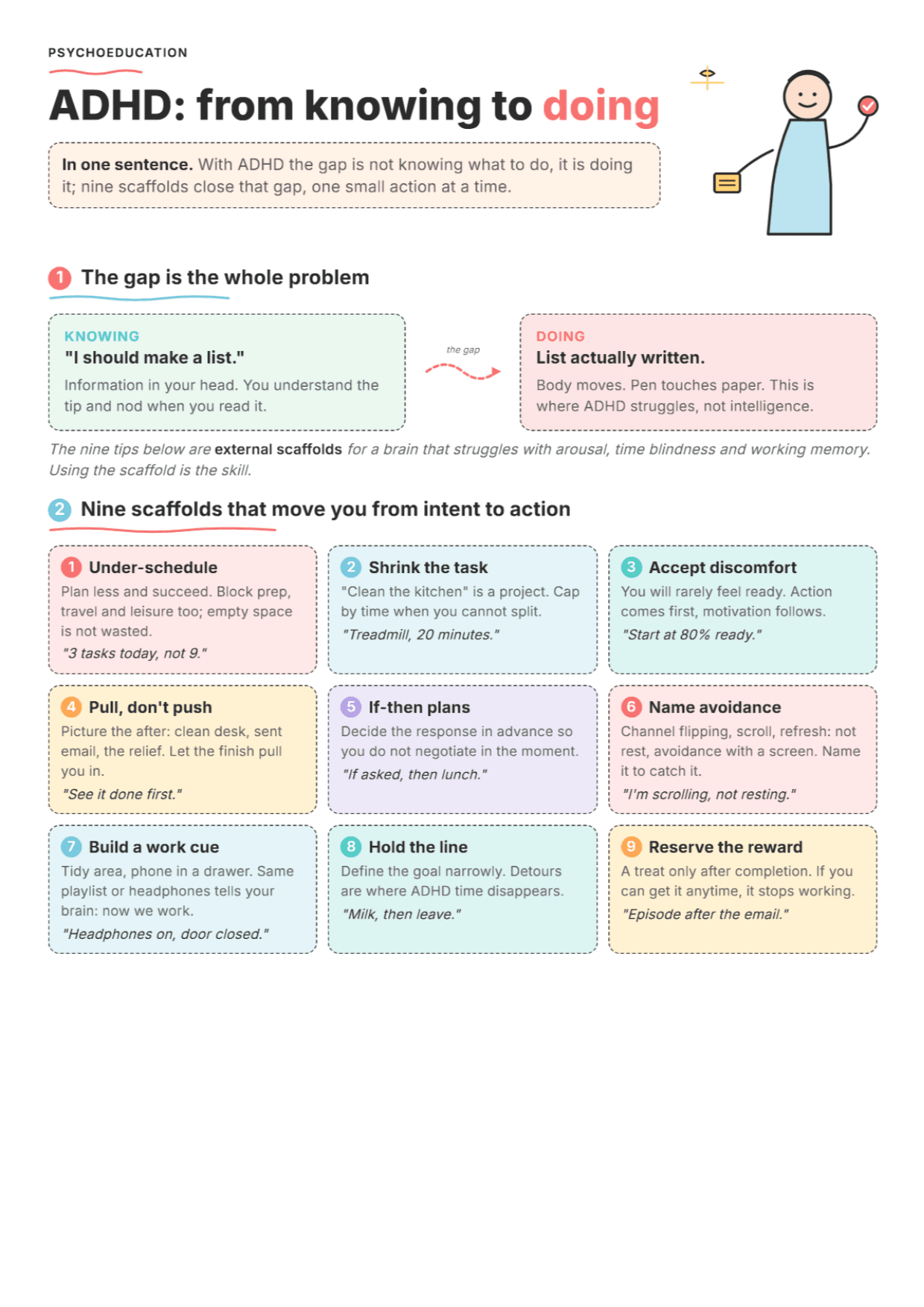
Handout
ADHD Management Tips: PDF Worksheet, Tools and Exercises
A visual PDF worksheet with nine concrete scaffolds to help clinicians explain the knowing-doing gap in ADHD and give patients a practical take-home reference.
NeurodevelopmentBehaviours & addictions