
Clinical picture. M., a woman in her late thirties, presented with recurrent conflict in her long-term partnership, describing cycles of reassurance-seeking followed by cold withdrawal that neither she nor her partner could fully explain. In session, the clinician introduced the informational sheet on the twelve beliefs and invited her to read through it without pressure to self-diagnose. M. paused at belief 04 ("They don't care") and remarked, quietly, that she had never seen that pattern named before. Over the following two sessions she was able to identify how that belief drove her to manufacture tests of her partner's commitment, and to observe that the tests were producing exactly the distance she feared. No resolution was reached quickly, but naming the hook gave her something concrete to bring to couples work.
12 Beliefs That Damage Relationships: PDF Worksheet, Tools and Exercises
A visual PDF worksheet with clinical exercises to help patients identify the silent relational beliefs driving avoidance, conflict, and emotional withdrawal in session.
Clinical vignettes
Psychoeducation Surfaces a Core Hook
When Contempt Has a Label
Clinical picture. T., a man in his mid-forties, was referred following a period of marital estrangement; he described his wife as consistently falling short, though he acknowledged she had changed her behaviour repeatedly at his request. The clinician offered the worksheet as a shared reading exercise rather than a confrontation, framing it as material many people find useful to scan for personal relevance. T. identified belief 02 ("Someone better exists") with some discomfort, noting that he had always attributed his dissatisfaction to genuine incompatibility. The psychoeducation did not resolve his ambivalence, but it shifted the clinical conversation from external attribution to internal process, making ACT-based defusion work more accessible in subsequent sessions.
Patients rarely arrive saying "I have a belief that my partner will leave." They arrive saying their partner is cold, that arguments never resolve, that they feel constantly on guard. Naming the cognitive-relational mechanics beneath those complaints, in a way that lands rather than lectures, is one of the harder tasks of early-to-mid formulation work. This fiche PDF makes that task faster and more precise by giving you a shared visual map to work from the moment you open it in session.
Use this resource with your patients
Handout, exercises and materials ready to use, right inside SessionFuel.
Why Relational Beliefs Are So Difficult to Explain Verbally
The clinical challenge is not that patients lack insight. It is that the belief fires and disappears before they can catch it. By the time they report a conflict in session, what they remember is the emotion and the behaviour, not the micro-second appraisal that set everything in motion. A purely verbal explanation of fusion or experiential avoidance in a relational context tends to feel abstract or, worse, pathologising.
There is also a specificity problem. Concepts like the abandonment schema or attachment style patterns in couples carry genuine clinical weight, but asking a patient to identify which one applies to them without a structured prompt often produces vague answers. The fiche PDF solves both problems at once: it externalises the belief set onto a page, so the patient can point rather than introspect under pressure.
What the Fiche Contains: A Visual Taxonomy of 12 Relational Beliefs
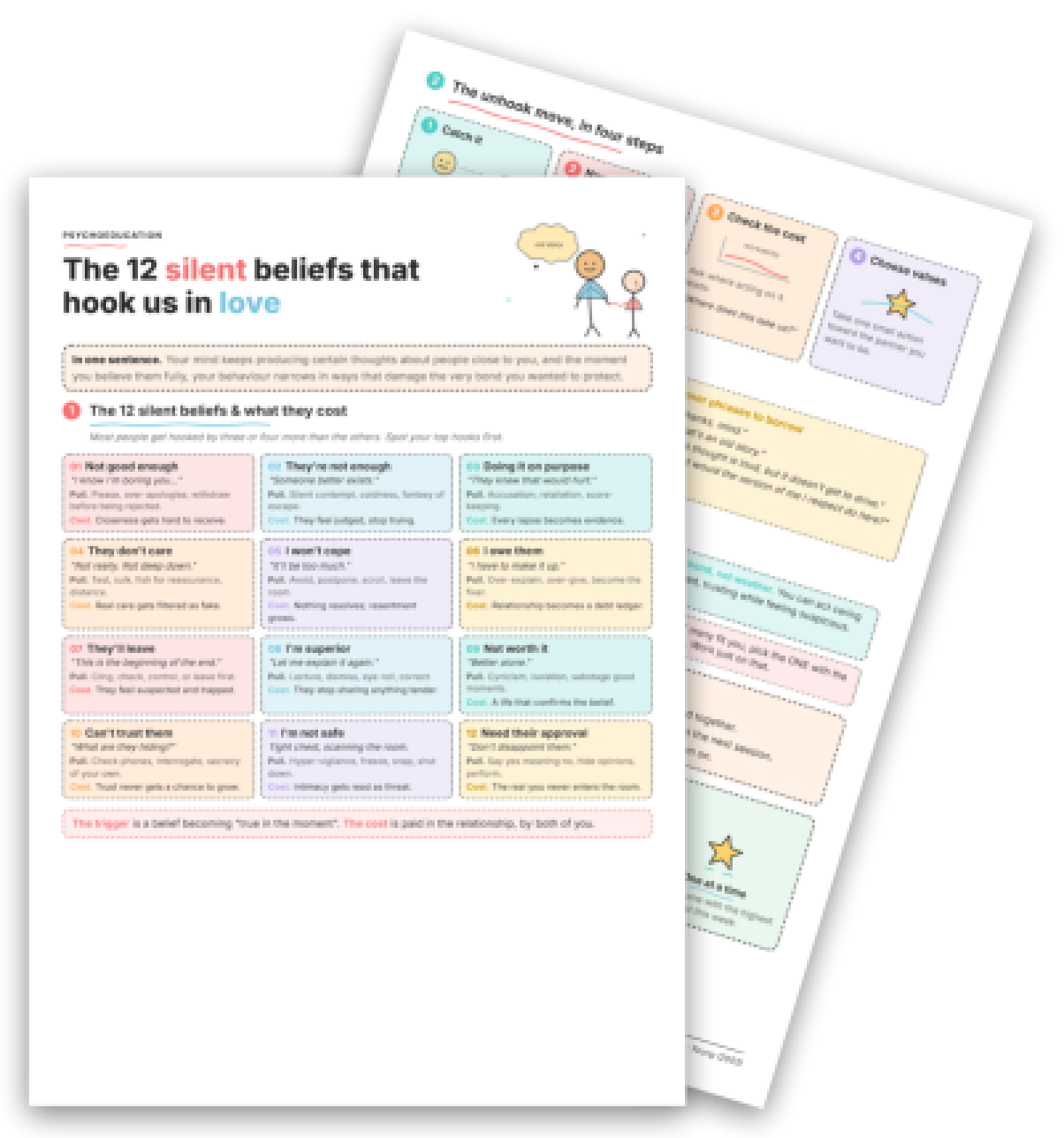
The fiche is organised across four panels. Panel 1 is its clinical core: a structured taxonomy of twelve named beliefs, each presented with a typical thought, a behavioural pull, and a relational cost. The range is deliberate, covering beliefs rooted in self-inadequacy ("Not good enough", "I won't cope"), beliefs about the partner ("They don't care", "They're not enough"), and beliefs that operate through hypervigilance or approach-avoidance dynamics ("I'm not safe", "They'll leave"). For each entry, the fiche makes the workability question visible: not "is this belief true?" but "where does acting on it take you both?"
> Key point: This fiche is not a self-report questionnaire. It is a visual support that facilitates the explanation of relational fusion in session, giving patient and clinician a concrete shared reference rather than an abstract psychoeducational monologue.
Panel 2 introduces a four-step unhook move, grounded in ACT defusion work and closely aligned with the Choice Point model: catch the belief, label it as a thought rather than a fact, check the relational cost, and redirect toward a values-based action. Panel 3 provides a worked example and a short set of inner phrases to borrow ("That's an old story." / "This thought is loud, but it doesn't get to drive."), which function as ready-made defusion scripts patients can rehearse between sessions. Panel 4 names four counter-intuitive points that frequently produce productive friction in session, including the key ACT reframe: "Not about removing the belief. These thoughts come back. The goal is to stop letting them choose your behaviour."
The fiche closes with a "To discuss in session" block, giving you three structured prompts to anchor the debrief.
750+ clinical tools
A library built with and for clinicians, ready to use in session and extend between appointments.
Access all the toolsWhen and How to Introduce It
This fiche is well-placed from session two or three onward, once you have enough of the relational pattern to hypothesise which beliefs are operating. It works particularly well in individual therapy focused on relational difficulties, in couples communication work, and alongside healthy relationship psychoeducation programs.
A low-stigma introduction might sound like: "I'd like to show you a map of twelve beliefs that often show up in close relationships. Most people recognise three or four that feel very familiar. Have a look and tell me which ones land." This immediately shifts the patient from feeling assessed to feeling recognised. You can follow their selection directly into tracing the relational origins of the core belief or into clarifying which core belief currently carries the highest cost.
For patients presenting with fear of being left or trust rupture, the fiche works as a normalising frame before heavier schema or EMDR work begins. It pairs naturally with psychological flexibility exercises and with the ACT schemas and modes of thinking overview when a broader psychoeducation arc is needed.
One limit worth noting: with patients whose fusion is ego-syntonic or who are highly intellectualised, the four-step model in Panel 2 can land as too neat. In those cases, use Panel 1 for mapping and defer the unhook work to a later session once the belief cost has been felt, not just understood.
The fiche does not replace formulation or the therapeutic relationship. What it does is compress a complex ACT-informed psychoeducation sequence into a single page, leaving the patient with a concrete visual reference they can return to between sessions, and return to in the next one.
Use it with your patients
Share this tool in the mobile app and follow the work between sessions.
Sources
- Harris, R. (2019). ACT Made Simple: An Easy-to-Read Primer on Acceptance and Commitment Therapy. New Harbinger Publications.
- Harris, R. (2023). ACT with Love: Stop Struggling, Reconcile Differences, and Strengthen Your Relationship with Acceptance and Commitment Therapy. New Harbinger Publications.
- Young, J. E., Klosko, J. S., Weishaar, M. E. (2003). Schema Therapy: A Practitioner's Guide. Guilford Press.
- Hayes, S. C., Strosahl, K. D., Wilson, K. G. (2012). Acceptance and Commitment Therapy: The Process and Practice of Mindful Change. Guilford Press.
Your session continues in your patients' pocket
Use with a patientYour resources, available everywhere
The handouts, exercises, programs and audios above: you choose which ones to make available to your patients, in the mobile app dedicated to them.
And far more than a library
The app goes well beyond resources, to support your patients every day:
Related categories
Explore other clinical resources by category.

Identity
Clinical resources for self-identity work in therapy: CBT, ACT, schema tools for clinicians addressing self-concept, core beliefs, and identity disruption.

Relationships
Clinical worksheets and tools on relational functioning: attachment, schemas, assertiveness, and communication skills for therapists. Printable PDF resources.

Cognition
Printable cognitive therapy worksheets and clinical tools for therapists: CBT, ACT, schema work, defusion, distortions, and belief restructuring.

Understand
Clinical hub for the therapeutic aim 'Understand': worksheets and tools to build patient insight across CBT, ACT, schema therapy and more.

Build awareness
Clinical worksheets and tools to build awareness in therapy: cognitive distortions, schemas, emotions, ACT and CBT resources for practitioners.

Restructure
Clinical hub for cognitive restructuring worksheets: distortion identification, belief disputation, ABC model, and schema work for evidence-based practice.