
Clinical picture. M., a woman in her early 30s, presented with residual anxiety and low self-esteem following the end of a controlling long-term relationship. Her clinician introduced the Healthy Relationship psychoeducation program between sessions, starting with Lesson 1 on the four pillars of a healthy relationship. M. completed the guided prompt on boundaries, writing that she had difficulty distinguishing her own limits from those she had adopted to appease her former partner. In the subsequent session, this written reflection opened a productive discussion on boundary-setting and self-assertion that would have been harder to initiate without a concrete anchor. Progress was modest but measurable: M. began articulating one or two personal limits she wished to uphold in future relationships.
Healthy Relationships: A Psychoeducation Program for Clinicians
A structured 4-lesson program to help patients understand the foundations of a healthy romantic relationship, step by step.
Clinical vignettes
Revisiting Boundaries After a Conflictual Relationship
Addressing Control Patterns in Couples Work
Clinical picture. T., a man in his mid-40s seen individually alongside couples therapy, reported persistent tension around predictability and trust in his current relationship. His clinician assigned Lesson 2 of the Healthy Relationship program, which addresses letting go of control and self-knowledge, asking T. to complete the reflection prompt on what he might relinquish managing. T. returned the following week having written a short list, noting surprise at recognising how much cognitive load his controlling behaviour cost him personally. The clinician used this material to connect T.'s need for predictability to early relational experiences, deepening the therapeutic work without introducing new psychoeducational content prematurely. T. described a small but concrete change: he had stopped checking his partner's schedule daily for the first time in years.

Use this resource with your patients
Handout, exercises and materials ready to use, right inside SessionFuel.
What makes this concept clinically tricky
Every patient who comes in with relational difficulties carries a personal theory of what love is supposed to look like, and that theory is rarely examined. Misconceptions about conflict, communication, and intimacy are woven so tightly into everyday thinking that a brief oral explanation rarely dislodges them. When you tell a patient that arguments can be constructive, or that "clicking naturally" is not a relationship maintenance plan, you often meet polite agreement followed by no change. The resistance is not defiance; it is that abstract relational principles need to be processed slowly, applied personally, and revisited more than once before they shift behavior.
This is where a structured self-paced program earns its place. Rather than relying on what you can convey in the last five minutes of a session, you assign a progressive curriculum the patient works through on their own, returning with personal reflections you can then explore clinically. For patients working on trust in their relationship, communication patterns, or long-term relational health, this kind of scaffolding makes your clinical work far more efficient.
What the program contains
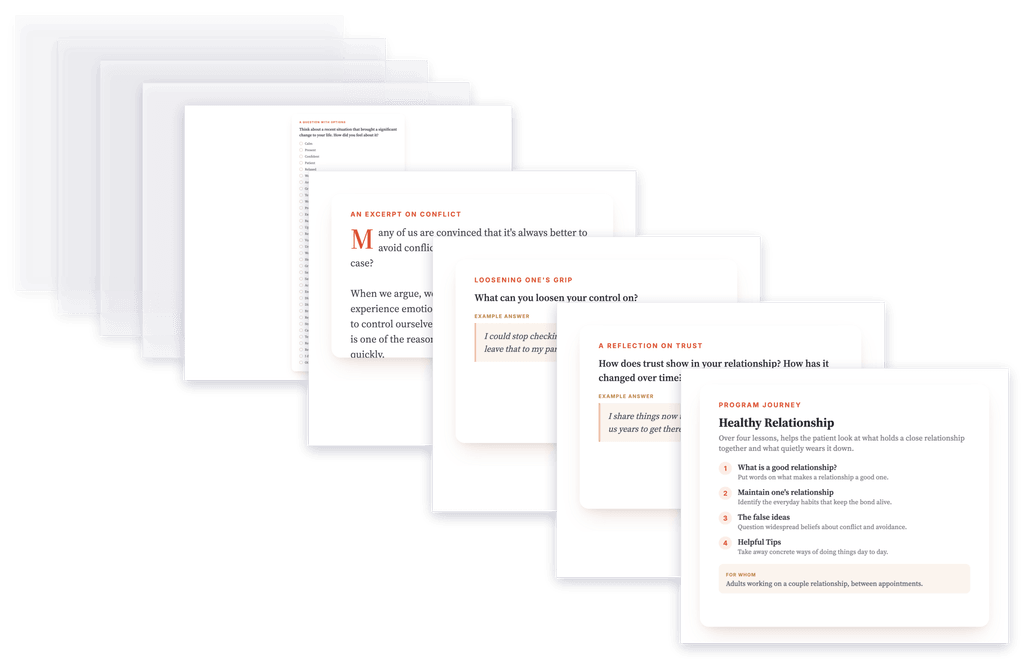
The program is organized into four sequenced lessons, each building on the previous one.
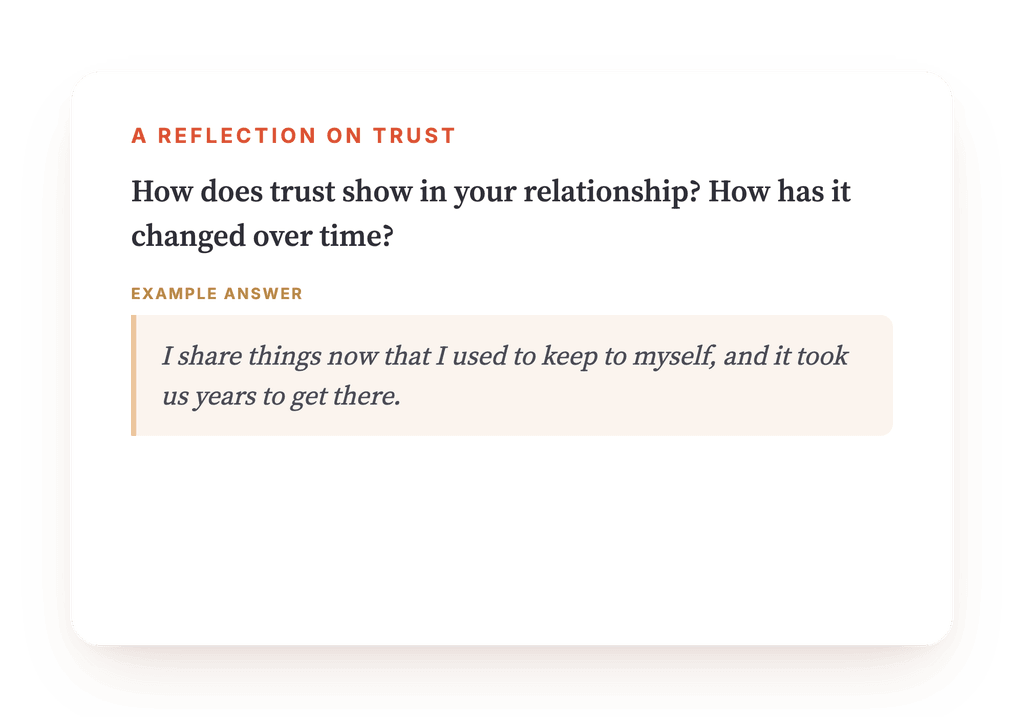
Lesson 1 introduces the four pillars of a healthy relationship: trust, boundaries, communication, and consent. Patients are not just given definitions, they are prompted to examine how trust has evolved in their own relationship, to articulate their partner's limits and their own, and to name the situations where they want to improve how they communicate. Consent is treated broadly, covering emotional and behavioral dimensions as well as physical intimacy.
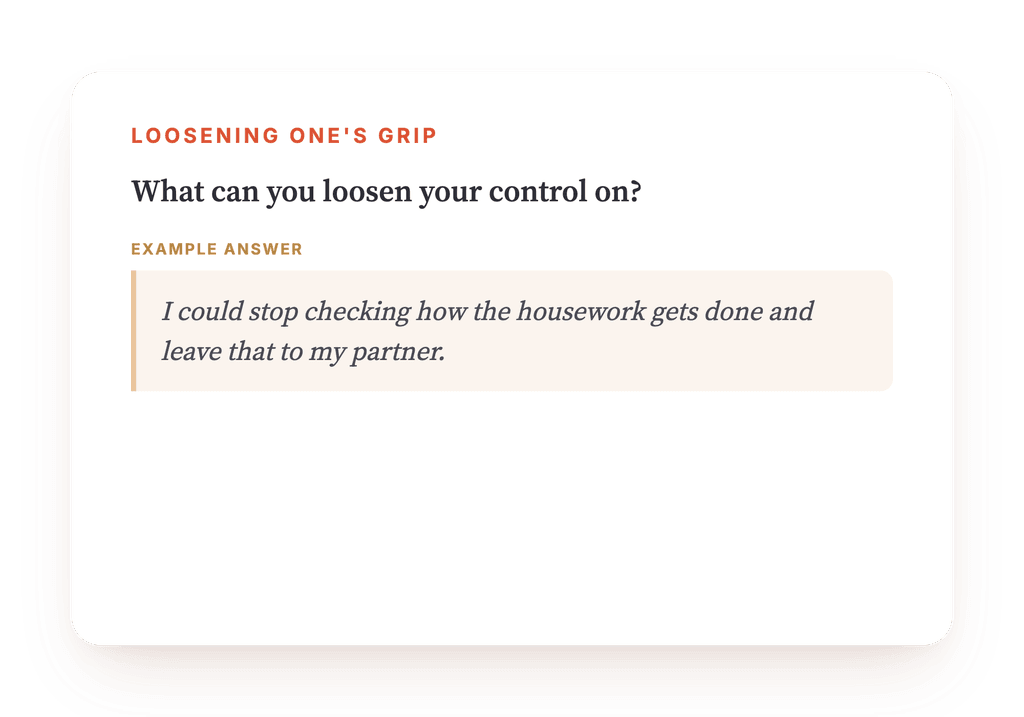
Lesson 2 focuses on maintaining the relationship over time through three key behaviors: releasing excessive control, developing self-knowledge, and embracing relational growth. A guided prompt asks patients to reflect on past experiences, their own and their partner's, that may still be shaping current behaviors. This step connects naturally to work on attachment styles, setting personal boundaries, and behavior and underlying needs.
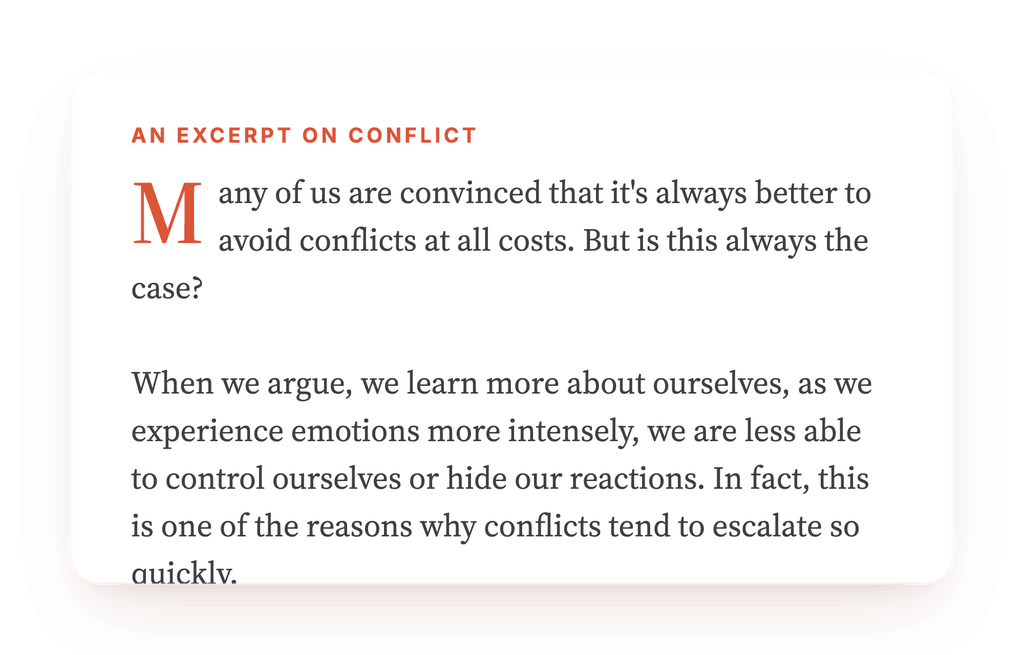
Lesson 3 targets four common relational misconceptions: that conflict is always harmful, that communication becomes unnecessary with familiarity, that love sustains itself without effort, and that neglecting intimacy is inconsequential. A reflection prompt on the patient's most recent argument invites reappraisal of conflict rather than avoidance, a reframe that pairs well with your work using the Conflict in Romantic Relationships program or the Ten Principles for Healthy Conflict worksheet.
Lesson 4 closes with four practical strategies: quality time, openness to change, emotion regulation in the relational context, and reciprocity. A multiple-choice emotional check-in around a recent change event gives patients a concrete vocabulary for their internal experience. The lesson on reciprocity is notably subtle: it is not about accounting for favors, but about perceiving shared effort, a distinction worth unpacking with patients who tend toward the self-sacrifice schema.
This program is available to patients through the mobile application that is the patient-side interface of SessionFuel: once you assign it in SessionFuel, your patient receives and completes each lesson directly on their phone, on their own, between appointments.
The preview images embedded here, an overview map and a couple of sample cards, show only a small fraction of the program. The complete curriculum contains many more lessons, steps, guided prompts, and reflection exercises than what these aperçus display.
Key insight: The program's value lies in its arc: it moves patients from defining the basics (what a healthy relationship actually requires) through examining their own patterns, to correcting misconceptions, and finally to actionable habits, a progression that mirrors solid psychoeducation logic.
750+ clinical tools
A library built with and for clinicians, ready to use in session and extend between appointments.
Access all the toolsHow to integrate it into your practice as between-session homework
Which patients: This program suits couples in individual or conjoint therapy, single patients reflecting on a past or current relationship, and those who struggle to articulate what a relationship should feel like, particularly patients with abandonment schema tendencies, approval-seeking patterns, or a history of relationships that lacked secure attachment. It also works well as a first structured step for patients who are highly motivated but cognitively overwhelmed when relational topics are raised verbally.
How to introduce it: Frame it simply as homework, a step-by-step program they complete between sessions, at their own pace. You might say: "Between now and our next meeting, I am going to assign you the first two lessons. There are short reflection prompts inside; just answer them as honestly as you can. We will look at what comes up when we meet." Pairing the first lesson with the Relationship Green Flags worksheet or the Relationship Maintenance Behaviors fiche can provide an immediate visual anchor.
How to use what the patient brings back: The guided prompts, on how trust has evolved, on what the patient can relinquish control over, on what their relationship has given them so far, on what they drew from their last argument, are rich clinical material. Treat the patient's written answers as a springboard rather than a report. A patient who writes "nothing" in response to a prompt about relational growth is giving you as much information as one who fills the page. Lesson 4's emotion check-in around change can open productive work on emotion regulation or on assertive communication if the patient identifies anxiety or resistance. Pairs naturally with the Weekly Couples Relationship Check-In exercise and the Relational Gratitude exercise for patients who need continued between-session reinforcement.
Use it with your patients
Share this tool in the mobile app and follow the work between sessions.
Articulation with adjacent tools
Once patients have completed this program, the Compromise in Relationships program and the Relationship Compatibility program extend the work naturally. For patients where communication breakdowns dominate, the Nonviolent Communication for Couples worksheet and the Soft Startups for Couples fiche give concrete language for what the program describes in principle. Patients whose reflection prompts reveal a pattern of emotional suppression may benefit from the Expressing Vulnerability in Relationships worksheet as a complementary assignment.
Your session continues in your patients' pocket
Use with a patientYour resources, available everywhere
The handouts, exercises, programs and audios above: you choose which ones to make available to your patients, in the mobile app dedicated to them.
And far more than a library
The app goes well beyond resources, to support your patients every day:
Related categories
Explore other clinical resources by category.

Relationships
Clinical worksheets and tools on relational functioning: attachment, schemas, assertiveness, and communication skills for therapists. Printable PDF resources.

Understand
Clinical hub for the therapeutic aim 'Understand': worksheets and tools to build patient insight across CBT, ACT, schema therapy and more.

Build skills
Skill-building resources for clinicians: printable worksheets and exercises for coping, assertiveness, and communication skills training in therapy.

Integrative
Integrative therapy clinical resources: worksheets, psychoeducation programs, and exercises for eclectic, multimodal practice across orientations.

Anxiety
Clinical hub for anxiety disorders: CBT and ACT worksheets, psychoeducation sheets, and exercises for assessment and treatment across the anxiety spectrum.
Trauma
Clinical hub on trauma and PTSD: assessment, differential diagnosis, treatment phases, and printable resources for practitioners. 155 chars.