
Clinical picture. L. and M., a couple in their late thirties, presented after several months of escalating arguments about household labour, with L. reporting a pervasive sense of being unseen and M. describing feeling perpetually accused. During a conjoint session, the clinician introduced the NVC informational sheet and walked the couple through the four-step grammar using one of L.'s habitual complaints as raw material. L. worked through the rewrite aloud, moving from "you never do anything around here" to an observation, a feeling, a need, and a concrete, refusable request. M. noted that the revised phrasing felt less like a verdict and was able to respond to the need rather than defend against the accusation. The couple left with the worksheet and an agreement to attempt one written NVC exchange before the next session.
Nonviolent Communication for Couples: PDF Worksheet, Tools and Exercises
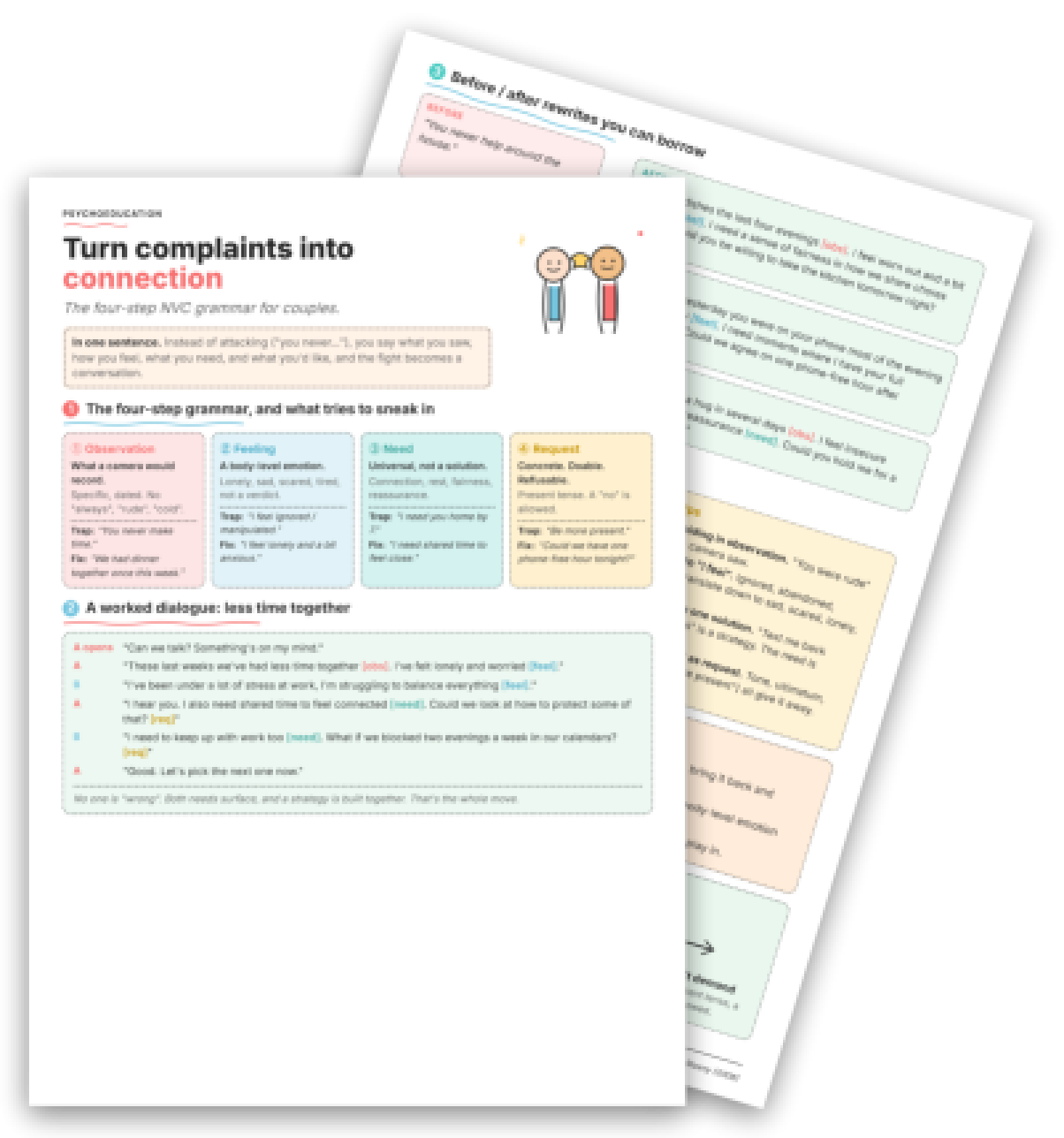
A printable fiche grounding the four-step NVC grammar in couples work, giving clinicians a precise visual support to introduce observation, feeling, need, and request without the model collapsing mid-session.
Clinical vignettes
NVC Worksheet Reframes a Recurring Complaint
Shifting From Demand to Dialogue in Session
Clinical picture. T., a 44-year-old in individual therapy for anxiety, raised a pattern of conflict with their partner centred on perceived emotional distance, describing their usual opening as "you make me feel ignored." The clinician used the NVC sheet to distinguish feeling-words that function as verdicts from those that name a body-level state, and T. practised reformulating the complaint as loneliness tied to an unmet need for reassurance. T. identified a specific, time-limited request to offer the partner rather than a global demand for more presence. At the following session T. reported that the partner had responded with curiosity rather than withdrawal, and that the conversation had continued past the usual point of shutdown.
Explaining Nonviolent Communication to a couple verbally almost always loses something in translation: one partner nods while already drafting a counter-argument, and by the time you reach "need," both have forgotten what "observation" actually meant. This fiche PDF exists to anchor the model visually so the grammar lands intact rather than dissolving into goodwill alone.
Use this resource with your patients
Handout, exercises and materials ready to use, right inside SessionFuel.
Why NVC Is Harder to Teach Than It Looks
The four-step sequence (observation, feeling, need, request) sounds straightforward in theory. In the room, it falls apart in predictable places. Partners routinely conflate feelings with verdicts ("I feel ignored" reads as an accusation, not an emotion), confuse needs with strategies ("I need you home by seven" is a solution, not a universal need), and soften demands into nominal requests that carry no genuine refusability. These are not comprehension failures; they are the product of deeply habituated communication patterns, many of them defensively functional.
Explaining the distinction between "You never make time" and "We had dinner together once this week" orally works once. It does not build the transferable discrimination skill that lets a patient catch their own slips at eleven on a Tuesday night. And with two partners in the room, competing activation levels mean the model rarely registers with both simultaneously.
This is exactly the problem the fiche addresses. Handing it over shifts the model from something you said to something both partners can see, return to, and hold accountable together.
750+ clinical tools
A library built with and for clinicians, ready to use in session and extend between appointments.
Access all the toolsWhat the Fiche Contains
The fiche is structured across four panels, each grounded in a concrete clinical function.
- Panel 1: The four-step grammar, with explicit traps and corrected alternatives for each step. The before/after format ("Trap: 'I feel ignored'" → "Fix: 'I feel lonely and a bit anxious'") makes the discriminative training immediate and portable.
- Panel 2: A worked dialogue, showing how a real exchange ("These last weeks we've had less time together") moves through all four steps without either partner being cast as wrong.
- Panel 3: Before/after rewrites across three common conflict themes ("You never help around the house," "You're always on your phone," "You're so cold lately"), each rewritten in full with step labels.
- Panel 4: The mechanics and slips, covering why the model works (criticism triggers defence; vulnerability invites empathy) and four named failure modes, judgment hiding in observation, blame glued to "I feel," need fused with one solution, demand disguised as request.
A closing "To discuss in session" block gives you three ready-made prompts for debrief: catching "always/never" sentence openings, pausing when "I feel" is followed by a verdict, and replaying a recent fight in writing using the four steps.
> Key point: The fiche is a visual support that facilitates the in-session explanation of NVC; it is not a questionnaire the couple fills out alone. The schematic layout shows the four-step grammar and its failure modes side by side, which an oral explanation simply cannot do.
Use it with your patients
Share this tool in the mobile app and follow the work between sessions.
When and How to Introduce It
This fiche fits naturally once couple conflict patterns have been mapped and the therapeutic alliance is solid enough for both partners to receive a structured model without one reading it as ammunition against the other. It pairs well with work on the Four Horsemen antidotes (Gottman) and extends naturally into assertive I-message training.
A low-threshold introduction: "I want to show you a grammar that a lot of couples find useful. It doesn't fix anything on its own, but it gives you both a shared language to slow a conversation down before it escalates." Avoid framing it as corrective. Present it as a map, not a verdict.
During debrief, ask each partner which step they find hardest to reach under stress. The vulnerability in relationships step (feeling) typically produces the most telling answer. You can then combine the fiche with active listening work and fair fighting structure to build a fuller communication protocol across sessions.
A note on contraindication: in the presence of relational coercion or significant power asymmetry, structured communication tools can be weaponised. Assess the dynamic before introducing any shared language framework.
The fiche does not replace formulation or the relational work. It makes the explanation stick, leaves both partners with the same reference, and gives the next session something concrete to build on.
Your session continues in your patients' pocket
Use with a patientYour resources, available everywhere
The handouts, exercises, programs and audios above: you choose which ones to make available to your patients, in the mobile app dedicated to them.
And far more than a library
The app goes well beyond resources, to support your patients every day:
Related categories
Explore other clinical resources by category.
Relationships
Clinical worksheets and tools on relational functioning: attachment, schemas, assertiveness, and communication skills for therapists. Printable PDF resources.

Understand
Clinical hub for the therapeutic aim 'Understand': worksheets and tools to build patient insight across CBT, ACT, schema therapy and more.

Build awareness
Clinical worksheets and tools to build awareness in therapy: cognitive distortions, schemas, emotions, ACT and CBT resources for practitioners.

Build skills
Skill-building resources for clinicians: printable worksheets and exercises for coping, assertiveness, and communication skills training in therapy.

Humanistic
Printable clinical resources for humanistic therapy: worksheets, exercises, and psychoeducation programs for practitioners using person-centered and experiential approaches.

Integrative
Integrative therapy clinical resources: worksheets, psychoeducation programs, and exercises for eclectic, multimodal practice across orientations.