
Clinical picture. A couple in their late thirties, referred after a six-month escalation of conflict, presented with a recurring argument about household responsibilities. During the session, one partner opened with, "You never pull your weight, you're just lazy," a phrasing the clinician recognised as textbook criticism targeting character rather than behaviour. The clinician paused the exchange, named the pattern using the Four Horsemen framework, and invited the speaker to try a gentle startup instead, prompting an "I" statement about feeling overwhelmed and a specific request for shared evening routines. The partner who had been attacked visibly relaxed once the accusation was reframed, and both were able to stay in the conversation rather than withdraw. By session end they had drafted one concrete shared plan, a modest but measurable shift in tone.
The Four Horsemen & Their Antidotes: PDF Worksheet, Tools and Exercises
A visual PDF worksheet clinicians can use in session to name each destructive communication pattern and its precise antidote, grounded in Gottman's couples research.
Clinical vignettes
Criticism Softened Mid-Session
Defensiveness Recognised, Partial Ownership Attempted
Clinical picture. A partner in individual therapy described a pattern where every concern raised by her spouse triggered an immediate counter-accusation: "Well, you did the same thing last month." The clinician introduced the informational sheet on the Four Horsemen and asked her to identify which horseman she recognised in her own responses. She located defensiveness without difficulty and noted, with some discomfort, that her counter-attacks consistently shifted focus away from her spouse's original concern. They practised the take-responsibility antidote using a recent argument as material, with the clinician guiding her toward owning a specific, small piece of the disagreement rather than the whole of it. At the following session she reported having used the phrase "You have a point" once during a conflict at home, describing the interaction as unusually short.
Couples often arrive in your office having already argued about the argument. Each partner can describe what the other does wrong with considerable precision, and almost none can name what they themselves bring to the loop. Naming Gottman's four horsemen verbally, while two dysregulated people sit across from you, rarely lands. This fiche PDF gives you a structured visual to do that psychoeducation cleanly, in session, in a way that stays with the couple after they walk out.
Use this resource with your patients
Handout, exercises and materials ready to use, right inside SessionFuel.
Why the Four Horsemen Resist Verbal Explanation in Couples Work
The core clinical difficulty is not conceptual. Your patients can usually grasp "criticism is attacking character, not behaviour" the moment you say it. The problem is attribution: each partner hears the concept and immediately assigns it to the other person. The fiche short-circuits that reflex by presenting all four patterns symmetrically, side by side, before anyone has claimed which one applies to whom.
A second difficulty is flooding. When a patient is physiologically dysregulated, abstract distinctions like "complaint versus criticism" or "stonewalling versus a healthy pause" collapse entirely. Having a printed schema in their hands gives them something concrete to return to after their window of tolerance narrows. The couple conflict psychoeducation program addresses this same physiological dimension across multiple sessions, but the fiche lets you introduce the vocabulary in a single appointment.
What the Fiche Contains: A Visual Map of Each Pattern and Its Repair
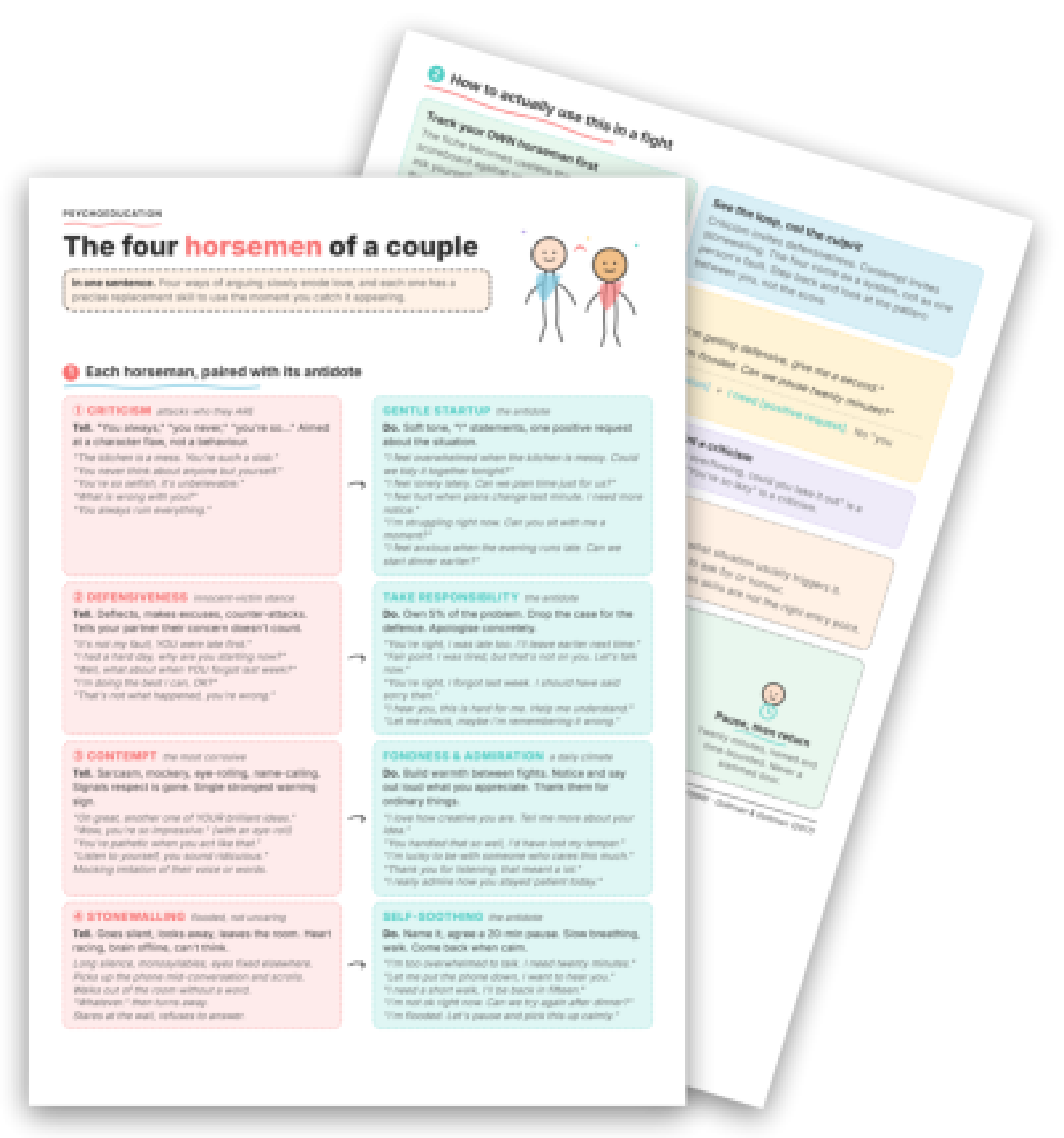
The fiche PDF is structured in two panels. The first presents each of the four horsemen paired directly with its antidote, so the repair move is never more than one glance away from the problem behaviour. Each horseman comes with a clinical description of what it does relationally and three to five verbatim examples drawn from ordinary couple arguments.
Criticism ("You always ruin everything") is paired with the Gentle Startup skill, with worked examples of the formula: I feel [emotion] + about [specific situation] + I need [positive request]. Defensiveness (the innocent-victim counter-attack) is paired with Take Responsibility: "Own 5% of the problem." Contempt, flagged explicitly as "the most corrosive" and "single strongest warning sign," is paired not with a single conversational move but with a daily climate of fondness and admiration, which reframes the work as ongoing rather than reactive. Stonewalling is paired with Self-Soothing, including the named, time-bounded 20-minute pause and the verbal scripts to initiate it.
The second panel, "How to actually use this in a fight," is what makes this more than an informational handout. It includes repair phrases patients can borrow mid-conflict ("I'm getting defensive, give me a second"), the explicit distinction between a healthy pause and stonewalling, and the complaint/criticism distinction modelled with concrete examples. A final "To discuss in session" block gives you three ready-made debriefing prompts, including the clinically important note: "When there is fear, control, or intimidation in the relationship, communication skills are not the right entry point."
> Key takeaway: The fiche is a visual support that facilitates the explanation of the four horsemen in session. It is not a self-report questionnaire. The layout places problem and repair side by side so the clinician can point, not just describe, and leave the couple with a reference they can consult in real time.
750+ clinical tools
A library built with and for clinicians, ready to use in session and extend between appointments.
Access all the toolsWhen and How to Introduce This Fiche
This fiche fits naturally in the psychoeducation phase of couples work, typically after one or two sessions of formulation. You already have a working picture of each partner's pattern; the fiche gives you language both partners can adopt without either feeling labelled.
A low-charge framing to introduce it: "I want to show you a schema from Gottman's research. It maps four patterns that tend to appear when couples argue. Before we look at which ones show up for you, I'd like us to go through each one together." That sequencing, concept first and then application, reduces the reflexive attribution described above.
Good candidates are couples with active relational conflict who have sufficient alliance with each other to work jointly, partners who have difficulty naming what escalates their arguments, and patients in individual therapy whose attachment patterns are playing out in current conflicts they describe session after session.
Pair the fiche with the EFT Infinity Loop when the systemic pursue/withdraw dynamic is prominent: the horsemen then become the visible surface of a deeper attachment cycle. For active listening as a parallel skill, the corresponding fiche reinforces the repair work introduced here. Between sessions, the weekly couple check-in and the relational gratitude exercise sustain the fondness and admiration climate the fiche identifies as the antidote to contempt.
For couples where the five love languages or vulnerability in communication are already on the table, the horsemen framework adds the conflict-specific layer. And for clinicians building a longer psychoeducation arc, the communication in couples program and the healthy relationships program offer the multi-session scaffolding this single fiche does not.
One limit worth naming: the fiche assumes a non-coercive relational context. The "To discuss in session" block flags this explicitly. When safety is in question, hold the skills work.
The fiche does not replace the therapeutic relationship, the formulation, or the slow work of shifting entrenched patterns. What it does is give you a shared vocabulary on day one, and give the couple something precise to hold onto when the next argument starts before the next session arrives.
Use it with your patients
Share this tool in the mobile app and follow the work between sessions.
Sources
- Gottman, J. M. (1994). Why Marriages Succeed or Fail: And How You Can Make Yours Last. Simon & Schuster.
- Gottman, J. M., & Silver, N. (1999). The Seven Principles for Making Marriage Work. Harmony Books (Penguin Random House).
- The Gottman Institute. The Four Horsemen: Criticism, Contempt, Defensiveness, and Stonewalling.
Your session continues in your patients' pocket
Use with a patientYour resources, available everywhere
The handouts, exercises, programs and audios above: you choose which ones to make available to your patients, in the mobile app dedicated to them.
And far more than a library
The app goes well beyond resources, to support your patients every day:
Related categories
Explore other clinical resources by category.

Relationships
Clinical worksheets and tools on relational functioning: attachment, schemas, assertiveness, and communication skills for therapists. Printable PDF resources.

Understand
Clinical hub for the therapeutic aim 'Understand': worksheets and tools to build patient insight across CBT, ACT, schema therapy and more.

Regulate
Clinical resources for emotion regulation: worksheets, ACT exercises, and psychoeducation tools for affect regulation across diagnoses. For clinicians.

Build skills
Skill-building resources for clinicians: printable worksheets and exercises for coping, assertiveness, and communication skills training in therapy.

Systemic & narrative
Systemic family narrative therapy resources for clinicians: worksheets, psychoeducation programs, and exercises for couples, families, and groups.
Anxiety
Clinical hub for anxiety disorders: CBT and ACT worksheets, psychoeducation sheets, and exercises for assessment and treatment across the anxiety spectrum.