
Clinical picture. A and B, a cohabiting couple in their mid-thirties, presented after a pattern of escalating arguments that typically ended with one partner leaving the flat and contact going cold for the rest of the evening. The treating psychologist introduced the I-statement structure during a joint session, walking both partners through the four-part formula on the printed fiche. A initially produced statements such as "I feel that you dismiss me", and the clinician gently flagged the disguised you-statement, prompting a reworking: "I feel invisible when the conversation moves on before I've finished, because I start thinking my point doesn't matter to you." B reported feeling less targeted and was able to respond without immediately defending. The couple agreed to practise the format on a low-stakes disagreement before the next session.
Relationship Conflict Resolution: PDF Worksheet, Tools and Exercises
A visual PDF worksheet presenting five concrete conflict skills clinicians can use in session to give couples a shared language and a workable framework to argue without rupturing the bond.
Clinical vignettes
I-Statements in a Couples Session
Negotiating a Time-Out Protocol
Clinical picture. C, a 47-year-old in individual therapy for generalised anxiety, described recurring conflicts with their spouse that derailed quickly once physiological arousal rose: raised voices, door-slamming, and days of reduced communication. The clinician used the time-out section of the fiche to frame the couple's pattern as a nervous-system problem rather than a willpower failure, noting that less than twenty minutes is physiologically insufficient for the body to settle. C was asked to raise the idea of a pre-agreed signal and a fixed return time with their spouse during a calm moment, not mid-argument. At the following session C reported that the couple had chosen a word and a thirty-minute window, and that one activation during the week had ended with a return conversation rather than a prolonged shutdown. Progress was modest and the clinician noted that consistent use across multiple incidents would be needed before drawing conclusions.
Explaining conflict regulation to a couple verbally almost always produces the same result: both partners nod, and then reproduce the exact same pattern in the parking lot. This fiche PDF on relationship conflict resolution is a visual support designed for use in session, giving clinicians a concrete anchor to introduce five interdependent de-escalation skills without relying on a lecture.
Use this resource with your patients
Handout, exercises and materials ready to use, right inside SessionFuel.
Why Conflict Skills Are So Hard to Transfer From Session to Real Life
The core difficulty is not conceptual: most patients in couples work can articulate that blaming language is unproductive. The failure is procedural and physiological. Once physiological flooding sets in, accessed prefrontal capacity drops sharply, and any skill explained only at the verbal-semantic level is simply unavailable. Couples also routinely confuse the goal of a difficult conversation. Without an explicit reframe, winning the argument and resolving the conflict feel like the same thing.
A second obstacle is the asymmetry of emotional vocabulary. One partner articulates feelings fluently; the other defaults to behaviour-criticism disguised as feeling language ("I feel that you never..."). Naming this trap out loud in a session is often insufficient: the partner who does it has genuine difficulty recognising the substitution in real time. A printed reference changes that. It becomes a shared object in the room, not the therapist's opinion about who is communicating poorly.
For work grounded in Gottman's research on the four horsemen and their antidotes or in nonviolent communication for couples, having a portable visual that operationalises those principles session by session materially shortens the psychoeducation phase.
What the Fiche Contains: A Visual Map of Five Skills
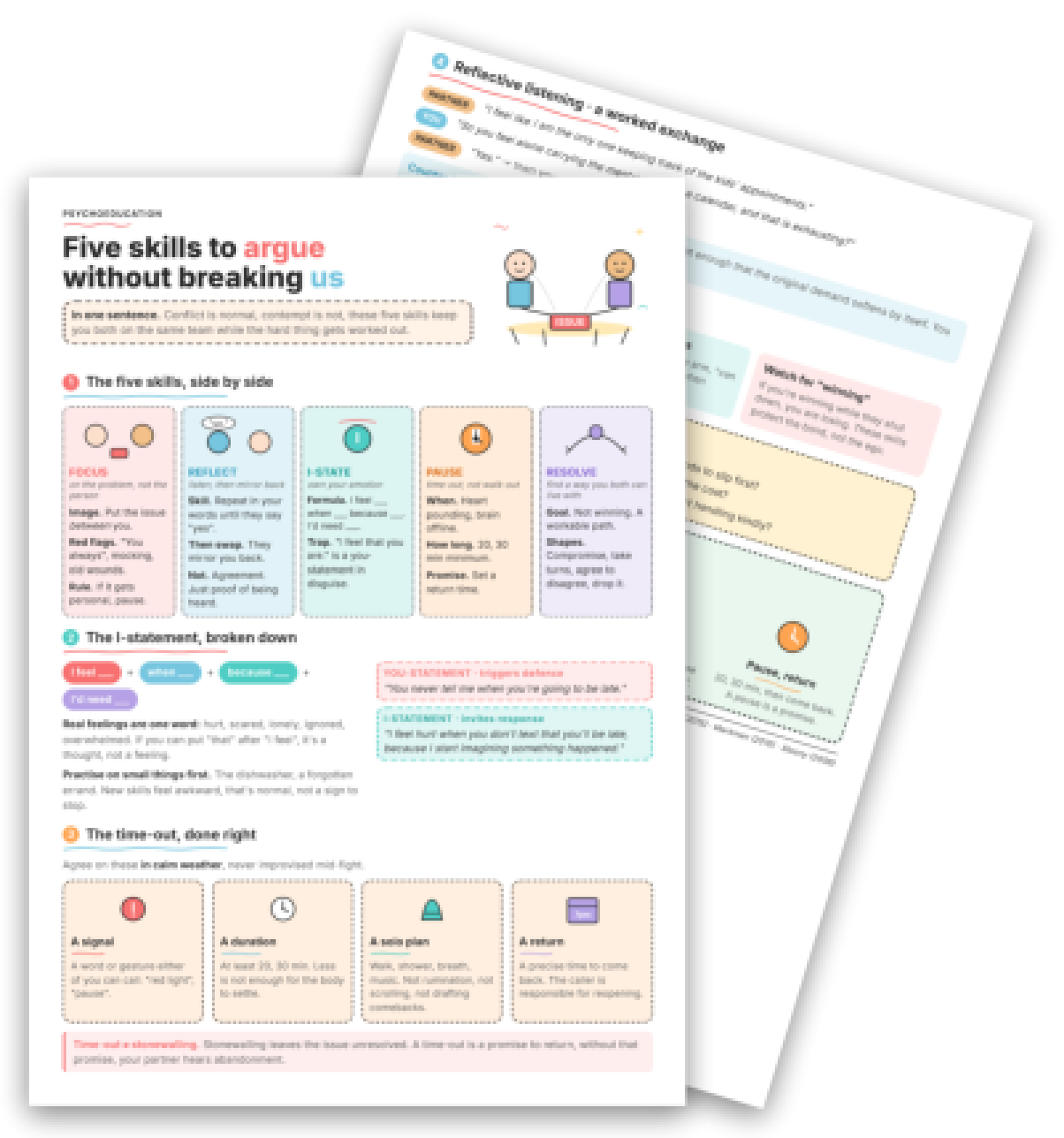
The fiche organises five skills in a single-page layout, each presented with a name, a brief rule, and the red flags that signal the skill is slipping. The five are: Focus (issue between you, not on the person), Reflect (mirror back until the partner says "yes, that's it"), I-State (the I-statement formula), Pause (structured time-out), and Resolve (workable path, not victory).
A second panel breaks down the I-statement formula visually: I feel ___ / when ___ / because ___ / I'd need ___, with an explicit note that distinguishes genuine feeling words from disguised accusations ("if you can put 'that' after 'I feel', it's a thought, not a feeling"). The contrast between a you-statement and an I-statement is shown side by side with real-language examples, which is precisely the kind of perceptual exercise that works on paper but not in verbal explanation alone. This pairs naturally with the dedicated I-Messages worksheet for patients who need to practise the formula further between sessions.
A third panel details the time-out protocol: a agreed signal, a minimum duration of twenty to thirty minutes (with the physiological rationale implicit in the layout), a solo activity plan, and a precise return time. The fiche makes explicit the clinical distinction that often needs spelling out: "Time-out ≠ stonewalling." A fourth panel shows a worked reflective listening exchange, demonstrating the counter-intuitive point that accurate mirroring often softens the original demand without any problem-solving taking place. The reflective listening communication worksheet works well as a companion if you want to extend practice on this skill alone.
A closing section offers three session discussion prompts, including "Which of the five skills tends to slip first?" and "Which permanent disagreement could you stop trying to solve and start handling kindly?", which anchor the debrief in the patient's own pattern rather than the generic framework.
> Key clinical point: this fiche is a visual support that facilitates the explanation of conflict skills during the session; the clinician uses it as a shared reference while talking, not as a self-administered questionnaire. It leaves the couple with a concrete take-home that carries the session vocabulary into their daily life.
750+ clinical tools
A library built with and for clinicians, ready to use in session and extend between appointments.
Access all the toolsWhen and How to Introduce It in Session
The fiche fits naturally in the second or third session of couples work, once the initial formulation is in place and both partners have agreed on at least one target behaviour pattern. Introducing it earlier risks feeling prescriptive before the alliance is established; waiting too long means the couple has already reproduced the same cycle several times without a common vocabulary to discuss it.
For patients working individually on relational patterns, the fiche works equally well: presenting it alongside the interpersonal conflict resolution exercise or the guided exercise on cognitive rigidity in conflict allows you to anchor the psychoeducation phase before moving to behavioural rehearsal.
A useful introduction: "I want to show you something that maps out what tends to go wrong in the kinds of arguments you've described, and five very specific things that can interrupt that. Let's go through it together and you tell me which parts feel familiar." This framing positions the fiche as descriptive before prescriptive, which reduces defensiveness and opens a richer debrief. For the time-out panel specifically, reinforce that the protocol must be agreed on in calm weather, never improvised mid-conflict: the fiche says so explicitly, and pointing to it on the page carries more weight than saying it yourself.
The fiche does not replace the couple conflict psychoeducation program or structured work on communication patterns in couples. It is a session anchor that keeps the most important behavioural targets visible and names them the same way every time.
Use it with your patients
Share this tool in the mobile app and follow the work between sessions.
Sources
- Gottman, J. M., & Silver, N. (1995). Why Marriages Succeed or Fail: And How You Can Make Yours Last. Simon & Schuster.
- Gottman, J. M., & Silver, N. (1999). The Seven Principles for Making Marriage Work. Crown Publishers.
- Gordon, T. (2000). Parent Effectiveness Training: The Proven Program for Raising Responsible Children. Three Rivers Press.
- Markman, H. J., Stanley, S. M., & Blumberg, S. L. (2010). Fighting for Your Marriage: A Deluxe Revised Edition of the Classic Best-Seller for Enhancing Marriage and Preventing Divorce. Jossey-Bass.
Your session continues in your patients' pocket
Use with a patientYour resources, available everywhere
The handouts, exercises, programs and audios above: you choose which ones to make available to your patients, in the mobile app dedicated to them.
And far more than a library
The app goes well beyond resources, to support your patients every day:
Related categories
Explore other clinical resources by category.

Emotions
Clinical resources on emotion regulation: worksheets, coping tools, CBT, REBT, and ACT exercises for therapists working across diagnoses and age groups.
Relationships
Clinical worksheets and tools on relational functioning: attachment, schemas, assertiveness, and communication skills for therapists. Printable PDF resources.

Regulate
Clinical resources for emotion regulation: worksheets, ACT exercises, and psychoeducation tools for affect regulation across diagnoses. For clinicians.

Build skills
Skill-building resources for clinicians: printable worksheets and exercises for coping, assertiveness, and communication skills training in therapy.
CBT
CBT worksheets, cognitive restructuring exercises & behavioral tools for clinicians. Evidence-based resources for every phase of cognitive behavioral therapy.

Emotion-focused
Emotion-focused therapy clinical resources: worksheets, exercises & programs for EFT practitioners working with individuals and couples.