
Clinical picture. A., a woman in her early 30s, presents with recurrent relationship distress and describes spending several hours each evening monitoring her partner's messaging delays, which she reads as signs of impending abandonment. During a mid-therapy session, the clinician introduces the psychoeducational sheet and positions A.'s pattern within the anxious attachment style, normalising its developmental origins while naming the maintenance cycle clearly. The clinician proposes a graded counter-pattern task: tolerating a self-imposed two-hour window without checking her phone before contacting her partner, and using a brief body-scan to regulate first. Over the following three weeks A. reported completing the task on four occasions; she noted residual discomfort but also a modest reduction in post-contact relief-seeking, which the clinician reflected back as early evidence that self-soothing was becoming a viable option.
Building Secure Attachment: PDF Worksheet, Tools and Exercises
A clinical PDF worksheet with seven structured skills to support attachment psychoeducation, counter-pattern practice, and earned-security work in session.
Clinical vignettes
Anxious Style, Soothing Before Seeking
Avoidant Pattern, Staying in the Conversation
Clinical picture. T., a man in his mid-40s referred following a relationship separation, acknowledges a longstanding habit of ending emotionally charged conversations early, often citing fatigue or a need to think alone. The clinician uses the sheet's avoidant counter-pattern section to frame this not as preference but as a learned exit strategy that reduces short-term discomfort while reinforcing distance over time. Together they identify one low-stakes situation, a weekly check-in call with his adult daughter, where T. agrees to stay present for ten additional minutes when the urge to close the conversation arises, and to say one affectionate thing before hanging up. At the next session T. reported the call had extended by roughly fifteen minutes; he described discomfort that peaked and then settled, which opened a productive discussion about the difference between intensity being dangerous and intensity simply being unfamiliar.
Explaining earned secure attachment to a patient who has spent years operating from an anxious or avoidant strategy rarely works through verbal description alone. The four styles blur together quickly in conversation, the counter-intuitive moves feel abstract, and the belief layer stays invisible until it is laid out on paper. This fiche PDF gives you a visual scaffold to anchor that explanation in session, no, wait. Let me be precise: it gives you a structured visual map you work through with the patient, panel by panel, so the psychoeducation lands rather than floats.
Use this resource with your patients
Handout, exercises and materials ready to use, right inside SessionFuel.
Why attachment concepts resist verbal explanation in session
Attachment theory is clinically indispensable and notoriously hard to transmit at the psychoeducation stage. When you name the four styles verbally, patients often self-assign too fast ("I'm clearly the anxious one") or defend against recognition ("I just value my independence"). The phenomenological texture of each position, the hypervigilant scanning of anxious attachment, the approach-avoidance oscillation of the disorganized style, needs to be externalized into something the patient can look at alongside you rather than merely hear about.
The fiche also targets a second obstacle: the belief that relational style is fixed. Most patients arrive with precisely that assumption, and the reframe toward earned security as a deliberate, months-long counter-pattern practice (consistent with Mikulincer & Shaver's model and Johnson's EFT framework) is far easier to land when the patient sees it mapped visually rather than hears it announced. Naming the trajectory, not just the starting position, changes the therapeutic conversation.
What the fiche contains: a structured visual map of seven skills
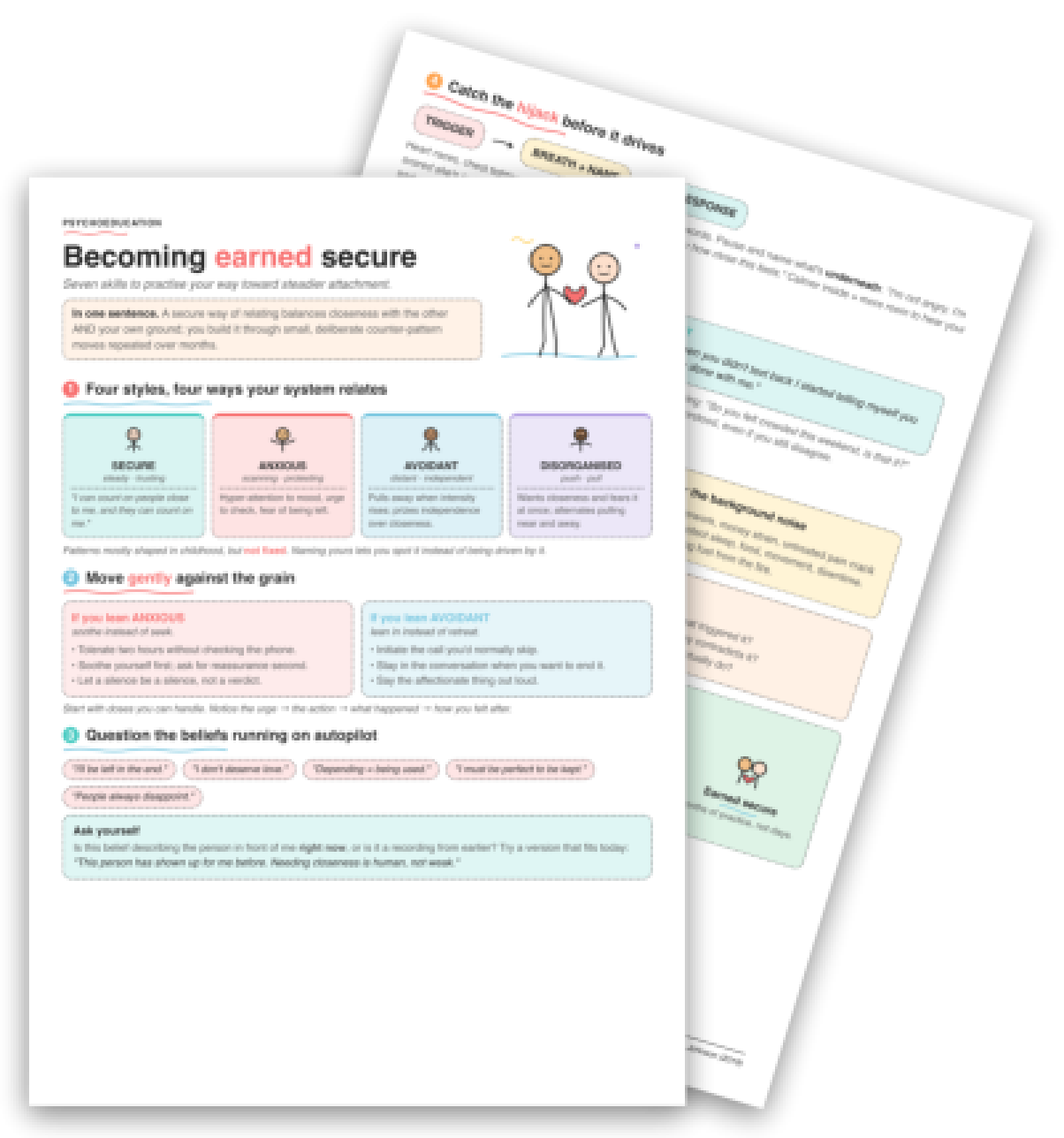
The printable opens with four attachment style portraits, each reduced to a phenomenological one-liner and a representative inner-voice sample. "I can count on people close to me, and they can count on me" anchors the secure position; the disorganized portrait captures the simultaneous push-pull with clinical precision that is genuinely hard to convey in words alone. These four panels create a shared vocabulary before any intervention is introduced.
From there, the fiche moves through six additional skill blocks:
- Counter-pattern moves by style: specific micro-behaviors for the anxious position ("tolerate two hours without checking the phone," "let a silence be a silence, not a verdict") and the avoidant position ("initiate the call you'd normally skip," "say the affectionate thing out loud"), with an explicit notice-the-urge-then-act-then-debrief loop
- Autopilot beliefs to interrogate: "I'll be left in the end," "Depending = being used," and four others that patients often recognize on sight, with a built-in reframe prompt
- A trigger-breath-name-response sequence for catching emotional hijacks pre-verbally, including scripted re-labels that separate the primary emotion from the presenting behavior
- I-statement reframes for conflict, paired with empathic listening prompts, which connects naturally to assertive I-message work and active listening skills if you want to go deeper
- Environmental and lifestyle factors: sleep, overwork, and the relational modeling value of spending time around securely attached dyads
- Three "To discuss in session" prompts printed at the bottom, designed to structure your debrief, not to function as standalone homework
> Key takeaway: The fiche is a visual support that facilitates in-session explanation. You use it as a psychoeducation scaffold with the patient in the room; they leave with a concrete reference map, not a self-report questionnaire to fill out alone.
750+ clinical tools
A library built with and for clinicians, ready to use in session and extend between appointments.
Access all the toolsWhen and how to propose it in your clinical work
The fiche fits cleanly after the relational anamnesis and before beginning graduated counter-pattern work, typically from the second or third session onward. It is particularly useful with patients presenting abandonment schema dynamics, emotional dependency patterns, fear that a partner will leave, or repetitive couple conflict where the relational schema has been identified but not yet named in shared language.
A low-threshold framing: "I'd like to show you a map of how different relational strategies develop, it might help us name what we're observing together." This avoids the risk of the patient treating style labels as diagnostic verdicts rather than descriptive starting points.
Use the three "To discuss in session" prompts at the bottom to structure the debrief: which style was active in a recent moment, which autopilot belief surfaced, and what the smallest counter-pattern move would actually look like this week. Pairing the fiche with attachment in romantic relationships broadens the case formulation; linking it to work on beliefs that damage relationships or a core beliefs self-reflection exercise deepens the schema layer.
One limit worth naming: the counter-pattern section addresses anxious and avoidant positions specifically. With disorganized presentations rooted in complex trauma, the fiche functions best as an orienting frame, embedded within a longer formulation that may include trauma-focused work alongside tools addressing conflict dynamics in couples or a structured program on healthy relationship foundations. The visual map clarifies the concept; the clinical container remains yours to build.
Use it with your patients
Share this tool in the mobile app and follow the work between sessions.
Sources
- Bowlby, J. (1982). Attachment and Loss, Vol. 1: Attachment. Basic Books.
- Levine, A., Heller, R. S. F. (2010). Attached: The New Science of Adult Attachment and How It Can Help You Find and Keep Love. TarcherPerigee.
- Harwood, E. (2023). Securely Attached: Transform Your Attachment Patterns into Loving, Lasting Relationships. Ulysses Press.
Your session continues in your patients' pocket
Use with a patientYour resources, available everywhere
The handouts, exercises, programs and audios above: you choose which ones to make available to your patients, in the mobile app dedicated to them.
And far more than a library
The app goes well beyond resources, to support your patients every day:
Related categories
Explore other clinical resources by category.

Identity
Clinical resources for self-identity work in therapy: CBT, ACT, schema tools for clinicians addressing self-concept, core beliefs, and identity disruption.

Relationships
Clinical worksheets and tools on relational functioning: attachment, schemas, assertiveness, and communication skills for therapists. Printable PDF resources.

Understand
Clinical hub for the therapeutic aim 'Understand': worksheets and tools to build patient insight across CBT, ACT, schema therapy and more.

Build awareness
Clinical worksheets and tools to build awareness in therapy: cognitive distortions, schemas, emotions, ACT and CBT resources for practitioners.

Restructure
Clinical hub for cognitive restructuring worksheets: distortion identification, belief disputation, ABC model, and schema work for evidence-based practice.

Build skills
Skill-building resources for clinicians: printable worksheets and exercises for coping, assertiveness, and communication skills training in therapy.