
Clinical picture. A and B, a couple in their late thirties, present with recurring arguments that tend to escalate before either partner feels understood. In session, the clinician introduces the three-move framework from the active listening worksheet: showing attentiveness through body language, asking open questions, and reflecting content alongside feeling before responding. The clinician models a reflection live, compressing B's account of a recent conflict into one sentence that names both the core point and the underlying frustration. B pauses, then says quietly, "That's exactly it." A reports that hearing the reflection rather than a rebuttal shifted something, and the couple agrees to practise the reflect-before-reply step at home before the next session.
Active Listening Skills: PDF Worksheet, Tools and Exercises
A visual psychoeducation worksheet helping clinicians teach the three concrete moves of active listening, from behavioral cues to reflective responses, in session.
Clinical vignettes
Reflective Listening in Couples Work
Phone-Down Rule in Individual Therapy
Clinical picture. C, a man in his mid-forties, reports that his teenage son has stopped confiding in him; C suspects the relationship has grown distant but cannot identify why. The clinician reviews the worksheet section on how even two glances at a phone during a conversation alter the perceived quality of attention, and asks C to recall a recent talk with his son. C acknowledges his phone was in his hand throughout. Over the following week C practises one focused ten-minute check-in each evening, phone face-down, using open stems such as "What was that like for you?" At the next appointment he reports that his son spoke for considerably longer than usual and, unprompted, sought him out the following night.
Most patients you see for relational difficulties will tell you they are good listeners. They are not lying. They simply have no behavioral map of what active listening actually requires, and verbal instruction in session rarely builds one. This PDF worksheet gives the concept structure, makes it visual, and gives patients something concrete to leave with.
Use this resource with your patients
Handout, exercises and materials ready to use, right inside SessionFuel.
Why Active Listening Resists Verbal Explanation in Session
The core problem is that patients conflate passive silence with active engagement. They are not present, they are waiting. When working on couples communication, parent-child communication patterns, or assertiveness skills, this distinction is clinically essential and deceptively hard to convey at the oral level alone.
Oral instruction tends to stay abstract. Patients nod, agree, and then return the following week having replicated the same patterns: rehearsing their reply while the other person speaks, reaching for their phone, or jumping to fix before being asked. The breakdown is behavioral, and naming it verbally rarely changes it. What helps is a shared visual reference that makes the specific behaviors legible, nameable, and discussable.
What the Worksheet Contains, and What the Visual Layout Does
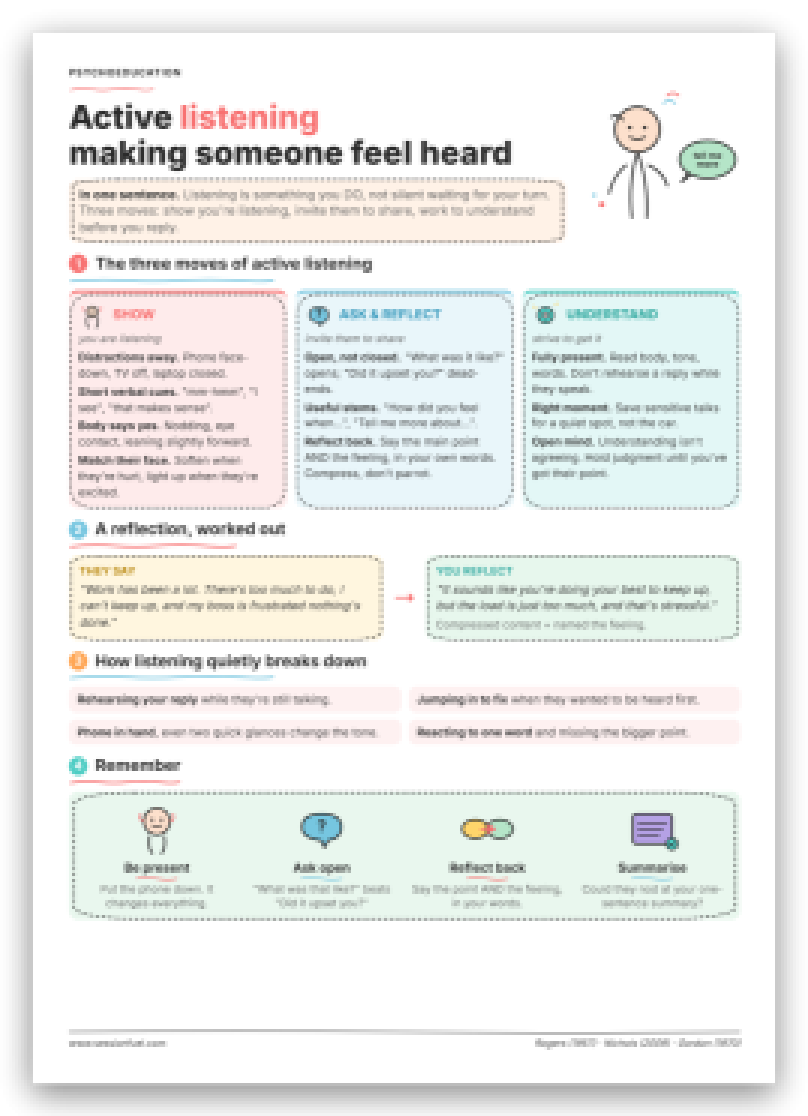
The fiche structures active listening into three distinct moves, each given its own panel: SHOW (you are listening), ASK & REFLECT (invite them to share), and UNDERSTAND (strive to get it). Each panel lists discrete, observable behaviors rather than attitudes. Under SHOW, for instance: "Distractions away. Phone face-down, TV off, laptop closed" and "Match their face. Soften when they're hurt, light up when they're excited." Under ASK & REFLECT, the fiche draws a sharp contrast between open and closed questions: "'What was it like?' opens; 'Did it upset you?' dead-ends."
A worked-out reflection example (panel 2) shows the three-move logic applied to a real utterance: a patient reports work overload; the reflective response compresses the content and names the feeling, explicitly labeled "compressed content + named the feeling." This worked example does what oral explanation cannot: it shows the gap between parroting and genuine reflection.
Panel 3 maps the four most common listening failures, rehearsing a reply, jumping to fix, phone in hand, and reacting to one word while missing the larger point. Seeing these laid out visually tends to produce immediate recognition in patients, which you can work with directly in session. The closing panel distills four behavioral anchors: being present, asking open, reflecting back, and summarising.
> Key takeaway: This worksheet is a visual support that facilitates the explanation of active listening in session, not a self-administered quiz, but a psychoeducation tool you use alongside the patient to make a complex interpersonal skill concrete, behavioral, and memorable.
750+ clinical tools
A library built with and for clinicians, ready to use in session and extend between appointments.
Access all the toolsWhen and How to Introduce It in Session
This fiche fits naturally into any work where relational communication is a treatment target: communication in couples, conflict resolution, couple conflict psychoeducation, social anxiety in relational contexts, or work with beliefs that damage relationships.
Timing-wise, it works well once the therapeutic alliance is established and the patient has begun identifying a relational pattern they want to shift. It pairs naturally with the Reflections communication skill worksheet and can follow assertiveness ladder work.
To introduce it without creating self-consciousness, you might say: "I'd like to look at something with you, a simple map of what it actually looks like to make someone feel heard. Let's go through it together." Use the worked example in panel 2 to demonstrate the difference between restating content and naming feeling. The four listening failures in panel 3 typically open a productive conversation without any labeling on your part.
For patients working on healthy relationship building, this worksheet integrates cleanly into a healthy relationship psychoeducation program. It also complements assertive rights work for patients who conflate assertiveness with not listening.
The fiche does not replace clinical formulation. It gives patients a behavioral vocabulary they can use between sessions, refer back to, and bring to difficult conversations before the next appointment.
Use it with your patients
Share this tool in the mobile app and follow the work between sessions.
Sources
- Nichols, M. P. (2009). The Lost Art of Listening: How Learning to Listen Can Improve Relationships (2nd ed.). Guilford Press.
- Gordon, T. (1970). Parent Effectiveness Training. P.H. Wyden.
Your session continues in your patients' pocket
Use with a patientYour resources, available everywhere
The handouts, exercises, programs and audios above: you choose which ones to make available to your patients, in the mobile app dedicated to them.
And far more than a library
The app goes well beyond resources, to support your patients every day:
Related categories
Explore other clinical resources by category.

Relationships
Clinical worksheets and tools on relational functioning: attachment, schemas, assertiveness, and communication skills for therapists. Printable PDF resources.

Understand
Clinical hub for the therapeutic aim 'Understand': worksheets and tools to build patient insight across CBT, ACT, schema therapy and more.

Build skills
Skill-building resources for clinicians: printable worksheets and exercises for coping, assertiveness, and communication skills training in therapy.
CBT
CBT worksheets, cognitive restructuring exercises & behavioral tools for clinicians. Evidence-based resources for every phase of cognitive behavioral therapy.

Integrative
Integrative therapy clinical resources: worksheets, psychoeducation programs, and exercises for eclectic, multimodal practice across orientations.

Anxiety
Clinical hub for anxiety disorders: CBT and ACT worksheets, psychoeducation sheets, and exercises for assessment and treatment across the anxiety spectrum.