
Clinical picture. M., a 34-year-old project manager, presented with marked social anxiety centred on professional settings; he consistently left team meetings convinced his colleagues found him incompetent. His therapist introduced the first lesson of the Anxiété en société program, which invites patients to examine what they believe others think of them and to identify mind-reading as a cognitive error. Working through the lesson between sessions, M. completed the guided prompt asking him to recall a recent situation in which he had assumed others' thoughts, and he identified three specific episodes from the preceding week. At the next appointment he reported mild surprise at how automatic and unexamined those inferences had been, which opened a productive conversation about the distinction between a perceived judgment and a verifiable fact.
Social Anxiety in Relationships: A Psychoeducation Program
A structured 4-lesson program helping anxious patients navigate others' judgment, vulnerability, emotional expression, and assertive communication.
Clinical vignettes
Mind-Reading in a Meeting Room
Impostor Fears and the Masked Self
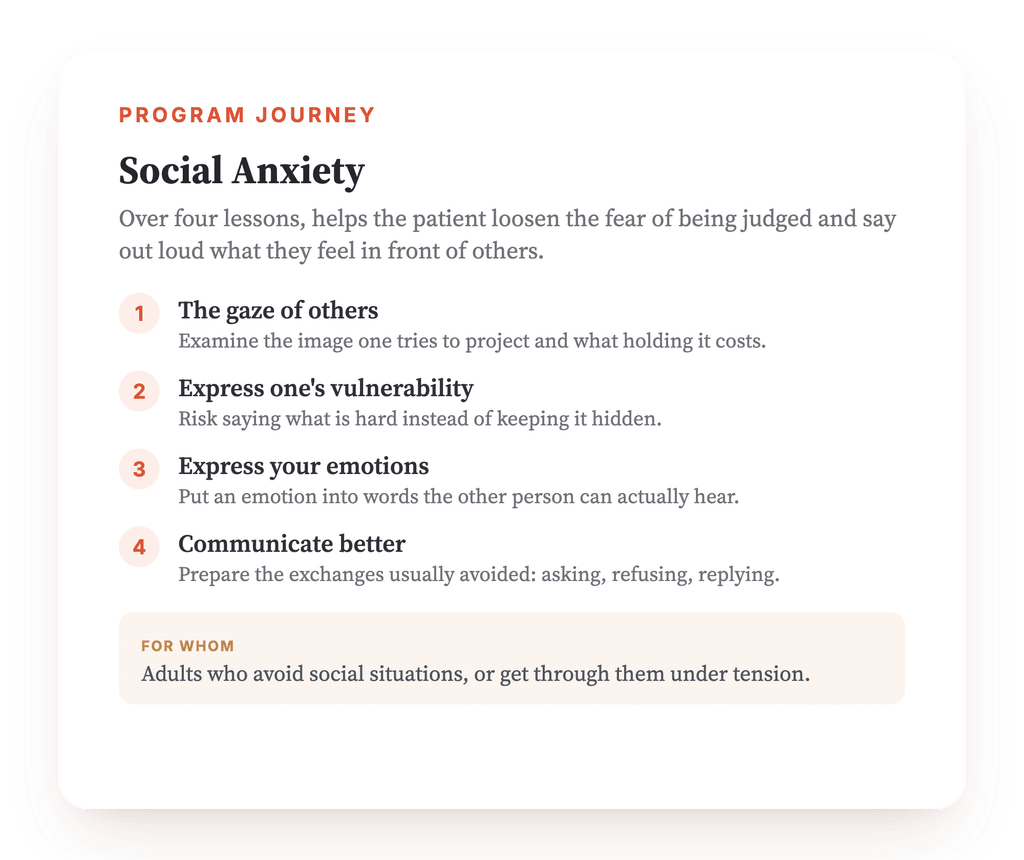
Clinical picture. A., a 41-year-old teacher, described chronic anxiety in social gatherings outside work; she routinely declined invitations by inventing plausible excuses. Her clinician recommended the Anxiété en société program as structured self-guided work between sessions, starting with Lesson 1's section on the image one tries to project and the fear of being exposed as falling short of it. A. selected several items from the multiple-choice question on how she managed her anxiety in public and noted, unprompted, that she had never connected her excuse-making to a fear of being revealed rather than a simple wish to avoid discomfort. This reframing did not eliminate avoidance immediately, yet it gave the therapist a clearer entry point for subsequent work on behavioural experiments.
Use this resource with your patients
Handout, exercises and materials ready to use, right inside SessionFuel.
Why Social Anxiety in Relationships Is So Hard to Address Verbally
Patients with social anxiety rarely struggle to understand, in the abstract, that their fears are exaggerated. What resists is the felt sense: the weight of others' perceived judgment, the automatic assumption that they know what people think, the exhausting performance of projecting a flawless image. These dynamics sit at the intersection of cognitive distortions (notably mind-reading), safety behaviors), and interpersonal avoidance. Naming them verbally in a consultation is rarely enough. Patients need structured time, away from the therapy room, to actually sit with the material, respond to guided prompts, and notice where they get stuck. That is exactly the gap this program is designed to fill.
750+ clinical tools
A library built with and for clinicians, ready to use in session and extend between appointments.
Access all the toolsWhat the Program Contains
This four-lesson autonomous program walks patients through four consecutive and clinically coherent domains.
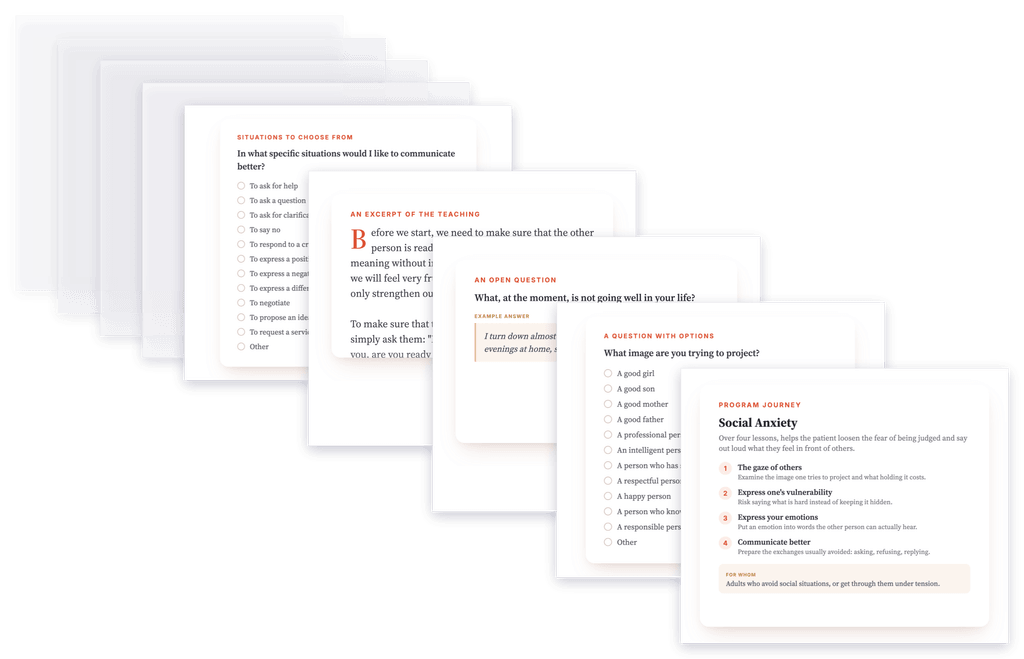
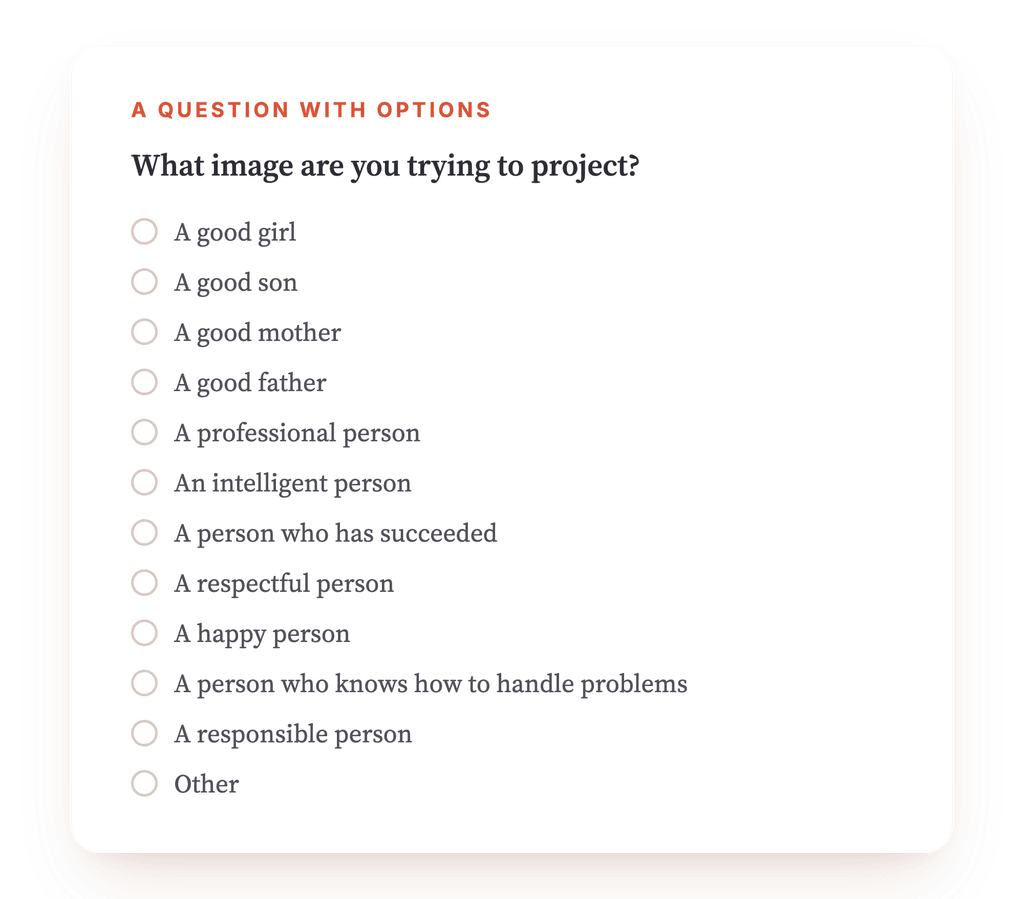
Lesson 1 addresses the tyranny of others' gaze: the evolutionary logic behind social monitoring, the cognitive error of assuming one knows what others think (linked directly to the mind-reading distortion), and the costly strategies used to manage the image one projects, including the impostor syndrome) dynamic that emerges when patients fear being "found out." Patients reflect, via guided prompts, on which ideal images they feel compelled to embody and how they actually manage anxiety in public.
Lesson 2 reframes vulnerability not as weakness but as courage, drawing the counterintuitive link between sharing vulnerability and reducing shame. Patients identify who in their lives could be a safe recipient of such disclosure, and why this practice strengthens, rather than damages, relational bonds. This lesson articulates naturally with your work using Expressing Vulnerability in Relationships).
Lesson 3 builds a concrete structure for externalizing emotions to others: checking that the listener is genuinely available, identifying the triggering behavior (not the person's character), naming the emotion, and clarifying the underlying need. The lesson aligns step by step with the Behavior, Emotion, Underlying Need) framework and prepares the ground for Nonviolent Communication).
Lesson 4 introduces the fundamentals of assertive communication: patients' relational rights, describing a problem concisely, making a concrete and realistic request, and learning to say no. This connects directly to resources such as Assertive Rights), I-Messages), and Assertive Communication).
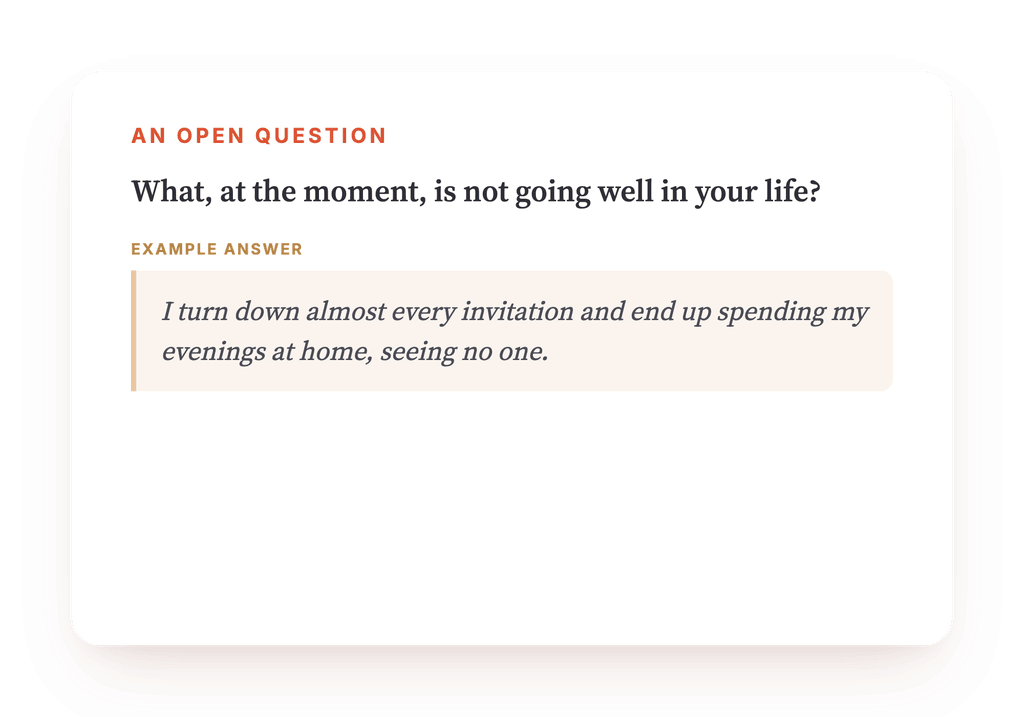
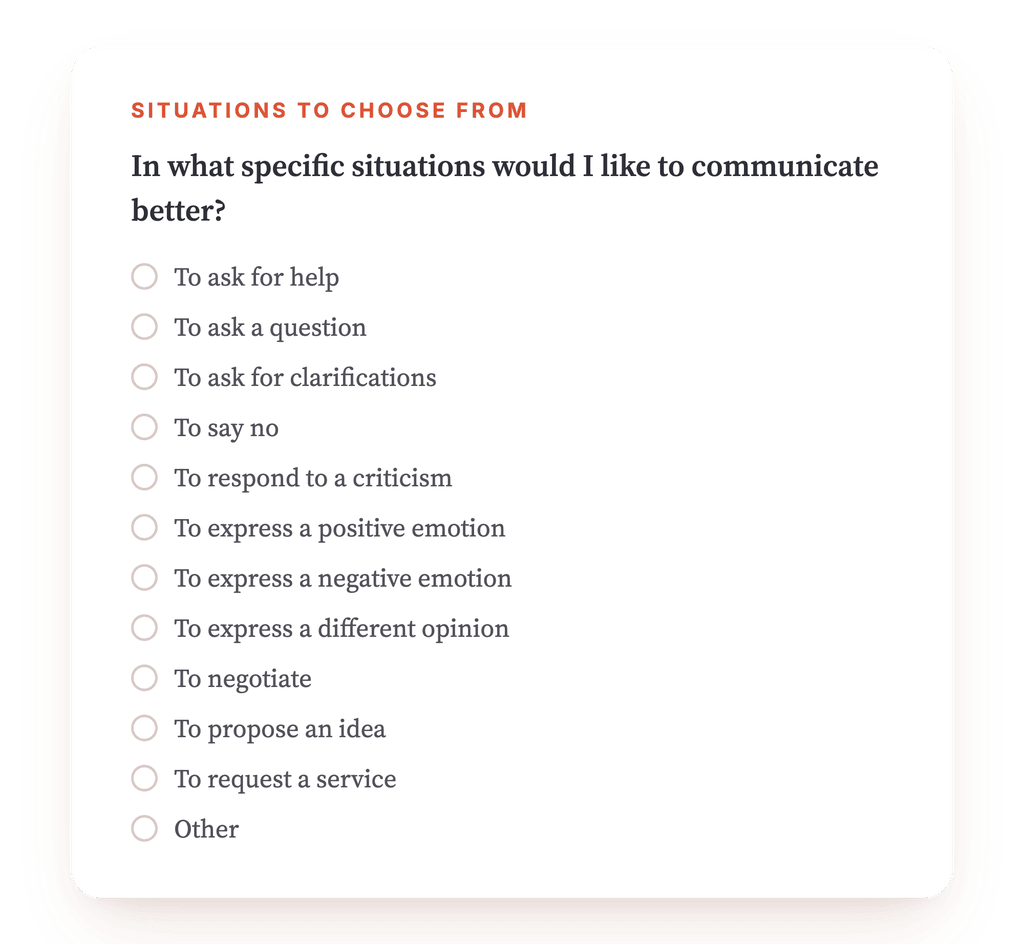
The preview images embedded here show the program overview map and a handful of sample cards. They are only a small fraction of the full program: the complete curriculum contains many more lessons, guided prompts, multiple-choice reflection questions, and psychoeducation texts than what these aperçus reveal.
Key insight: The program's clinical value lies in its arc: each lesson builds on the previous one, moving patients from insight about cognitive errors through relational courage, emotional expression, and finally assertive self-advocacy, a coherent sequence that mirrors the therapeutic progression itself.
This program is available to patients through the mobile application that is the dedicated patient-side interface of SessionFuel: once you assign it within your SessionFuel account, your patient opens the app on their phone and works through the lessons independently, at their own pace, between your consultations.
Use it with your patients
Share this tool in the mobile app and follow the work between sessions.
How to Assign and Use It Between Sessions
This program is designed as structured homework between consultations, not supplementary reading. Assign it when a patient's avoidance of social situations, tendency to over-monitor others' reactions, or difficulty expressing needs is clearly limiting therapeutic progress.
Which patients benefit most: those presenting with social anxiety disorder), marked fear of judgment, interpersonal passivity linked to anxiety, or patterns consistent with the Clark and Wells maintenance cycle). It also suits patients with communication style) difficulties rooted in anxiety rather than skill deficit alone.
How to introduce it: frame it as a structured reflection practice to carry out between two appointments. Tell the patient the program will ask them genuine questions, not trick questions, and that their honest responses are what they will bring back to the next consultation.
How to exploit what the patient produces: the guided prompts are your richest clinical material. A patient who writes that they feel compelled to project the image of "a person who has it together" opens the door to schema work. A patient who has never spoken about their anxiety to a single person (Lesson 2) makes the vulnerability step a genuine behavioral experiment. The Lesson 3 emotion-behavior-need chain becomes a ready-made script to rehearse in your follow-up work with assertiveness training) or DEAR MAN).
Each lesson advances the patient's self-understanding in a way that arrives in the consulting room as processed, personal material rather than abstract concepts to be explained from scratch.
Your session continues in your patients' pocket
Use with a patientYour resources, available everywhere
The handouts, exercises, programs and audios above: you choose which ones to make available to your patients, in the mobile app dedicated to them.
And far more than a library
The app goes well beyond resources, to support your patients every day:
Related categories
Explore other clinical resources by category.

Anxiety
Clinical hub for anxiety disorders: CBT and ACT worksheets, psychoeducation sheets, and exercises for assessment and treatment across the anxiety spectrum.

Identity
Clinical resources for self-identity work in therapy: CBT, ACT, schema tools for clinicians addressing self-concept, core beliefs, and identity disruption.

Relationships
Clinical worksheets and tools on relational functioning: attachment, schemas, assertiveness, and communication skills for therapists. Printable PDF resources.

Cognition
Printable cognitive therapy worksheets and clinical tools for therapists: CBT, ACT, schema work, defusion, distortions, and belief restructuring.

CBT
CBT worksheets, cognitive restructuring exercises & behavioral tools for clinicians. Evidence-based resources for every phase of cognitive behavioral therapy.

Compassion-focused
CFT clinical tools for practioners: exercises, programs and guided audio on shame, self-criticism, guilt and self-compassion. Ready to use in session.