
Clinical picture. M., a woman in her late thirties, was referred for mild anxiety following a significant promotion she had worked toward for several years. She reported feeling like "a fraud waiting to be caught" and attributed her advancement entirely to good timing and a forgiving hiring panel. In session, the clinician introduced the psychoeducational sheet on imposter syndrome, and M. was visibly relieved to find a label for the pattern she had never named. She noted that she systematically dismissed positive feedback while replaying a single critical comment from a peer meeting for days. Over the following two weeks she began a praise file as suggested, which she described as "uncomfortable but harder to argue with than my own memory."
Imposter Syndrome: PDF Worksheet, Tools and Exercises for Clinicians
A printable PDF fiche clinicians can use in session to explain imposter syndrome, distinguish it from low self-esteem, and give patients a concrete visual anchor.
Clinical vignettes
Discounting Competence After Promotion
First-Generation Professional, Chronic Over-Preparation
Clinical picture. T., a man in his early forties and the first in his family to hold a senior academic post, presented with burnout symptoms and persistent sleep disruption. He reported spending three to four extra hours rehearsing presentations that colleagues delivered with minimal preparation, convinced any visible hesitation would expose him as out of place. The clinician used the informational sheet to draw a clear distinction between low self-esteem and the imposter pattern, which T. found clarifying: he did not globally doubt his worth, but he experienced a specific fear of unmasking in professional rooms. Naming the dynamic reduced some of its authority, and T. agreed to experiment with submitting one short piece of written work without his usual cycle of repeated checking. He returned the following week reporting no negative outcome, though he noted the urge to over-prepare had not disappeared.
Patients who carry the imposter feeling rarely lack insight, they often have too much of it, turned in the wrong direction. The clinical difficulty is not getting them to talk about it; it is dismantling a belief structure that is, paradoxically, self-reinforcing. This imposter syndrome fiche PDF is a visual support clinicians can use in session to make that dismantling concrete, efficient, and something the patient can take home.
Use this resource with your patients
Handout, exercises and materials ready to use, right inside SessionFuel.
Why Imposter Syndrome Is Hard to Explain Verbally
The notion resists oral explanation for a specific reason: the patient already knows it sounds irrational. They have usually googled the term, nodded along, and gone back to feeling fraudulent by the following Monday. Conceptual recognition does not touch the maintaining processes.
Two confusions slow progress in session. First, patients conflate the imposter feeling with low self-esteem, which triggers a different clinical pathway. Second, they misread success attribution: rather than seeing reattribution to luck as a cognitive bias, they experience it as simple honesty. Without a visual structure to hold both distinctions at once, the verbal explanation tends to collapse under the weight of the patient's own counter-arguments.
A further complication is prevalence. The fiche notes that around 70% of people meet this pattern at some point in life, a psychoeducational fact that normalises without dismissing, but lands differently when a patient can see it written in front of them rather than just hear it from you.
What the Fiche Contains
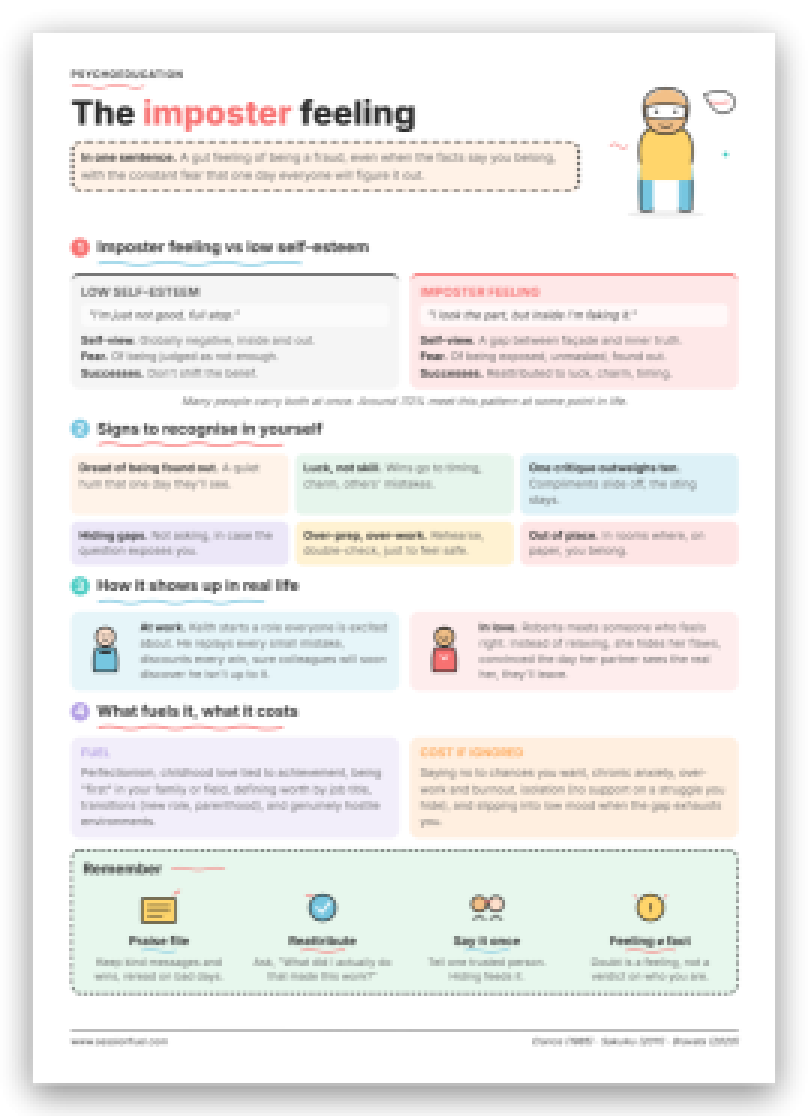
The fiche is organised into four numbered panels, followed by a short action block. The visual layout is the point: a clinician can move through each section with the patient rather than deliver a monologue.
Panel 1 presents a side-by-side comparison between low self-esteem and the imposter feeling across three dimensions: self-view, fear, and how successes are processed. The contrast is stark. Low self-esteem says "I'm just not good, full stop," while the imposter position says "I look the part, but inside I'm faking it." Seeing this distinction drawn in parallel columns helps patients locate themselves precisely, which often produces clinically useful surprise.
Panel 2 lists six behavioural signs: dread of exposure, attributing wins to luck rather than skill, discounting compliments while retaining criticism, hiding knowledge gaps, over-preparation as a safety behaviour, and the persistent sense of being out of place in rooms where one formally belongs. Patients regularly identify their own pattern in this list without prompting, useful as a rapid automatic thought trigger in session.
Panel 3 gives two brief real-life vignettes (work and intimate relationship contexts), grounding the abstract in recognisable situations.
Panel 4 maps maintaining factors, including perfectionism, achievement-conditional childhood validation, role transitions, and hostile environments, alongside the long-term costs: avoidance of opportunity, chronic anxiety, overwork and burnout, and isolation sustained by shame. This cost-benefit framing connects naturally to approval-seeking schemas when these are active in the formulation.
The closing block proposes four brief strategies: keeping a praise file, reattributing wins with the question "What did I actually do that made this work?", disclosing to one trusted person, and anchoring the key cognitive defusion point: "Feeling ≠ fact."
> Key takeaway: The fiche is a visual support that facilitates the explanation of imposter syndrome in session. It is not a self-assessment questionnaire; it is a shared reference the clinician and patient work through together, leaving the patient with a concrete anchor rather than a vague concept.
750+ clinical tools
A library built with and for clinicians, ready to use in session and extend between appointments.
Access all the toolsWhen and How to Introduce It
The fiche fits most naturally from the second or third session onward, once the presenting problem is mapped and the alliance is established. It is particularly indicated for patients presenting with perfectionism, self-image difficulties, shame-based schemas, or social comparison patterns, and for high-achievers or first-generation professionals who have never named what they are experiencing.
A neutral, non-pathologising introduction works well: "There's a concept I want to show you, it comes up in a lot of people who are highly capable. Tell me if any of this matches what you described." This frames the fiche as a map, not a verdict.
Debrief by focusing on Panel 1 first: ask the patient to locate their position between the two columns. Then move to Panel 2 and invite them to identify the two or three signs that fit most closely. The guided self-reflection exercise on impostor syndrome can extend this work as structured homework.
A contraindication worth noting: patients in acute depressive episodes may absorb the cost panel (Panel 4) and amplify rather than contextualise it. In those cases, defer the fiche until mood is more stable, and open with Panel 1 only.
The fiche does not replace formulation, and it does not replace the therapeutic relationship. What it does is close the gap between a patient who understands imposter syndrome in the abstract and one who can actually see where they sit in the pattern, which is usually where clinical movement begins.
Use it with your patients
Share this tool in the mobile app and follow the work between sessions.
Sources
- Clance, P. R., & Imes, S. A. (1978). The Imposter Phenomenon in High Achieving Women: Dynamics and Therapeutic Intervention. Psychotherapy: Theory, Research and Practice, 15(3), 241-247.
- Clance, P. R. (1985). The Impostor Phenomenon: Overcoming the Fear That Haunts Your Success. Peachtree Publishers.
- Sakulku, J., & Alexander, J. (2011). The Impostor Phenomenon. The Journal of Behavioral Science, 6(1), 75-97.
- Bravata, D. M., Watts, S. A., Keefer, A. L., Madhusudhan, D. K., Taylor, K. T., Clark, D. M., Nelson, R. S., Cokley, K. O., & Hagg, H. K. (2020). Prevalence, Predictors, and Treatment of Impostor Syndrome: a Systematic Review. Journal of General Internal Medicine, 35(4), 1252-1275.
Your session continues in your patients' pocket
Use with a patientYour resources, available everywhere
The handouts, exercises, programs and audios above: you choose which ones to make available to your patients, in the mobile app dedicated to them.
And far more than a library
The app goes well beyond resources, to support your patients every day:
Related categories
Explore other clinical resources by category.

Mood
Evidence-based worksheets and clinical tools for mood disorders: CBT, ACT, and positive psychology resources for psychologists and therapists.

Identity
Clinical resources for self-identity work in therapy: CBT, ACT, schema tools for clinicians addressing self-concept, core beliefs, and identity disruption.

Transitions
Clinical hub for life transitions: tools, worksheets and exercises to support psychosocial adjustment, role change and identity work in practice.

Understand
Clinical hub for the therapeutic aim 'Understand': worksheets and tools to build patient insight across CBT, ACT, schema therapy and more.

Build awareness
Clinical worksheets and tools to build awareness in therapy: cognitive distortions, schemas, emotions, ACT and CBT resources for practitioners.

CBT
CBT worksheets, cognitive restructuring exercises & behavioral tools for clinicians. Evidence-based resources for every phase of cognitive behavioral therapy.