
Clinical picture. M., a 44-year-old project manager, presented with persistent sleep disruption and irritability he attributed to unmanageable workload after a team restructuring. He described feeling solely accountable for every delivery delay, regardless of upstream factors outside his control. The clinician introduced the structured exercise, guiding M. to list pressure sources and then weigh his actual share of responsibility against systemic constraints. At question three, M. identified that his line manager had repeatedly acknowledged resource shortfalls in writing, a detail he had minimised. By the final question, M. formulated two concrete actions: scheduling a boundary-setting conversation with his director and delegating one reporting task weekly, both of which he rated as feasible within the fortnight.
Workplace Pressure: A Guided Cognitive Restructuring Exercise
Help patients examine the real sources of work stress, calibrate their share of responsibility, and build concrete regulatory actions.
Clinical vignettes
Reappraising Responsibility in a Senior Manager
Calibrating Workplace Stress in a Young Professional
Clinical picture. T., 29, a newly qualified accountant, came to the session describing a sense of being constantly overwhelmed and fearing she would be dismissed if any error occurred. She met criteria for an adjustment disorder with anxious mood and had begun avoiding complex files. Working through the exercise across two sessions, she found that responses to question two revealed she had overstated her causal role in a billing error that an audit had traced to a software fault. Question three prompted her to recall that her supervisor had given positive written feedback the previous month, evidence she had discounted entirely. The process did not resolve her anxiety, but it shifted her appraisal sufficiently that she resumed full caseload and agreed to monitor automatic thoughts as a next step.
The Clinical Challenge: When Pressure Feels Total
Patients presenting with excessive workplace pressure rarely lack awareness that they are struggling. What they typically lack is a structured way to separate what is genuinely demanding from what their cognitive appraisal is amplifying. That distinction resists verbal explanation alone. Telling a patient in session that they may be overestimating their responsibility rarely lands; they need to encounter the evidence themselves, in their own words, on their own time.
This exercise addresses that gap directly. It targets the intersection of real occupational stressors, distorted attribution of personal responsibility, and the absence of concrete regulatory action. It is particularly relevant when personalization is at play, when patients absorb organizational dysfunction as a personal failing, or when demanding standards inflate the felt weight of ordinary professional constraints. It also pairs naturally with broader psychosocial risk mapping for patients navigating difficult work environments.
Use this resource with your patients
Handout, exercises and materials ready to use, right inside SessionFuel.
What the Exercise Contains
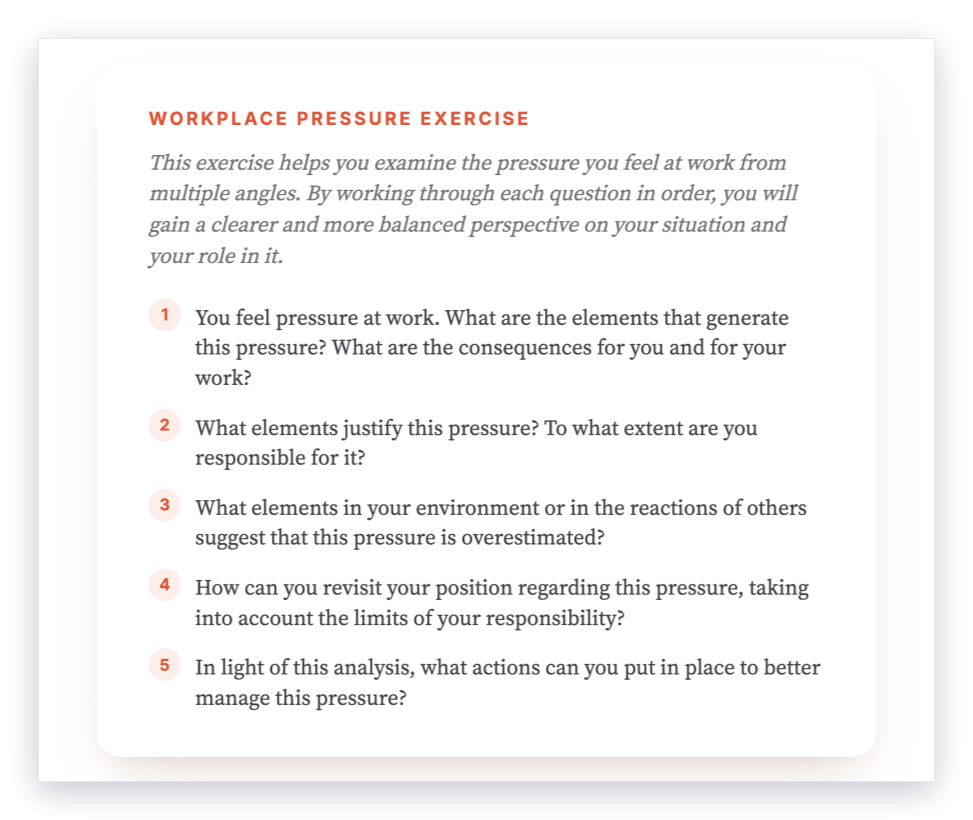
The exercise moves through five structured questions. The image above lists them in order with a brief orienting introduction.
Please note: this image is a static preview of the questions only. The full guided exercise, with patient-facing instructions, explanatory context, and space to write responses, is experienced by the patient independently in the app, not in this image.
The first question asks patients to name the sources of pressure at work and describe their consequences, building an explicit map of the stressor landscape. The second introduces a calibration move: which elements actually justify this pressure, and to what degree is the patient genuinely responsible? This targets over-attribution of responsibility, an area where the Responsibility Pie Chart and the Personalization and Self-Blame exercise offer complementary clinical scaffolding.
The third question pivots to disconfirming evidence: what do the environment and others' reactions actually show about whether this pressure is overestimated? This is a form of structured perspective-taking and follows the same logic as Challenging Negative Thoughts. The fourth question asks the patient to revise their position in light of the limits of their responsibility, consolidating the appraisal work into a more calibrated stance. The fifth translates this reappraisal into concrete regulatory actions.
Taken together, the five questions move the patient from raw distress to calibrated appraisal to planned response, a trajectory consistent with cognitive restructuring principles and with the ABC Model.
Key insight: The exercise's value lies in its sequence. It does not jump to solutions before the patient has examined what is real versus what is amplified. The action step earns its place only after a genuine appraisal has been made.
This exercise is available to patients through the mobile application that is the dedicated patient-side interface of SessionFuel: the clinician assigns it as homework, and the patient completes it directly on their phone, on their own, between two sessions.
750+ clinical tools
A library built with and for clinicians, ready to use in session and extend between appointments.
Access all the toolsUse it with your patients
Share this tool in the mobile app and follow the work between sessions.
How to Integrate It Into Your Practice
This exercise is best assigned as between-session homework to patients presenting with occupational stress, burnout risk, or chronic overcommitment. It suits patients who already have some capacity for self-reflection and who have started working on cognitive appraisal in their consultations. Patients struggling with rigid rules around professional performance or evaluating demanding standards will find it particularly generative.
When introducing it, a simple framing works well: "Between now and our next appointment, I'd like you to work through a set of questions about the pressure you've described. Take your time with each one." No preparation is needed beyond willingness to reflect.
At the following session, what the patient produces becomes clinical material in itself. Their answer to question 2 often surfaces implicit beliefs about responsibility worth exploring further with the Downward Arrow Technique or Self-Blame psychoeducation. The gap between questions 2 and 3 frequently reveals cognitive distortions such as magnification or all-or-nothing thinking. Question 5, the action plan, becomes a natural bridge to problem-solving work, work-life boundary conversations, or priority-setting with the Eisenhower Urgency-Importance Matrix.
Your session continues in your patients' pocket
Use with a patientYour resources, available everywhere
The handouts, exercises, programs and audios above: you choose which ones to make available to your patients, in the mobile app dedicated to them.
And far more than a library
The app goes well beyond resources, to support your patients every day:
Related categories
Explore other clinical resources by category.

Emotions
Clinical resources on emotion regulation: worksheets, coping tools, CBT, REBT, and ACT exercises for therapists working across diagnoses and age groups.

Transitions
Clinical hub for life transitions: tools, worksheets and exercises to support psychosocial adjustment, role change and identity work in practice.

Restructure
Clinical hub for cognitive restructuring worksheets: distortion identification, belief disputation, ABC model, and schema work for evidence-based practice.

CBT
CBT worksheets, cognitive restructuring exercises & behavioral tools for clinicians. Evidence-based resources for every phase of cognitive behavioral therapy.

Solution-focused
Clinical hub for Solution Focused Therapy resources: worksheets, exercises and programs for goal-oriented, strengths-based practice across individual and couple work.

Anxiety
Clinical hub for anxiety disorders: CBT and ACT worksheets, psychoeducation sheets, and exercises for assessment and treatment across the anxiety spectrum.