
A, a woman in her mid-thirties, presented with persistent guilt and low mood following a serious medication error at the hospital where she worked as a senior nurse. She reported a fixed belief that the incident was entirely her fault, rating her personal responsibility at 100% during the initial assessment. The clinician introduced the Responsibility Pie Chart as a structured exercise within the session, guiding A to list contributing factors before assigning her own slice: a staffing shortfall that shift, a malfunctioning electronic prescribing system, a handover conducted during a concurrent emergency, and her own documented fatigue after a double shift. When A drew the pie and added her slice last, she allocated herself roughly 25%. She did not dismiss her role, but the exercise created enough cognitive distance to begin examining what realistic accountability could look like without the weight of total self-blame.
Responsibility Pie Chart: PDF Worksheet, Tools and Exercises
A visual PDF worksheet, clinical tools, and structured exercises to help patients redistribute self-blame accurately and move from crushing guilt to honest, proportionate responsibility.
Clinical vignettes
Redistributing Blame After a Workplace Incident
Addressing Parental Guilt After a Child's Diagnosis
T, a father in his late forties, was referred following his adolescent son's diagnosis with a severe anxiety disorder; he attributed the condition entirely to his own parenting during a period of marital conflict six years earlier. In the third session the clinician offered the Responsibility Pie Chart worksheet, asking T to write down every factor that might have shaped his son's difficulties before assigning his own share. T identified genetic vulnerability on both sides of the family, school bullying that had gone undetected for two years, and a significant bereavement the son had experienced at age nine. Adding his own slice last, T settled on approximately 20%, acknowledging his contribution without erasing the other influences. The exercise did not resolve his guilt fully, but it interrupted the loop of sole self-attribution enough to allow more productive work on his current parenting behaviour.
Patients who over-attribute blame rarely shift when you address it verbally. They nod, they agree intellectually, and then they return the following week with the same looping conviction: "It was all my fault." This Responsibility Pie Chart fiche PDF gives you a concrete visual structure to interrupt that loop in session, rather than working against it with words alone.
Use this resource with your patients
Handout, exercises and materials ready to use, right inside SessionFuel.
Why Personalisation Resists Verbal Correction
Personalisation is one of the most treatment-resistant cognitive distortions precisely because it feeds on egocentric bias: the patient's own actions are the most vivid and emotionally charged in memory, so they feel disproportionately causal. Layer on hindsight bias, where the past self is judged with information only available now, and you get a cognition that is both felt as obvious and internally consistent. Oral psychoeducation tends to dent neither.
The third trap the fiche targets is all-or-nothing blame: "Either it's entirely my fault, or it's nobody's." That binary forecloses any shared-responsibility accounting before it begins. When you try to introduce nuance verbally, patients frequently experience it as absolution-seeking on your part, not as clinical reasoning. A drawn circle with labelled slices sidesteps that impasse entirely.
What the Fiche Contains and Why the Visual Layout Matters
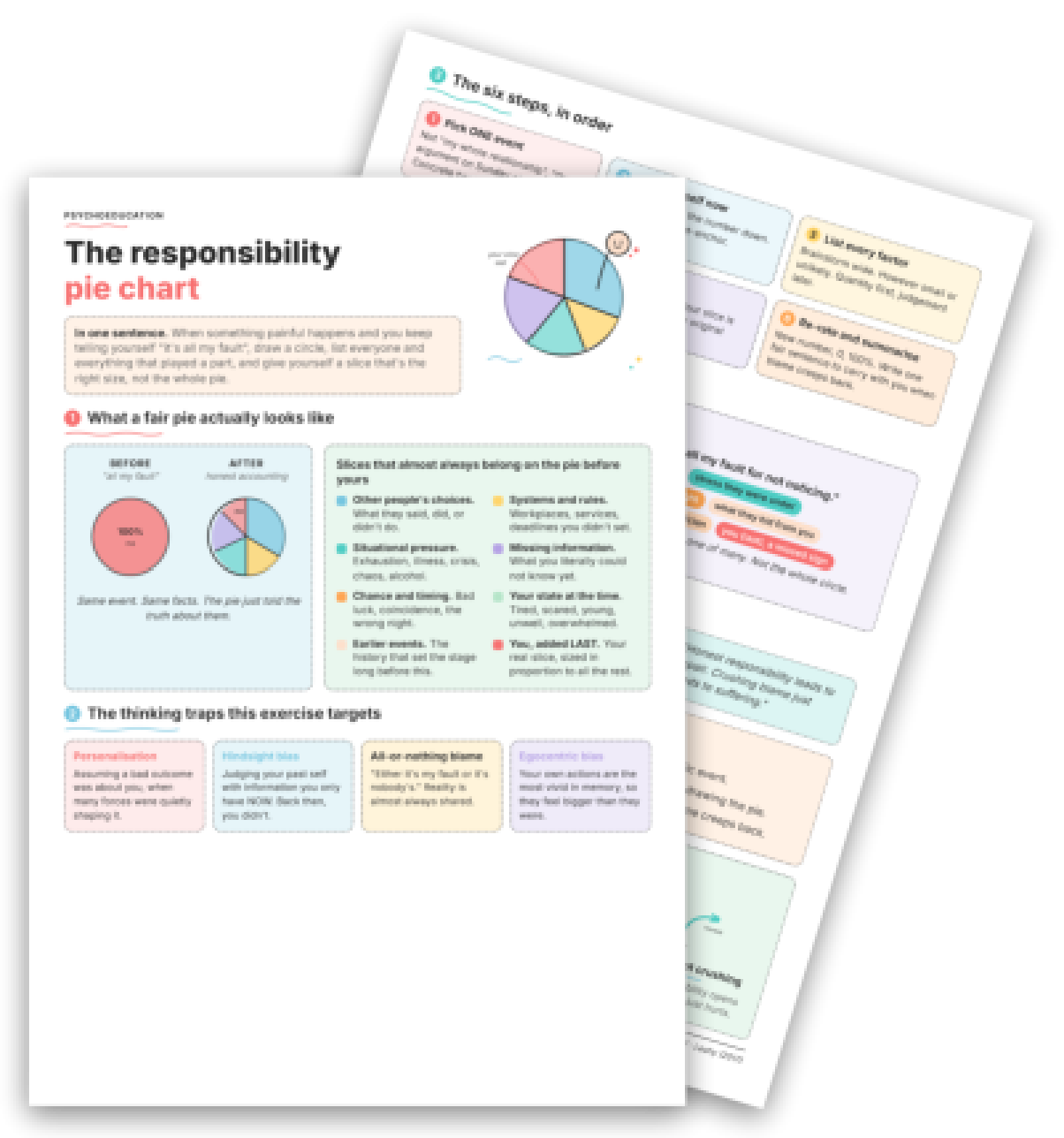
The fiche PDF is structured across five numbered panels, each building on the last. Panel 1 presents the before/after contrast explicitly: a full circle labelled "100% me" on the left, and a redistributed pie on the right, both representing the same event. That single image, shown silently, often produces more movement than several minutes of Socratic dialogue.
Panel 2 lists eight categories of factors that "almost always belong on the pie before yours": other people's choices, systemic and situational pressures, missing information, chance and timing, and the patient's own state at the time (exhaustion, fear, illness, youth). Having these categories pre-printed removes the cognitive load of generating them under emotional pressure. Panel 3 names the four thinking traps the exercise targets: personalisation, hindsight bias, all-or-nothing blame, and egocentric bias.
Panel 4 gives the six-step protocol in explicit order. The single most important instruction is structural, not cognitive: "Add your own slice LAST." This sequencing rule is the mechanism. By adding themselves after every other factor has been sized, patients experience the contraction of their slice as a direct consequence of the accounting, rather than as a therapeutic suggestion they are being asked to accept. Panel 5 offers a worked example around a friend's relapse, and the closing panel provides three carry phrases and three therapist-facing cues for continuing the work in session.
> Key takeaway: The fiche is a visual support that facilitates the explanation of personalisation during the session; the patient leaves with a concrete, drawn artefact, not a homework assignment to complete alone.
750+ clinical tools
A library built with and for clinicians, ready to use in session and extend between appointments.
Access all the toolsHow and When to Introduce It in Your Practice
This fiche is well-suited from the second or third session onward, once you have identified a recurring self-blame narrative in the anamnesis. It is particularly indicated for presentations involving guilt and excessive self-attribution, shame-laden rumination, post-traumatic presentations where the patient holds themselves responsible for what happened, and chronic personalisation patterns in the context of low self-esteem or depression.
You can introduce it without labelling the patient's cognition: "I'd like to draw something with you about this event. Before we decide what your share was, let's list everything else that was in the room." That framing positions the fiche as a joint investigation rather than a correction. Once the pie is drawn, the debrief question does most of the work: "What do you notice about your slice?" Patients typically name the shift themselves.
One clinical limit worth flagging: with patients whose prominent mode is externalisation or who habitually minimise their own agency, the fiche can reinforce avoidance of genuine responsibility. In that profile, it is contraindicated or requires a reframe before use. For trauma presentations specifically, pair it with making-mistakes self-compassion work to ensure that redistribution of blame does not simply migrate into a different form of self-attack.
Between sessions, the carry phrase "I played a part. I was not the whole story" functions as a cognitive anchor the patient can retrieve when the old loop resurfaces. The fiche does not replace the therapeutic frame; it makes the explanation more precise and leaves the patient with a drawn reference point they can return to on their own.
Use it with your patients
Share this tool in the mobile app and follow the work between sessions.
Sources
- Greenberger, D., & Padesky, C. A. (2016). Mind Over Mood: Change How You Feel by Changing the Way You Think (2nd ed.). Guilford Press.
- Padesky, C. A., & Greenberger, D. (2020). Clinician's Guide to CBT Using Mind Over Mood (2nd ed.). Guilford Press.
Your session continues in your patients' pocket
Use with a patientYour resources, available everywhere
The handouts, exercises, programs and audios above: you choose which ones to make available to your patients, in the mobile app dedicated to them.
And far more than a library
The app goes well beyond resources, to support your patients every day:
Related categories
Explore other clinical resources by category.

Anxiety
Clinical hub for anxiety disorders: CBT and ACT worksheets, psychoeducation sheets, and exercises for assessment and treatment across the anxiety spectrum.

Trauma
Clinical hub on trauma and PTSD: assessment, differential diagnosis, treatment phases, and printable resources for practitioners. 155 chars.

Identity
Clinical resources for self-identity work in therapy: CBT, ACT, schema tools for clinicians addressing self-concept, core beliefs, and identity disruption.

Cognition
Printable cognitive therapy worksheets and clinical tools for therapists: CBT, ACT, schema work, defusion, distortions, and belief restructuring.

Build awareness
Clinical worksheets and tools to build awareness in therapy: cognitive distortions, schemas, emotions, ACT and CBT resources for practitioners.

Restructure
Clinical hub for cognitive restructuring worksheets: distortion identification, belief disputation, ABC model, and schema work for evidence-based practice.