
Clinical picture. A., a 34-year-old professional, presents with chronic work-related anxiety and recurrent self-critical rumination after minor errors. During a session, she identifies the automatic thought: I made a mistake in that report, so my manager will think I am incompetent. The clinician introduces the downward arrow exercise, prompting her to ask repeatedly what it would mean if each successive thought were true. After four iterations, A. arrives at the core belief: I am only acceptable if I perform flawlessly, because otherwise I am fundamentally not enough. She is then invited to articulate one alternative belief she finds even partially credible, settling on: My value is not contingent on the absence of error. She notes that formulating this alternative does not resolve the anxiety immediately, but gives her a concrete reference point to return to between sessions.
Downward Arrow: Tracing a Negative Thought to Its Core Belief
A guided exercise helping patients move from a surface automatic thought to the deep core belief driving it, then build a genuine alternative.
Clinical vignettes
Perfectionism Traced to Unworthiness
Social Withdrawal Linked to Core Shame
Clinical picture. T., a man in his late forties referred for low mood and progressive social withdrawal, reports the recurring thought: If I speak up in a group, people will find me ridiculous. The clinician guides him through the downward arrow sequence in written form between sessions, using the exercise questions as a structured worksheet. Working through three successive implications, T. identifies the underlying core belief: I am inherently different from others and will inevitably be rejected if I am truly seen. He returns the following week having also drafted two alternative beliefs, one of which he rates as moderately believable: Some people have found my perspective worth hearing. The clinician notes this as a working hypothesis rather than a conclusion, and they agree to test it against upcoming social situations.
Why Core Belief Work Is Hard to Hand Over to Patients
The gap between spotting an automatic thought and reaching the core belief underneath it is one of the trickiest distances in CBT. Clinicians can explain the vertical descent in session, draw the iceberg, use the Downward Arrow Technique worksheet as a shared map, and still find that patients leave the consultation without the experiential grasp of the process. Understanding it intellectually is not the same as going through it oneself. What patients often need is a structured opportunity to run the descent autonomously, at their own pace, with a thought that is live and personally charged rather than a worked example on a printed sheet. That is precisely the gap this exercise fills.
This exercise is available to patients through the SessionFuel patient app, the mobile interface reserved for patients whose clinician uses SessionFuel. The clinician assigns it directly, and the patient completes it on their own phone, between appointments, at a time that suits them.
The Cognitive Case Formulation tool and the Core Beliefs: Examining the Evidence worksheet are powerful in-session anchors. But they belong to the clinician's side of the work. This exercise belongs to the patient.
Use this resource with your patients
Handout, exercises and materials ready to use, right inside SessionFuel.
What the Exercise Contains
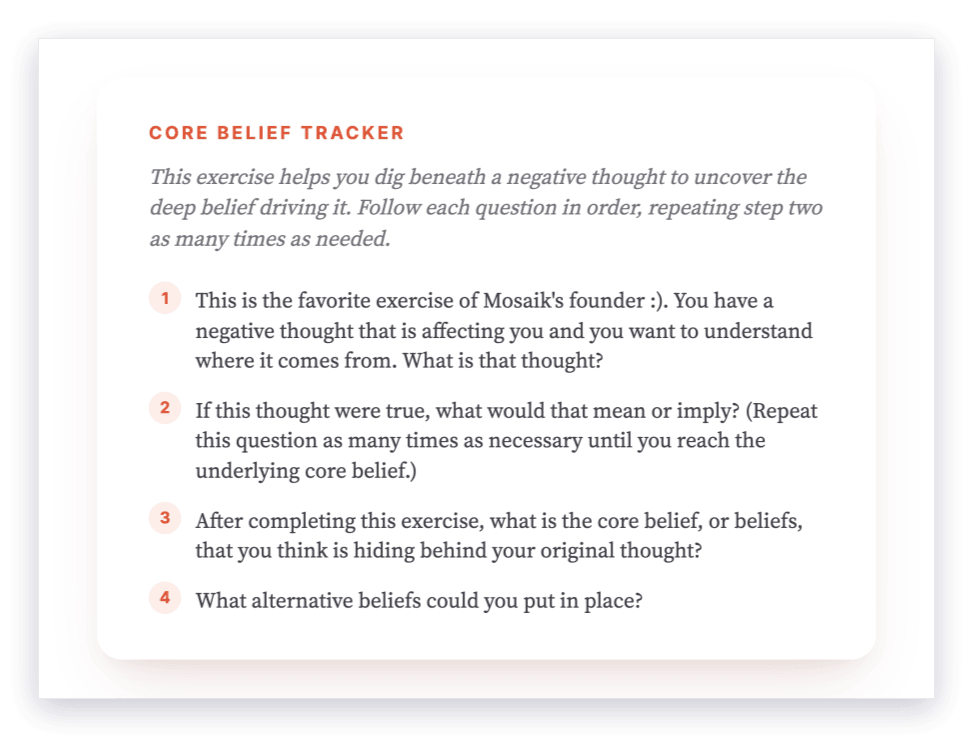
The image above lists the four questions in order, with a short introductory framing. Please note that this image is a static preview of the question structure only. The patient never sees this image; they experience the full guided exercise, with patient-facing instructions, space to write, and a progressive flow, directly in the app, on their own.
The exercise opens by asking the patient to name a specific negative thought that is currently affecting them. It then applies the core downward-arrow logic: "If this thought were true, what would it imply?" The patient is invited to repeat this move as many times as necessary until they can no longer go deeper, until they reach what the exercise names a deep underlying belief. After the descent, they are asked to identify the belief (or beliefs) they found. The final question opens the restructuring phase: what alternative beliefs could take its place?
The structure is deliberate. It is the same four-move sequence that underpins tools such as Clarifying a Core Belief and Replacing a Negative Core Belief, but here the patient navigates the full arc independently, from surface thought to deep schema to alternative, without the clinician present to guide each step. That autonomy is clinically significant: it means the patient owns the discovery.
Key insight: The downward-arrow movement only produces durable clinical material when the patient runs it on a thought that is emotionally live for them. An autonomous exercise makes that possible in a way that an in-session demonstration rarely does.
750+ clinical tools
A library built with and for clinicians, ready to use in session and extend between appointments.
Access all the toolsUse it with your patients
Share this tool in the mobile app and follow the work between sessions.
Integrating It as Between-Session Homework
This exercise suits patients who have already been introduced to the idea that automatic thoughts are not the whole story, that surface cognitions rest on deeper layers. Patients working on low self-esteem, perfectionism, or approval-seeking patterns are often excellent candidates, as are those who report recurrent distressing thoughts without being able to articulate why those thoughts feel so absolute.
To introduce it, you might frame it this way: "When a thought bothers you significantly this week, I would like you to use this exercise to follow it downward. You will be looking for the belief underneath it, not just the thought itself." Pairing it with an exercise such as Automatic Thoughts: A Guided Cognitive Restructuring Exercise or Cognitive Restructuring When Patients Feel Bad helps patients who are still building the habit of thought monitoring before going deeper.
At the following session, the patient's written output gives you direct access to their working formulation. The belief they identified in question 3 can be compared against your own Cognitive Case Formulation or cross-referenced with exercises like My Beliefs: A Guided Core Belief Self-Reflection Exercise and Tracing the Origin of Core Beliefs. The alternative belief generated in question 4 becomes the starting point for consolidation work using Reinforcing a New Core Belief or Restructuring a Negative Core Belief. The patient arrives with material; the session can go straight to depth.
Your session continues in your patients' pocket
Use with a patientYour resources, available everywhere
The handouts, exercises, programs and audios above: you choose which ones to make available to your patients, in the mobile app dedicated to them.
And far more than a library
The app goes well beyond resources, to support your patients every day:
Related categories
Explore other clinical resources by category.
Anxiety
Clinical hub for anxiety disorders: CBT and ACT worksheets, psychoeducation sheets, and exercises for assessment and treatment across the anxiety spectrum.

Mood
Evidence-based worksheets and clinical tools for mood disorders: CBT, ACT, and positive psychology resources for psychologists and therapists.

Identity
Clinical resources for self-identity work in therapy: CBT, ACT, schema tools for clinicians addressing self-concept, core beliefs, and identity disruption.

Emotions
Clinical resources on emotion regulation: worksheets, coping tools, CBT, REBT, and ACT exercises for therapists working across diagnoses and age groups.

Behaviours
Clinical hub for behaviors in therapy: worksheets and tools for coping, eating disorders, CBT formulation, and maladaptive behavioral patterns.

Cognition
Printable cognitive therapy worksheets and clinical tools for therapists: CBT, ACT, schema work, defusion, distortions, and belief restructuring.