
Clinical picture. M., a 34-year-old with recurrent depressive disorder and a history of workplace humiliation, was convinced she would 'freeze and embarrass herself' at an upcoming job interview and had already considered withdrawing her application. The clinician introduced the exercise as between-session homework, asking her to write out her predicted scenario in detail before working through the remaining questions. Reflecting on question two, M. identified that a single failed presentation at age 22 had calcified into a general rule about her competence in evaluative situations. Question three surfaced a pattern she had not previously articulated: each avoided interview reinforced the belief and narrowed her professional options over time. She attended the interview; her performance was unremarkable in the best sense, and the exercise gave her a concrete framework she could reapply independently.
Fortune Telling and Negative Predictions: A CBT Exercise
A structured guided homework tool to help patients examine, cost, and prepare for their worst-case predictions between therapy sessions.
Clinical vignettes
Job Interview Dread, Avoidance Avoided
Social Gathering, Catastrophic Script Examined
Clinical picture. T., a 41-year-old with social anxiety disorder, predicted with near-certainty that he would 'say something stupid' at a colleague's birthday gathering and that everyone would notice and judge him. During the session preceding the event, the clinician assigned the written exercise, and T. returned the following week with responses to all four questions. His answer to question two revealed a longstanding family narrative that he was 'the awkward one,' a label he had absorbed without scrutiny. Preparing a brief contingency plan for question four, specifically deciding in advance how he would exit politely if distress became unmanageable, reduced anticipatory arousal enough that he attended for ninety minutes. The outcome was unremarkable, which itself became clinically useful material.
Why negative predictions resist conversation alone
Patients who chronically predict failure or disaster rarely lack awareness that their thinking might be skewed. What they lack is a method for pausing the prediction long enough to examine it. Telling them in the consulting room that they are engaging in fortune telling rarely moves the needle. The distortion feels like fact, not inference. It is experienced as lived certainty, not hypothesis.
What makes this particular pattern clinically stubborn is the invisible cost it carries. The prediction does not just distort reality; it drives avoidance and narrows the patient's life in ways that confirm the very belief underlying it. Pointing that out verbally often produces intellectual agreement without behavioral shift. A patient needs to trace the logic themselves, in their own words, on their own time, for the restructuring to have any traction. That is exactly what this exercise creates the conditions for.
Use this resource with your patients
Handout, exercises and materials ready to use, right inside SessionFuel.
What this exercise contains
The four questions are tightly sequenced and each does specific clinical work.
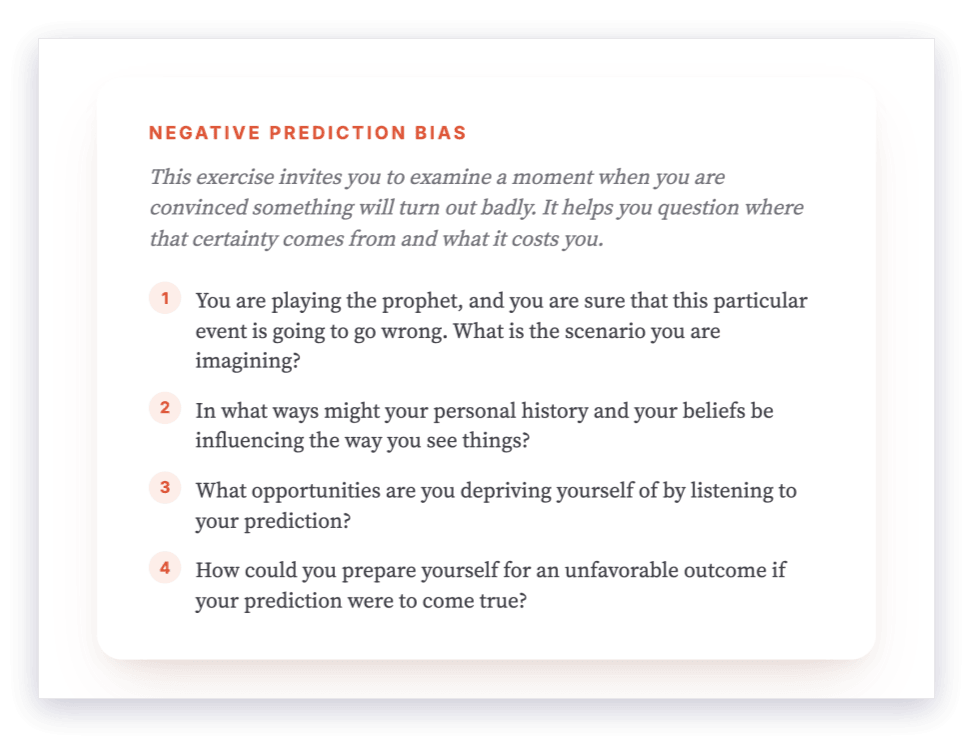
The first question asks the patient to name the specific catastrophic scenario they are anticipating, playing out the role of "prophet." This step makes the prediction concrete and separable from the patient as a person, creating the observational distance that cognitive defusion and cognitive restructuring both depend on.
The second question turns attention toward personal history and belief systems as sources of interpretive bias. This connects the present prediction to deeper material, which is useful groundwork for later core belief work and allows patients to begin seeing the prediction as a product of their own lens rather than an objective reading of reality. It pairs naturally with resources on arbitrary inference and the broader cognitive distortions framework.
The third question addresses opportunity cost: what the patient is actively giving up by treating the prediction as reliable. This is the behavioral lever. It links the thought directly to its functional consequences, echoing the logic of evaluating thought utility and making the real price of the prediction visible to the patient themselves.
The fourth question is a coping preparation prompt: if the feared outcome did occur, how would the patient manage it? This move is classically decatastrophizing in its effect. It reduces the psychological enormity of the feared event without dismissing it, and builds genuine coping confidence. It complements anticipatory fear work and the risk-weighted decision-making exercise.
The image above lists the four questions in order. Note that this is a static preview of the question structure only. The full guided exercise, complete with patient-facing instructions and space to write, is what the patient actually works through autonomously in the app.
This exercise is available to patients through the patient app of SessionFuel, the mobile application reserved for the patients of clinicians who use SessionFuel: you assign the exercise directly from your clinician interface, and the patient completes it on their own, on their phone, between two appointments.
750+ clinical tools
A library built with and for clinicians, ready to use in session and extend between appointments.
Access all the toolsIntegrating it as between-session homework
This exercise is well suited to patients presenting with anticipatory anxiety, avoidance patterns linked to negative outcome expectations, or worry that has become action-blocking. It also fits patients who intellectually accept the concept of catastrophizing but have not yet connected it to their own specific thought sequences.
To introduce it, you do not need a long preamble. Identify a concrete upcoming event the patient is dreading, name the prediction pattern briefly, and assign the exercise as work to carry out between this session and the next. The specificity of question one does the rest: it anchors the exercise in lived experience rather than abstract theory.
When the patient returns, the written answers give you precise clinical material. Question two often surfaces early beliefs or formative experiences worth exploring. Question three regularly reveals the behavioral costs the patient had not previously articulated. Question four sometimes catches the patient by surprise: finding that they could cope is, for some, the first genuine shift.
Key insight: The real clinical value of this exercise is that it turns a felt certainty into an object of inquiry the patient constructs themselves, which makes the restructuring far more durable than any question you could ask in the room.
Use it with your patients
Share this tool in the mobile app and follow the work between sessions.
Articulating it with related tools
This exercise pairs naturally with the Catastrophizing: A Structured Decatastrophizing Exercise for patients who need broader evidence-weighing alongside prediction examination. The Fortune Telling worksheet is a strong psychoeducation companion to introduce the distortion before assigning the exercise. For patients whose predictions are rooted in deeper challenging anxious thoughts patterns, coupling this homework with control, influence, and acceptance work can consolidate the gains across sessions.
Your session continues in your patients' pocket
Use with a patientYour resources, available everywhere
The handouts, exercises, programs and audios above: you choose which ones to make available to your patients, in the mobile app dedicated to them.
And far more than a library
The app goes well beyond resources, to support your patients every day:
Related categories
Explore other clinical resources by category.

Anxiety
Clinical hub for anxiety disorders: CBT and ACT worksheets, psychoeducation sheets, and exercises for assessment and treatment across the anxiety spectrum.

Mood
Evidence-based worksheets and clinical tools for mood disorders: CBT, ACT, and positive psychology resources for psychologists and therapists.

Emotions
Clinical resources on emotion regulation: worksheets, coping tools, CBT, REBT, and ACT exercises for therapists working across diagnoses and age groups.

Behaviours
Clinical hub for behaviors in therapy: worksheets and tools for coping, eating disorders, CBT formulation, and maladaptive behavioral patterns.

Cognition
Printable cognitive therapy worksheets and clinical tools for therapists: CBT, ACT, schema work, defusion, distortions, and belief restructuring.

Restructure
Clinical hub for cognitive restructuring worksheets: distortion identification, belief disputation, ABC model, and schema work for evidence-based practice.