
Clinical picture. M., a woman in her early forties, presents with generalized anxiety and a persistent automatic thought along the lines of I am going to embarrass myself, which surfaces reliably before professional meetings and triggers anticipatory shame and avoidance. Her therapist introduced the four-question exercise as a between-session task, asking her to complete it in writing within 48 hours of the thought's next occurrence. At the following session, M. reported that question 3 had been unexpectedly difficult: she initially struggled to identify any contradicting evidence, then recalled three recent meetings that had gone without incident. By the fourth question, she drafted the alternative I have managed difficult meetings before and I can ask for clarification if needed, which she described as believable rather than merely reassuring. Avoidance behavior did not resolve immediately, yet she attended the next meeting without canceling, which she identified as a meaningful shift.
Automatic Thoughts: A Guided Cognitive Restructuring Exercise
Help patients describe, contextualize, challenge, and replace unwanted automatic thoughts with a structured four-question between-session tool.
Clinical vignettes
Challenging a Recurrent Self-Critical Thought
Contextualizing an Intrusive Worthlessness Belief
Clinical picture. T., a man in his mid-thirties with a depressive episode in partial remission, reported an automatic thought of I am a burden to everyone around me that he experienced as ego-syntonic and therefore resistant to challenge. His therapist proposed the written exercise, emphasizing that question 2 (context of last occurrence) was the starting point, as T. tended to treat the thought as a timeless fact rather than a context-bound event. He noted that the thought had appeared after his partner left the room during a conversation, an ordinary moment he had interpreted as rejection. Working through question 3, he identified that his partner had returned within minutes and had initiated physical contact, evidence he had not registered at the time. The alternative thought he constructed at question 4 was tentative but grounded: When I feel like a burden, I may be reading the situation through the lens of low mood rather than through what is actually happening. His therapist recorded this as a modest but consolidable gain in metacognitive flexibility.
The clinical challenge: what makes automatic thoughts so hard to shift
Automatic thoughts are, by definition, fast, involuntary, and often felt as truth rather than interpretation. Patients know them well, they surface the moment you ask, yet they struggle to do anything useful with them outside the consultation room. The work of identifying automatic thoughts and then challenging them depends on a skill most patients have not yet built: the capacity to slow down, observe, and question a thought that feels entirely self-evident.
Verbal explanation in session is rarely enough. A patient can nod at the logic of cognitive restructuring and still be captured by the same thought forty-eight hours later. What breaks the pattern is repeated, autonomous practice: catching the thought in its natural context, putting it into words, and working through a structured questioning sequence. That is precisely the gap this exercise fills.
This exercise is available to patients through the patient app of SessionFuel, the clinician assigns it directly, and the patient completes it on their own, on their phone, between appointments, without any session time required.
Use this resource with your patients
Handout, exercises and materials ready to use, right inside SessionFuel.
What the exercise contains: four questions, one complete restructuring arc
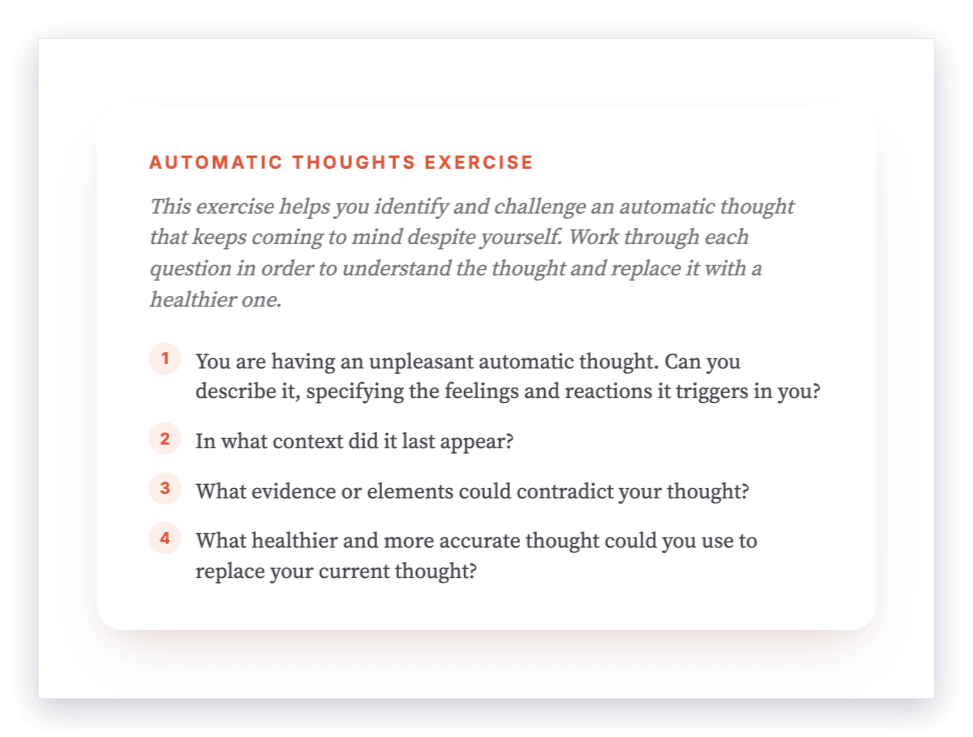
The image above lists the four questions in order. This is a static preview only, the full guided experience, with patient-facing instructions and space to write, is what the patient encounters when they open the exercise in the app on their own. The image is a reference for the clinician, not the exercise itself.
The four questions follow a clear clinical arc. The patient begins by describing the unwanted automatic thought and naming the feelings and reactions it produces, grounding the work in a concrete emotional experience rather than abstraction. The second question asks for the last specific context in which the thought appeared, anchoring it situationally rather than letting it feel universal or inevitable. This step alone does meaningful work: situational anchoring is the first move toward tracing a thought back to its origins.
The third question invites the patient to gather disconfirming evidence, elements that contradict the thought. This is the core of the evidence-weighing process and the moment where cognitive distortions become visible: a patient who cannot find any contradicting element is often running a mental filter or all-or-nothing thinking. The fourth question closes the loop by asking for a healthier, more accurate replacement thought, converting the intellectual challenge into a formulated alternative the patient can actually use.
Key insight: The exercise does not ask patients to suppress or dismiss the automatic thought. It asks them to examine it and build something more accurate in its place, a distinction that matters clinically and that patients notice.
750+ clinical tools
A library built with and for clinicians, ready to use in session and extend between appointments.
Access all the toolsUse it with your patients
Share this tool in the mobile app and follow the work between sessions.
How to integrate it as between-session homework
Assign this exercise when a patient has already named at least one recurrent automatic thought in session and can describe roughly when it tends to appear. It suits patients at any stage of CBT work who have enough distance from their distress to write about it reflectively, including those working on overgeneralization, catastrophizing, mind reading, or personalization. It is also a natural fit for patients in the middle of an inner dialogue psychoeducation program who need structured practice between program lessons.
Introduce it simply: explain that the exercise is designed to be completed the next time the thought appears, or shortly after, while the emotional context is still fresh. Ask the patient to assign it as a task to carry out between sessions, not to wait until the following appointment to think it through.
When the patient returns, the written answers give you immediate clinical material. The replacement thought (question 4) tells you whether the patient is genuinely building an alternative or producing a surface-level positive reframe, and that distinction drives your next session directly. The disconfirming evidence (question 3) reveals which cognitive distortions are still operating. The situational context (question 2) may point toward a trigger pattern worth mapping, particularly if it connects to work already underway on core beliefs or demanding standards.
Over several repetitions, this exercise builds the metacognitive habit that makes evaluating thought utility automatic, the patient begins doing in daily life what the questions taught them to do on paper.
Your session continues in your patients' pocket
Use with a patientYour resources, available everywhere
The handouts, exercises, programs and audios above: you choose which ones to make available to your patients, in the mobile app dedicated to them.
And far more than a library
The app goes well beyond resources, to support your patients every day:
Related categories
Explore other clinical resources by category.

Anxiety
Clinical hub for anxiety disorders: CBT and ACT worksheets, psychoeducation sheets, and exercises for assessment and treatment across the anxiety spectrum.

Mood
Evidence-based worksheets and clinical tools for mood disorders: CBT, ACT, and positive psychology resources for psychologists and therapists.

Identity
Clinical resources for self-identity work in therapy: CBT, ACT, schema tools for clinicians addressing self-concept, core beliefs, and identity disruption.

Emotions
Clinical resources on emotion regulation: worksheets, coping tools, CBT, REBT, and ACT exercises for therapists working across diagnoses and age groups.

Behaviours
Clinical hub for behaviors in therapy: worksheets and tools for coping, eating disorders, CBT formulation, and maladaptive behavioral patterns.

Cognition
Printable cognitive therapy worksheets and clinical tools for therapists: CBT, ACT, schema work, defusion, distortions, and belief restructuring.