
Clinical picture. T., a woman in her late thirties, presented with recurrent depressive episodes underpinned by the core belief "I am fundamentally defective." After several months of schema-focused CBT, she had intellectually accepted an alternative belief ("I am a person who makes mistakes and still has worth") yet reported that it felt "theoretical" rather than felt. The clinician introduced the four-question reinforcement exercise as a between-session task, asking T. to write out the new belief, identify concrete evidence of its truth relative to her stated values of honesty and care, name her residual doubts, and then consider whether she would transmit this belief to a child she cared for. At the following session T. noted that the fourth question had shifted something: articulating why she would teach the belief to a child revealed a double standard she had not previously noticed. The new belief did not feel fully settled, but her conviction rating increased from 20% to 45%, providing a foothold for continued consolidation work.
Reinforcing a New Core Belief: A Guided CBT Exercise
A structured four-question homework exercise helping patients consolidate an alternative belief and move from intellectual insight to genuine internalization.
Clinical vignettes
Consolidating a Belief After Chronic Shame
Testing a New Belief in Generalized Anxiety
Clinical picture. M., a man in his mid-forties with generalized anxiety disorder, had spent years operating under the assumption "I must be in control at all times or something will go wrong." Through cognitive restructuring he had drafted an alternative belief ("I can tolerate uncertainty and manage difficulties as they arise") but struggled to move beyond rote repetition of the phrase. The clinician assigned the guided exercise with instructions to answer each question in writing before the next appointment. When M. returned, his response to the third question revealed a specific doubt: he feared that accepting uncertainty meant becoming passive. Reviewing his written answer to the fourth question, which asked how he would frame the belief for a child, helped him articulate the distinction between helpless passivity and adaptive flexibility. The exercise did not resolve his anxiety, but it gave him a concrete reference point to revisit when the old belief resurfaced during the week.
The Clinical Gap This Exercise Addresses
Belief change work rarely stalls at the cognitive level. Most patients who have worked through core belief restructuring can articulate a new belief when asked. What they struggle with is feeling it as real. There is a well-documented gap between a patient who has constructed an alternative belief in the consulting room and one who has genuinely internalized it, who reaches for it spontaneously when the old pattern fires.
That gap is hard to close through conversation alone. The moment a new belief is proposed, residual doubts surface and, if left unexamined, quietly erode the work done. Patients need a structured opportunity to sit with the new belief on their own, test its truthfulness against their lived experience, name their objections honestly, and find their own answers to those objections. That is what this exercise is built to provide.
Key insight: The consolidation phase of belief change is not a passive process. Assigning structured between-session practice is what separates a belief a patient can repeat from one they can actually use.
Use this resource with your patients
Handout, exercises and materials ready to use, right inside SessionFuel.
What the Exercise Contains
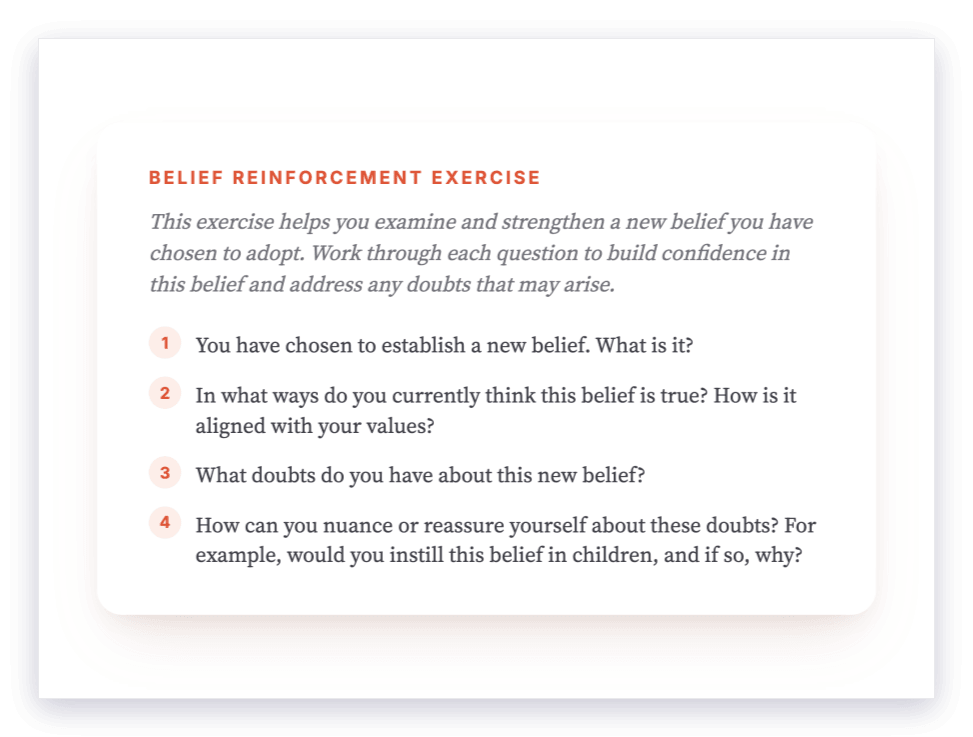
The exercise opens by asking the patient to state the new belief they have chosen to work with. This reactivates the commitment and makes it concrete rather than abstract. The second question asks them to find current, real-world evidence that this belief is true, and to reflect on how it aligns with their personal values. This step is pivotal: it moves the work from logic toward lived authenticity, which is what makes alternative beliefs durable rather than decorative.
The third question invites the patient to name their doubts about the new belief openly. This is a deliberate move. Suppressing doubt keeps it powerful; surfacing it gives the clinician and patient something to work with. The fourth and final question asks the patient to nuance or self-reassure around those doubts, including a striking prompt: would you teach this belief to a child, and why? That question recruits a compassionate self-observer and a values lens simultaneously, two levers that pure Socratic disputation sometimes misses.
The image above lists all four questions in order, with a short introductory framing. This is a static preview only: the full guided exercise, with patient-facing instructions and space to write responses, is what the patient experiences autonomously on their own device. That interactive format is not captured here.
This exercise is available to patients through the mobile application that is the dedicated patient-side interface of SessionFuel: once you assign it in your SessionFuel account, your patient receives it directly on their phone and completes it on their own, between sessions.
750+ clinical tools
A library built with and for clinicians, ready to use in session and extend between appointments.
Access all the toolsUse it with your patients
Share this tool in the mobile app and follow the work between sessions.
Integrating This Exercise Into Your Practice
This exercise belongs at the consolidation stage of belief work, not at the start. It presupposes that the patient has already identified a problematic core belief, perhaps through a downward arrow exploration or a clarifying exercise, and has actively constructed an alternative. It pairs naturally after Replacing a Negative Core Belief or after working through the restructuring worksheet in session.
Profiles it suits best: patients in the mid-to-late phase of CBT or schema-informed work; patients who show intellectual grasp of their new belief but whose emotional ratings of conviction remain low; patients prone to self-doubt who need structured permission to voice their objections rather than pushing them down.
How to introduce it: a simple framing works well. Tell the patient that new beliefs need active practice to take hold, and that this exercise gives them a private space to test theirs honestly, doubts included. If they have been working with tools like Examining the Evidence on Core Beliefs or Scaling Beliefs About Yourself, you can position this as the next step in a familiar sequence.
On return: the richest clinical material usually comes from questions three and four. The doubts the patient writes down are a direct window into residual schema pull and into which old belief is pushing back. The child-teaching rationale they construct often reveals the compassionate inner position they can access but have not yet extended to themselves, a thread worth following in the next session.
For patients working within a broader program, this exercise fits naturally alongside the Depression and Limiting Beliefs program or the Anxiety and Limiting Beliefs program, and can complement tracing the origins of core beliefs earlier in the sequence.
Your session continues in your patients' pocket
Use with a patientYour resources, available everywhere
The handouts, exercises, programs and audios above: you choose which ones to make available to your patients, in the mobile app dedicated to them.
And far more than a library
The app goes well beyond resources, to support your patients every day:
Related categories
Explore other clinical resources by category.
Anxiety
Clinical hub for anxiety disorders: CBT and ACT worksheets, psychoeducation sheets, and exercises for assessment and treatment across the anxiety spectrum.

Mood
Evidence-based worksheets and clinical tools for mood disorders: CBT, ACT, and positive psychology resources for psychologists and therapists.

Identity
Clinical resources for self-identity work in therapy: CBT, ACT, schema tools for clinicians addressing self-concept, core beliefs, and identity disruption.

Behaviours
Clinical hub for behaviors in therapy: worksheets and tools for coping, eating disorders, CBT formulation, and maladaptive behavioral patterns.

Cognition
Printable cognitive therapy worksheets and clinical tools for therapists: CBT, ACT, schema work, defusion, distortions, and belief restructuring.

Restructure
Clinical hub for cognitive restructuring worksheets: distortion identification, belief disputation, ABC model, and schema work for evidence-based practice.