
Clinical picture. M., a woman in her mid-forties, presented with a recurrent depressive episode and persistent low self-worth; she described feeling chronically inadequate at work despite objective evidence to the contrary. Between the second and third appointments, she completed Lesson 1 of the psychoeducation program, which introduced the concept of core beliefs and prompted her to note the themes of her automatic negative thoughts. At the following appointment she brought a written response to the prompt asking what she felt she must do to be loved, having identified the underlying belief that she was only acceptable when productive. The clinician used this material as a starting point for collaborative examination, rather than introducing the concept from scratch. M. expressed mild surprise that the belief had been so stable across different life areas, which opened a productive discussion about how beliefs function in depression.
Depression and Limiting Beliefs: A 4-Lesson Clinical Program
A structured psychoeducation program helping patients identify, challenge, and replace the core beliefs that sustain depression, step by step.

Clinical vignettes
Surfacing a Hidden Belief in Session
Recognising Belief Rigidity Over Lessons
Clinical picture. T., a man in his early thirties with a first depressive episode, initially reported that his negative thinking felt factual rather than interpretive, making psychoeducational framing difficult to accept. His clinician introduced the multi-lesson program gradually, beginning with Lesson 1 and asking T. to complete only the reflective prompts before their next meeting. By Lesson 2, which guides patients through tracing automatic thoughts back to underlying beliefs, T. identified a recurrent belief around intellectual inadequacy concentrated in academic and professional domains. He returned to the appointment able to name the belief explicitly and to recall a period in adolescence when it had been less fixed, which corresponded to the program step inviting reflection on beliefs that had already shifted over time. Progress remained slow, consistent with his overall presentation, but the structured lesson format gave him a concrete personal reference point that verbal explanation alone had not provided.
Use this resource with your patients
Handout, exercises and materials ready to use, right inside SessionFuel.
The clinical challenge: what words alone cannot shift
Depression is not only a mood disorder. It is, in large part, a belief system, a lattice of silent convictions about the self, others, and the future that filter every incoming experience and reinforce the low mood that generated them in the first place. You can describe the mechanism in session; patients nod. Yet the conviction that "I am defective" or "nothing will ever improve" does not loosen simply because a clinician names it.
What makes this hard to convey verbally is threefold. First, core beliefs are not conscious propositions, they operate like background assumptions, visible only through the automatic thoughts they generate. Second, the patient's mind actively recruits evidence in their favour (the Core Belief Magnet Metaphor is a useful clinical illustration of this filtering mechanism). Third, shifting a belief requires repeated, graduated cognitive and behavioural work across time, not a single in-session explanation. The Cycle of Depression makes this maintenance loop visible, but naming it is not enough: patients need a structured path to walk through on their own, between appointments.
What the program contains
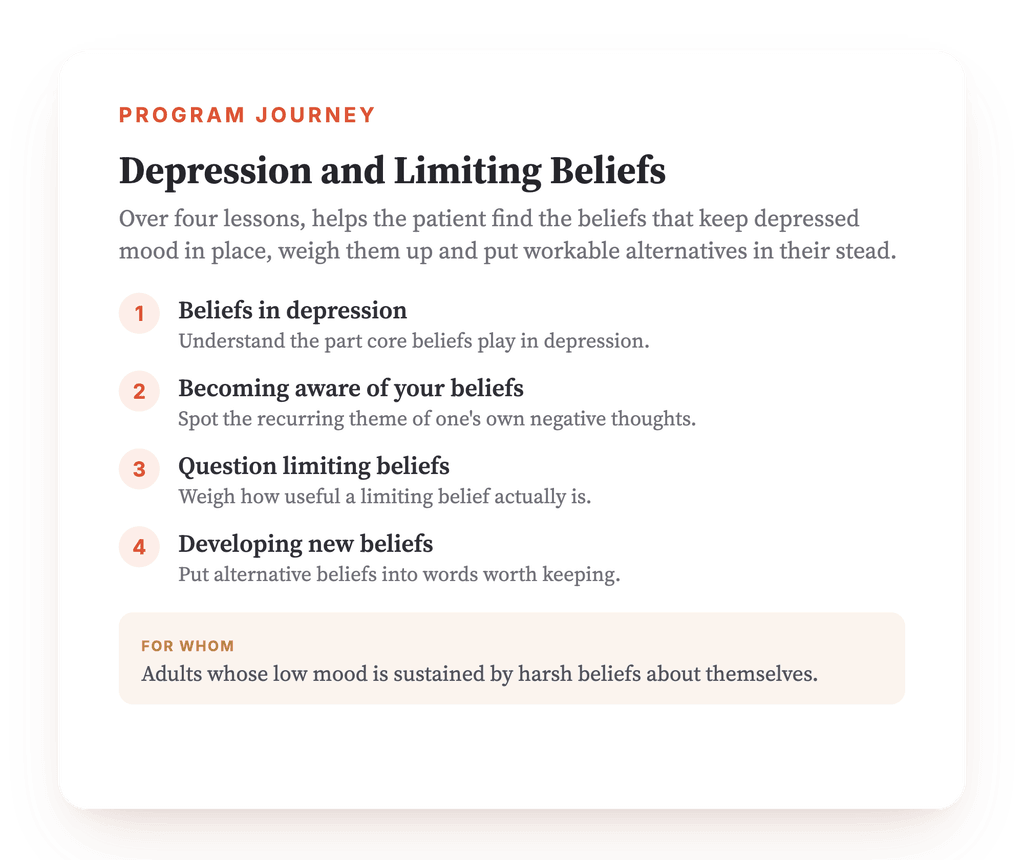
Depression and Limiting Beliefs is a four-lesson psychoeducation curriculum patients complete autonomously, step by step. Each lesson builds on the previous one and combines explanatory text, guided reflective prompts, and multiple-choice self-assessments.
-
Lesson 1, Beliefs in depression: Grounds the work conceptually. Patients learn what a core belief is, how negative generalisations about the self, the world, and the future crystallise in depression, and, critically, that beliefs can change. A reflection prompt asks them to recall a negative belief they once held that has since evolved, creating an experiential anchor for the programme's optimism.
-
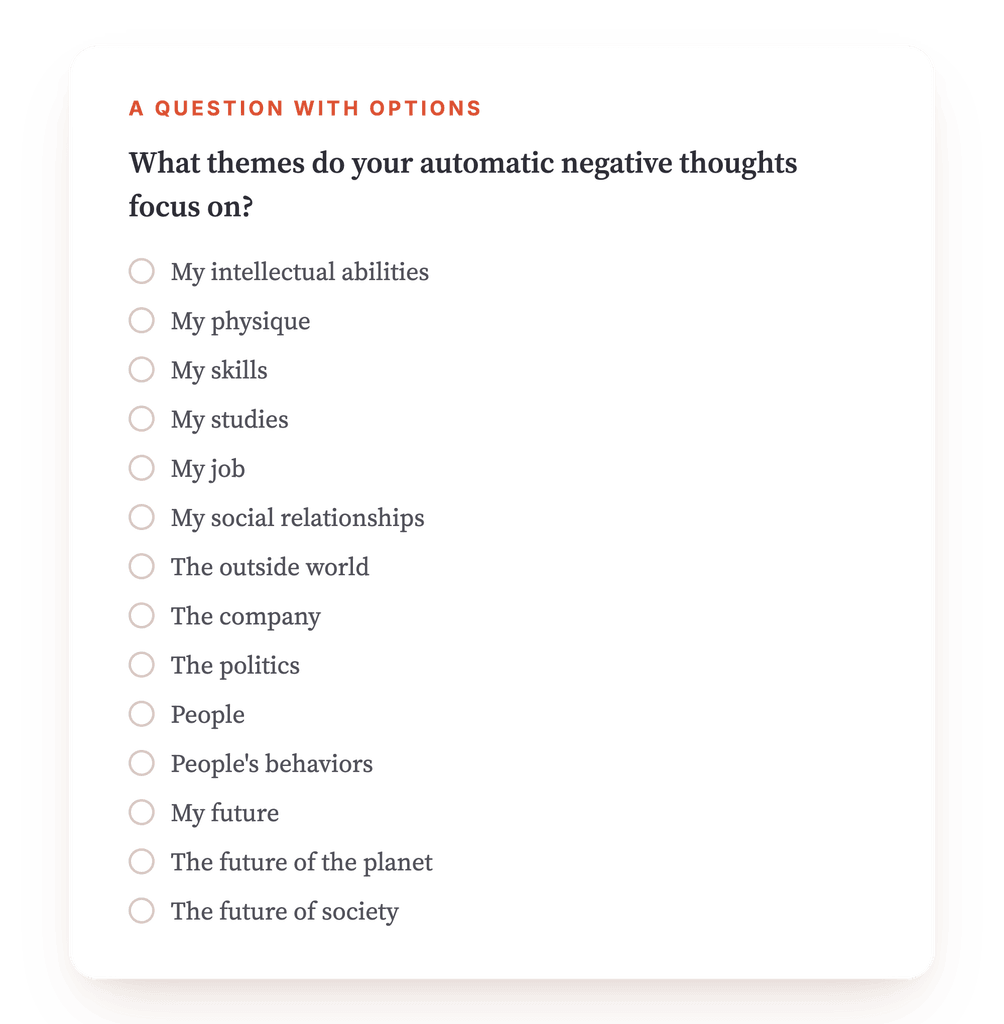
Lesson 2, Becoming aware of one's beliefs: Moves from concept to detection. Patients trace their automatic thoughts to intermediate beliefs and then to core beliefs using the downward arrow technique, the same procedure formalised in the Downward Arrow Technique worksheet and the guided exercise Downward Arrow: Tracing a Negative Thought to Its Core Belief. They categorise their beliefs (helplessness, unlovability, inferiority, and related themes) and are warned that this can be emotionally unsettling, preparing them for the affect that discovery provokes.
-
Lesson 3, Challenging limiting beliefs: Teaches three concrete tools: questioning a belief's utility, auditing the evidence for and against it (as in Core Beliefs: Examining the Evidence), and designing behavioural experiments to test the belief empirically. The lesson also introduces cognitive distortions, notably all-or-nothing thinking, directing patients to examine their reasoning errors, a topic developed further in the All-or-Nothing Thinking worksheet and the broader Cognitive Distortions guide.
-
Lesson 4, Developing new beliefs: Guides patients toward actively constructing alternative beliefs, acting as if the contrary of the limiting belief were true, cataloguing personal strengths, rewriting self-talk, selecting positive affirmations, and practising acceptance of negative events. It complements the structured approach in Replacing a Negative Core Belief and the Restructuring a Negative Core Belief worksheet.
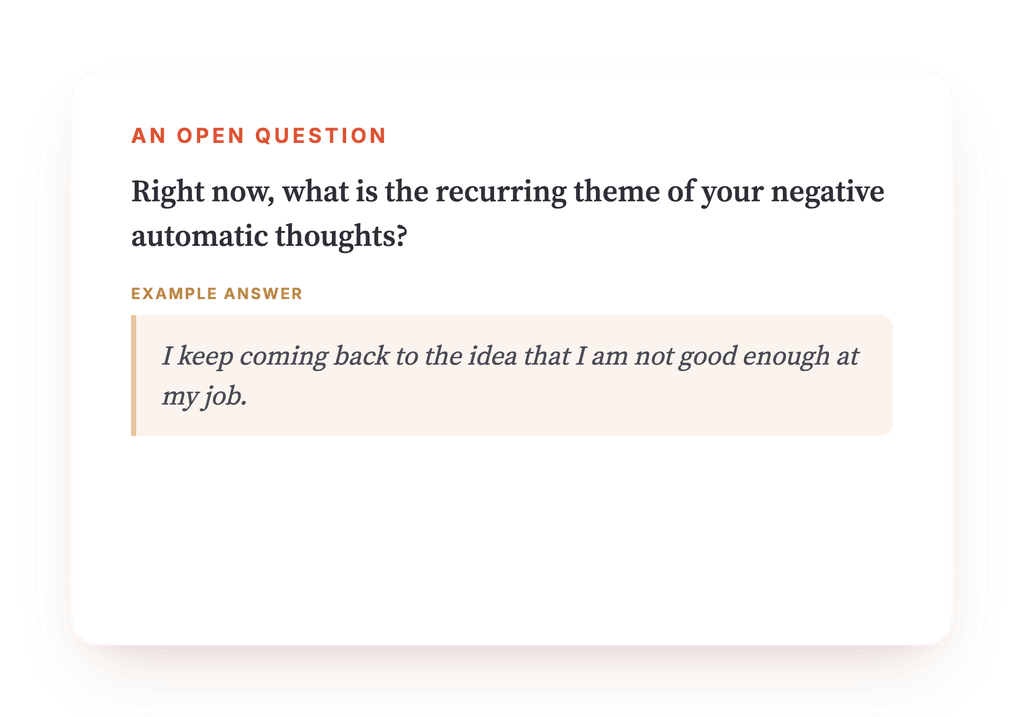
These preview images, the programme overview map and the sample cards shown here, represent only a small fraction of the full programme. The complete curriculum contains far more lessons, steps, exercises, and guided prompts than what is visible here.
This programme is available to patients through the mobile application that is the dedicated patient-side interface of SessionFuel. Once you assign it in SessionFuel, your patient receives it directly on their phone and works through each lesson independently, at their own pace, between your appointments.
750+ clinical tools
A library built with and for clinicians, ready to use in session and extend between appointments.
Access all the toolsIntegrating the programme into your practice
Which patients: This programme suits adults presenting with a depressive episode or subclinical low mood who have enough psychoeducation literacy to engage with written material and reflective prompts. It works well alongside CBT or schema-informed approaches where identifying core beliefs is already a shared focus, for instance when you have introduced the Cognitive Case Formulation or the How Your Past Affects Your Present framework.
How to introduce it: Assign the programme as between-session homework after you have introduced the concept of automatic thoughts and signalled that the real drivers lie deeper. A brief orienting phrase, "Between now and our next appointment, the first two lessons will help you map what those deeper beliefs actually are", is usually enough. Pacing matters: one to two lessons per inter-session interval gives time for the prompts to settle.
How to use what the patient brings back: The written responses to guided prompts are the clinical gold. The beliefs a patient identifies in Lesson 2, the evidence audit from Lesson 3, the new belief formulations from Lesson 4, each becomes a concrete object to examine together. You can cross-reference their self-identified belief category against the Early Maladaptive Schemas taxonomy, or use the Scaling Beliefs About Yourself worksheet to track belief intensity across sessions. The Clarifying a Core Belief guided exercise can deepen any belief the patient has surfaced but not yet fully examined.
Key insight: The programme's value is not in the reading, it is in the written traces it generates: the patient's own words, their own evidence audit, their own formulation of an alternative belief. That material drives the clinical conversation.

Use it with your patients
Share this tool in the mobile app and follow the work between sessions.
Articulation with other resources
The programme pairs naturally with the Thoughts and Depression worksheet for patients who need a visual anchor on the cognitive filter, and with the Four Strategies to Overcome Depression worksheet if you want to frame behavioural activation alongside belief work. For patients whose limiting beliefs organise around themes of failure or worthlessness, the Failure Schema and Defectiveness / Shame Schema worksheets offer session-level psychoeducation that dovetails with what the patient has been working on independently. The companion programme Emotions in Depression covers the affective dimension and can run in parallel or sequence.
Your session continues in your patients' pocket
Use with a patientYour resources, available everywhere
The handouts, exercises, programs and audios above: you choose which ones to make available to your patients, in the mobile app dedicated to them.
And far more than a library
The app goes well beyond resources, to support your patients every day:
Related categories
Explore other clinical resources by category.

Mood
Evidence-based worksheets and clinical tools for mood disorders: CBT, ACT, and positive psychology resources for psychologists and therapists.

Cognition
Printable cognitive therapy worksheets and clinical tools for therapists: CBT, ACT, schema work, defusion, distortions, and belief restructuring.

Understand
Clinical hub for the therapeutic aim 'Understand': worksheets and tools to build patient insight across CBT, ACT, schema therapy and more.

Build awareness
Clinical worksheets and tools to build awareness in therapy: cognitive distortions, schemas, emotions, ACT and CBT resources for practitioners.

Restructure
Clinical hub for cognitive restructuring worksheets: distortion identification, belief disputation, ABC model, and schema work for evidence-based practice.

CBT
CBT worksheets, cognitive restructuring exercises & behavioral tools for clinicians. Evidence-based resources for every phase of cognitive behavioral therapy.