
Clinical picture. T., a woman in her early forties, presented with recurrent low mood and a longstanding pattern of over-apologising at work. She had tried to challenge the automatic thought "My colleagues think I am incompetent" several times in previous sessions, but the thought returned reliably after each minor error. The clinician introduced the downward-arrow worksheet, and they ran five consecutive rounds of the core question together; T. moved from the surface thought through an intermediate rule ("If I make mistakes, others will see through me") to the statement "I am fundamentally defective," which she rated at 90% conviction. She described a physical sense of recognition rather than surprise. The session shifted focus from disputing individual thoughts to exploring the developmental origins of that core belief, opening work that had not been accessible before.
Deeper Core Beliefs: PDF Worksheet, Tools and Exercises
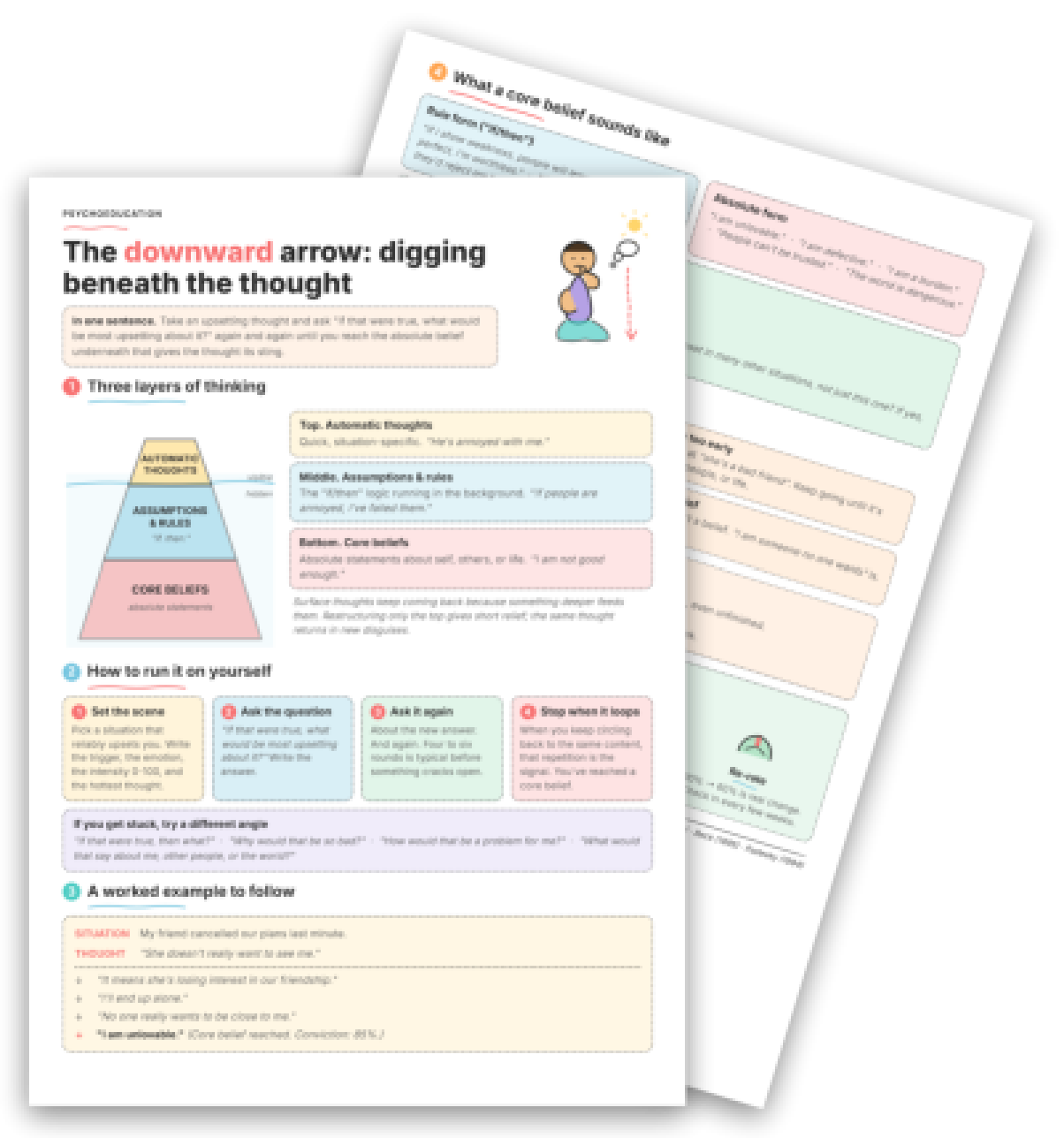
A visual PDF worksheet using the downward arrow technique to help clinicians guide patients from surface automatic thoughts to the absolute core beliefs underneath.
Clinical vignettes
Recurring Thought, Deeper Root
Social Anxiety and a Hidden Assumption
Clinical picture. M., a man in his late twenties, was referred for social anxiety that had not responded well to situational exposure alone; he could enter feared situations but left them feeling worse rather than better. In session, he chose a reliable trigger (receiving no reply to a text message) and rated his distress at 75/100. Using the worksheet's iterative question, the clinician guided four rounds until M. arrived at "If people knew the real me, they would leave," which he recognised as absolute and pervasive across relationships. Naming this belief did not immediately reduce his distress, but it reframed his avoidance as a logical consequence of the underlying conviction rather than irrational behaviour. Subsequent exposure tasks were redesigned to include a behavioural test of the core belief rather than merely the surface situation.
Explaining the downward arrow technique verbally often lands as an intellectual exercise the patient can follow in the room but cannot reproduce alone, and more critically, the three-tier architecture of cognition rarely becomes visceral until it's on paper in front of them. This fiche PDF gives that architecture a concrete visual form you can walk through together, making the vertical logic of the technique impossible to miss.
Use this resource with your patients
Handout, exercises and materials ready to use, right inside SessionFuel.
Why Core Beliefs Resist Oral Explanation in Session
The central clinical difficulty is one of abstraction level. A patient who says "I just keep catastrophising about social situations" is operating entirely at the level of automatic thoughts, the situation-specific surface layer that Beck's model describes as the most accessible but least informative tier. When you explain that something deeper is feeding those thoughts, the idea lands cognitively but rarely emotionally, because "core belief" is a technical term that means almost nothing until the patient has followed the chain downward themselves and arrived somewhere that genuinely hurts.
Two things compound this. First, patients often confuse emotional states with beliefs. "I feel sad" and "I am someone no one wants" are experientially blurred, even though only the second is a belief amenable to schema work or cognitive restructuring. Second, the middle tier, the assumptions and rules that run as silent if/then logic, is nearly invisible without a structured prompt. Oral explanation alone tends to skip over it, leaving the patient oscillating between surface thoughts and a vague sense that something deep is wrong. The gap between "He's annoyed with me" and "I am not good enough" needs to be traversed step by step, not described.
What the Fiche Contains: A Structured Visual for the Downward Arrow
The support is organised across five panels. The first presents the three-tier architecture: automatic thoughts (visible, situation-specific), assumptions and rules ("if/then" logic running in the background), and core beliefs (absolute statements about self, others, or life, the hidden layer). Seeing this as a vertical diagram rather than a list makes the concept of depth tangible in a way that speech cannot.
The second panel guides the patient through the four-step procedure: setting the scene with trigger, emotion, intensity 0-100, and hottest thought; then asking "If that were true, what would be most upsetting about it?" repeatedly. The fiche specifies that "four to six rounds is typical before something cracks open" and names the stopping criterion clearly: "When you keep circling back to the same content, that repetition is the signal." That instruction alone spares the patient, and you, the common error of stopping at a mid-level assumption.
A fully worked example in panel three traces a single situation from "My friend cancelled our plans last minute" down through five arrows to "I am unlovable (conviction: 85%)", making the abstraction concrete before the patient ever attempts it themselves. Panel four details what a core belief sounds like in both rule form and absolute form, with exemplars, and provides three diagnostic signs that the bottom has been reached. Panel five catalogs the most frequent pitfalls: going too fast, stopping too early at interpersonal content rather than self-referential content, conflating feelings with beliefs, and emotional flooding. A closing section specifies what to bring back to session even when the exercise is unfinished.
> Key takeaway: This fiche is a visual support that facilitates the in-session explanation of the downward arrow technique. It is not a self-directed questionnaire, it is a psychoeducational tool the clinician uses alongside the patient to make a vertical cognitive model legible and emotionally resonant, then leaves as a concrete reference.
750+ clinical tools
A library built with and for clinicians, ready to use in session and extend between appointments.
Access all the toolsWhen and How to Introduce It in Session
The fiche is most useful in mid-phase CBT or schema therapy, once the therapeutic alliance is established and the patient has some familiarity with automatic thought monitoring. Introducing it too early, before the patient can reliably catch a hot thought, risks arriving at a raw core belief without sufficient relational safety.
For patients presenting with low self-esteem, perfectionism, or abandonment-related schemas, the fiche accelerates formulation considerably. It also pairs well with early maladaptive schema psychoeducation and with the cognitive case formulation process. For patients where approval-seeking or self-sacrifice patterns are central, watching the arrows converge on a single core belief is often the most efficient route to schema-level awareness.
A straightforward introduction: "I want to show you why the same kind of thoughts keep coming back in different situations. There's a diagram that makes the logic visible, let's work through it together." Avoid naming core beliefs before the patient generates them through the procedure; the phenomenological weight of arriving there themselves is clinically significant.
After using the fiche, debrief around the conviction rating: the "0-100% how true it feels, not how logical" instruction from the fiche is worth emphasising, as it anchors affective credibility rather than intellectual assent. You can then connect directly to examining the evidence for the belief, restructuring the belief explicitly, or assigning the guided downward arrow homework exercise between sessions. For patients who become emotionally flooded mid-exercise, the fiche itself names this as an expected pitfall, which can normalise the experience without derailing the work.
The fiche does not replace the formulation conversation. It makes one specific piece of it, the vertical structure of cognition, clear enough that patients leave the session knowing what they are working on and why.
Use it with your patients
Share this tool in the mobile app and follow the work between sessions.
Sources
- Burns, D. D. (1980). Feeling Good: The New Mood Therapy. William Morrow.
- Beck, J. S. (2011). Cognitive Behavior Therapy: Basics and Beyond (2nd ed.). Guilford Press.
- Neenan, M. and Dryden, W. (2002). When Laddering and the Downward Arrow Can Be Used as Adjuncts to Inference Chaining in REBT Assessment. Journal of Rational-Emotive and Cognitive-Behavior Therapy.
- Young, J. E., Klosko, J. S. and Weishaar, M. E. (2003). Schema Therapy: A Practitioner's Guide. Guilford Press.
- Riso, L. P., du Toit, P. L., Stein, D. J. and Young, J. E. (2007). Cognitive Schemas and Core Beliefs in Psychological Problems: A Scientist-Practitioner Guide. American Psychological Association.
Your session continues in your patients' pocket
Use with a patientYour resources, available everywhere
The handouts, exercises, programs and audios above: you choose which ones to make available to your patients, in the mobile app dedicated to them.
And far more than a library
The app goes well beyond resources, to support your patients every day:
Related categories
Explore other clinical resources by category.
Anxiety
Clinical hub for anxiety disorders: CBT and ACT worksheets, psychoeducation sheets, and exercises for assessment and treatment across the anxiety spectrum.

Mood
Evidence-based worksheets and clinical tools for mood disorders: CBT, ACT, and positive psychology resources for psychologists and therapists.

Identity
Clinical resources for self-identity work in therapy: CBT, ACT, schema tools for clinicians addressing self-concept, core beliefs, and identity disruption.

Relationships
Clinical worksheets and tools on relational functioning: attachment, schemas, assertiveness, and communication skills for therapists. Printable PDF resources.

Cognition
Printable cognitive therapy worksheets and clinical tools for therapists: CBT, ACT, schema work, defusion, distortions, and belief restructuring.

Build awareness
Clinical worksheets and tools to build awareness in therapy: cognitive distortions, schemas, emotions, ACT and CBT resources for practitioners.