
Clinical picture. R., a man in his late thirties, presented with persistent social avoidance and a long history of cutting conversations short, convinced others found him tedious. Automatic thoughts such as "they are just being polite" and "I have nothing worth saying" recurred across work meetings, family dinners, and casual encounters, yet previous work targeting those thoughts had produced only short-lived relief. Using the informational worksheet, the clinician introduced the iceberg model, and R. was asked to apply the downward-arrow question until he arrived at a single first-person sentence: "I am boring." He identified a specific anchoring moment, a secondary-school class in which he had answered a question and a peer had looked away, which he had carried as confirmation ever since. Over the following week he gathered five pieces of mixed evidence, including two interactions in which sustained engagement contradicted the belief, and returned noting that the belief felt "less like a fact and more like an old habit."
Restructuring a Negative Core Belief: PDF Worksheet, Tools and Exercises
A visual psychoeducation worksheet clinicians use in session to explain the two-layer belief model, gather datable disconfirming evidence, and build a balanced alternative belief.
Clinical vignettes
Naming the Belief Behind Repeated Withdrawal
Core Belief Work in Recurrent Low Mood
Clinical picture. M., a woman in her mid-forties referred for recurrent depressive episodes, described a pattern of dismissing positive feedback at work while amplifying any critical remark, a dynamic she recognised but could not interrupt. The clinician used the worksheet's filter metaphor to help M. see that her automatic thought "my manager was just being generous" and her behaviour of over-preparing for every presentation were downstream expressions of an underlying claim, "I am not enough." M. anchored the belief to a specific appraisal meeting three years prior, which she had replayed selectively. Gathering five concrete pieces of evidence proved effortful; she initially rejected two items as "exceptions," and the clinician noted this as the filter operating in real time rather than treating it as resistance. By the session's end M. could articulate that the evidence was genuinely mixed, a modest but clinically meaningful shift in her relationship to the belief.
When a patient restructures a thought and the same sentence surfaces a week later in an unrelated situation, the loop rarely stops until the underlying belief is addressed. Oral explanation alone struggles here: without a visual, the distinction between thought and belief stays abstract, and patients leave the room unsure what they are actually meant to challenge. This fiche PDF gives the clinician a concrete, numbered scaffold to make that distinction visible and workable inside the session itself.
Use this resource with your patients
Handout, exercises and materials ready to use, right inside SessionFuel.
Why Core Beliefs Are So Hard to Explain Without a Visual
The two-layer model (automatic thoughts riding on top of a stable underlying claim) is clinically intuitive to the practitioner but consistently opaque to patients at first contact. Told verbally, "I'm unlikeable" and "he didn't smile at me" feel like the same category of experience. The patient does not spontaneously see one as the lens and the other as what the lens produces.
The confirmation bias embedded in core belief maintenance compounds this further. Patients dismiss disconfirming evidence before you can examine it ("they were just being polite"), a process that is far easier to name and interrupt when it is laid out on paper rather than described in the air. Practitioners working within schema therapy (Young, 2003), classic CBT (Beck, 1979; Padesky, 1994), or an ACT frame will recognize that cognitive distortions and automatic thoughts become much easier to challenge once the patient has grasped what is feeding them.
What the Fiche Contains: A Six-Panel Visual Walk-Through
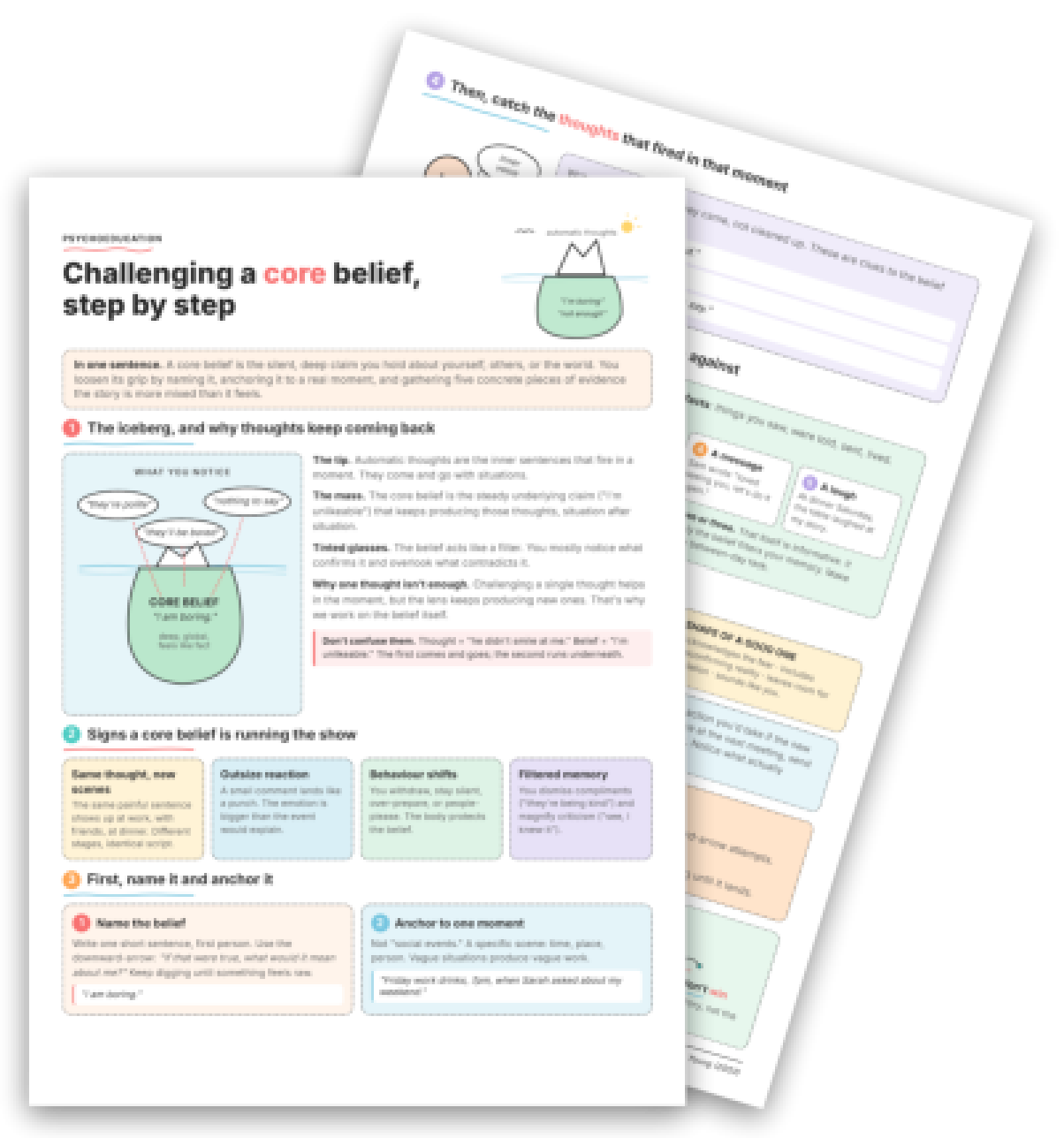
The fiche moves through six sequentially numbered panels, each building on the last. It is designed to be worked through with the clinician, not assigned as autonomous homework.
Panel 1 presents the iceberg: automatic thoughts at the tip, the core belief as the steady underlying claim beneath. The visual directly answers the question patients frequently ask: "Why does the same thought keep coming back?"
Panel 2 lists four observable signs that a belief is running the show: the same script appearing across different contexts, a disproportionate emotional reaction, behavioral withdrawal, and filtered memory. This is particularly useful for patients who intellectually accept the concept but have not yet recognized it in their own pattern.
Panels 3 and 4 walk through the downward-arrow work in writing: naming the belief in one raw first-person sentence, anchoring it to a "specific scene: time, place, person" rather than a vague situation, then listing the automatic thoughts that fired there. Writing them "as they came, not cleaned up" preserves the phenomenological texture that makes the belief legible.
Panel 5 is the structural core: gathering five pieces of real, datable evidence against the belief, across different time periods and contexts, explicitly contrasted with generic reassurance. "Real, datable facts: things you saw, were told, sent, lived" is the fiche's own phrasing, worth borrowing directly in session.
Panel 6 builds a balanced alternative thought, with a side-by-side comparison of a forced-positive reformulation (which the patient's mind will reject) versus a balanced one that acknowledges the fear, includes disconfirming reality, and sounds like the patient. A 0-to-100 believability rating closes the loop, with a prompt to re-rate after one week.
A "To discuss in session" checklist flags three specific sticking points: a belief that resists naming, an evidence gap of only two or three items, and a balanced thought that feels hollow even when logically correct.
> Key clinical takeaway: This fiche is a visual support that facilitates the in-session explanation of core belief restructuring. The clinician works through each panel with the patient; it is not a self-help questionnaire to complete alone.
750+ clinical tools
A library built with and for clinicians, ready to use in session and extend between appointments.
Access all the toolsWhen and How to Introduce This Worksheet
The fiche fits naturally once the case formulation has identified a recurrent belief driving presenting symptoms, typically from session three onward in a standard CBT sequence. It is well-suited to low self-esteem presentations and to patients caught in anxiety and limiting beliefs or depression and limiting beliefs cycles.
A workable introduction: "We've noticed the same sentence showing up across several situations. I'd like to show you a framework that explains why that happens and what we can do about it." Avoid framing it as homework to complete; position it as a map you read together.
If the belief is still loosely named, run a downward-arrow exercise first. The fiche pairs well downstream with Reinforcing a New Core Belief and Replacing a Negative Core Belief to consolidate the alternative once built. Patients presenting with abandonment schema or approval-seeking patterns will often reach the evidence step with very thin lists; the fiche explicitly names this as data, not failure, which defuses the shame that would otherwise stall the work.
The main contraindication is timing: proposing this before the patient has some fluency with automatic thought identification tends to produce rote completion rather than genuine cognitive shift. Use the "To discuss in session" checklist as your debrief guide at session end.
The fiche does not replace the formulation conversation; it makes one piece of it precise enough to hold.
Use it with your patients
Share this tool in the mobile app and follow the work between sessions.
Sources
- Beck, J. S. (2021). Cognitive Behavior Therapy: Basics and Beyond (3rd ed.). Guilford Press.
- Beck, J. S. (2005). Cognitive Therapy for Challenging Problems: What to Do When the Basics Don't Work. Guilford Press.
- Beck, A. T., Rush, A. J., Shaw, B. F., & Emery, G. (1979). Cognitive Therapy of Depression. Guilford Press.
Your session continues in your patients' pocket
Use with a patientYour resources, available everywhere
The handouts, exercises, programs and audios above: you choose which ones to make available to your patients, in the mobile app dedicated to them.
And far more than a library
The app goes well beyond resources, to support your patients every day:
Related categories
Explore other clinical resources by category.

Anxiety
Clinical hub for anxiety disorders: CBT and ACT worksheets, psychoeducation sheets, and exercises for assessment and treatment across the anxiety spectrum.

Mood
Evidence-based worksheets and clinical tools for mood disorders: CBT, ACT, and positive psychology resources for psychologists and therapists.

Cognition
Printable cognitive therapy worksheets and clinical tools for therapists: CBT, ACT, schema work, defusion, distortions, and belief restructuring.

Build awareness
Clinical worksheets and tools to build awareness in therapy: cognitive distortions, schemas, emotions, ACT and CBT resources for practitioners.

Restructure
Clinical hub for cognitive restructuring worksheets: distortion identification, belief disputation, ABC model, and schema work for evidence-based practice.

CBT
CBT worksheets, cognitive restructuring exercises & behavioral tools for clinicians. Evidence-based resources for every phase of cognitive behavioral therapy.