
Clinical picture. M., a woman in her mid-thirties, presented with persistent low mood and a long-standing pattern of dismissing her own competence at work, despite consistent positive feedback from colleagues. During a session focused on psychoeducation, the clinician introduced the five-item self-check from the worksheet; M. endorsed the warning-side responses on four of the five items, which she found quietly confronting. The clinician used the "name the voice" exercise to help her observe self-critical thoughts as events rather than facts, and M. practised saying aloud "there's that voice again" when the critic surfaced during the week. At the following session she reported a small but noticeable shift: she had caught the pattern twice and had not acted on it automatically. No claim was made about resolution; the exercise was framed as building observational distance over time.
Low Self-Esteem: PDF Worksheet, Tools and Exercises for Clinical Practice
A structured PDF worksheet, practical tools, and psychoeducation exercises to help clinicians explain low self-esteem clearly and efficiently in session.
Clinical vignettes
Naming the Inner Critic
Receiving Kindness Without Deflection
Clinical picture. T., a man in his late twenties referred for generalised anxiety, described a habit of deflecting compliments with self-deprecating humour and apologising frequently in social situations. Reviewing the worksheet together, the clinician highlighted the "signs that often travel with it" section; T. recognised the comparison and deflection patterns as familiar and was relieved the sheet did not attach a diagnostic label. The clinician introduced the "practise receiving" step as a between-session behavioural experiment: when someone expressed appreciation, T. was to say thank you and stop, without a follow-up joke or qualifier. He returned the next week reporting the exercise felt awkward but manageable, and that one interaction had ended without the usual self-undermining comment. The clinician noted this as early behavioural evidence to draw on when the inner critic reasserted itself.
Patients rarely arrive describing low self-esteem in those words. They present with perfectionism, chronic self-criticism, or a vague sense of not measuring up, and when you name the construct, many agree intellectually without recognising themselves in it. This fiche PDF offers a structured visual support to make low self-esteem immediately concrete and personally legible, in one session.
Use this resource with your patients
Handout, exercises and materials ready to use, right inside SessionFuel.
Why Low Self-Esteem Is Hard to Name in Session
The core difficulty is not patient resistance. It is the construct's pervasive invisibility. Drawing on Fennell's cognitive model, low self-esteem functions as a pre-reflective filter rather than a discrete symptom, shaping the interpretation of every event without announcing itself. Describing it verbally tends to produce intellectual agreement and little recognition.
There is also a fragmentation problem. The patient who deflects every compliment, magnifies every error, and habitually puts others down rarely connects these behaviours to a single underlying construct. They experience them as separate character traits, even moral failures. A visual tool that clusters these patterns changes the frame: recognition happens, and the therapeutic vocabulary shifts.
Patients with comorbid depression, impostor syndrome, or shame-driven avoidance are especially hard to reach with verbal psychoeducation alone. The fiche's structure gives you a neutral, non-pathologising entry point that bypasses defensiveness.
What the Fiche Contains: A Visual Support for Explaining Self-Worth
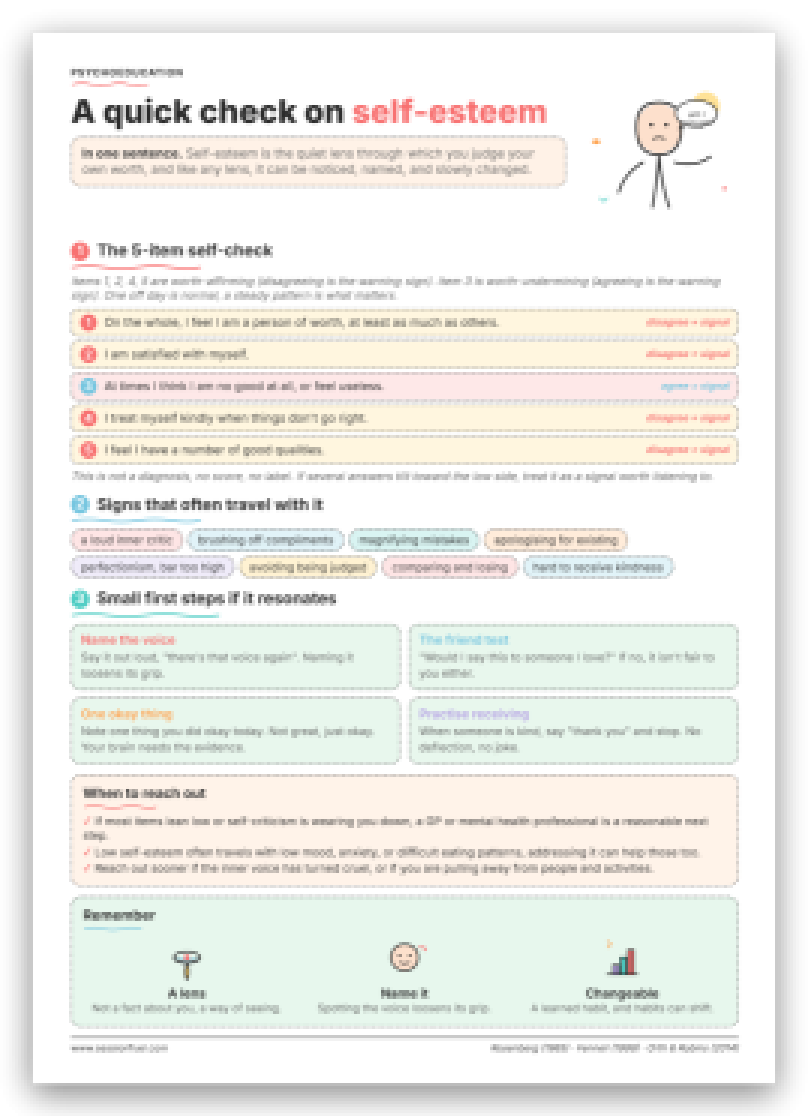
The printable opens with a 5-item self-check, adapted from the Rosenberg Self-Esteem Scale, presented not as a scored questionnaire but as a signal-spotting exercise. Each item is labelled clearly: items 1, 2, 4, and 5 flag low self-esteem when the patient disagrees; item 3 flags it when the patient agrees. The fiche states plainly: "This is not a diagnosis, no score, no label. If several answers tilt toward the low side, treat it as a signal worth listening to." That framing is exactly what helps patients engage without feeling assessed.
The second panel, "Signs that often travel with it", lists eight behavioural and cognitive patterns:
- a loud inner critic
- brushing off compliments
- magnifying mistakes
- apologising for existing
- perfectionism, bar too high
- avoiding being judged
- comparing and losing
- hard to receive kindness
Visually grouped, these eight items do what an oral enumeration cannot: the patient can scan them, pause on two or three, and say "that's me." That moment of self-recognition is the clinical lever.
The third section offers four grounded micro-exercises: naming the critical inner voice ("there's that voice again"), the friend test ("Would I say this to someone I love?"), logging one thing done okay today, and practising receiving kindness without deflection. Each step is short enough to introduce briefly in session and leave with the patient as a between-session task. You can also pair the deflection step directly with the Accepting Compliments exercise for patients who need more structured rehearsal.
A closing "When to reach out" panel and a three-point "Remember" summary anchor the fiche's message: self-esteem is "not a fact about you, a way of seeing" and, crucially, a learned habit that can shift.
> Key point: This fiche is a visual support that facilitates the psychoeducation conversation in session, not a self-administered questionnaire. You guide the patient through it; they leave with a concrete, portable reference that holds the vocabulary you built together.
750+ clinical tools
A library built with and for clinicians, ready to use in session and extend between appointments.
Access all the toolsWhen and How to Introduce It
This fiche fits naturally in early-to-mid assessment sessions, once a working alliance is established and you have identified self-worth as a relevant axis. It works especially well before moving into schema-focused or TCC work, as a way of establishing shared language. For patients engaged in a Self-Image and Self-Esteem program, it functions as a compact first-session anchor.
A low-threshold introduction: "I'd like to share a short visual with you, not to put a label on anything, but to see which parts resonate." Work through the 5-item check together, and let the patient do the scanning on the "Signs" panel without prompting every item.
Debrief by asking which items they paused on, rather than which they "scored." For patients with strong self-devaluation patterns or constant comparison cycles, the panel often surfaces examples they had not previously articulated. From there, the micro-exercises become natural next steps: the self-acceptance work exercise, clarifying the core belief underneath, or deepening the inner dialogue with the Inner Self-Talk program.
One limit worth noting: patients with acute shame or fragile alliance may find even a five-item self-check activating. In those cases, introduce the "Signs" panel first as an observation exercise before circling back to the self-check items.
The fiche does not replace the case formulation. It makes the first conversation about self-worth faster, clearer, and easier for the patient to carry forward.
Use it with your patients
Share this tool in the mobile app and follow the work between sessions.
Sources
- Rosenberg, M. (1965). Society and the Adolescent Self-Image. Princeton University Press.
- Fennell, M. J. V. (1997). Low Self-Esteem: A Cognitive Perspective. Behavioural and Cognitive Psychotherapy, 25(1), 1-26.
- Fennell, M. J. V. (1999). Overcoming Low Self-Esteem: A Self-Help Guide Using Cognitive Behavioural Techniques. Robinson Publishing.
Your session continues in your patients' pocket
Use with a patientYour resources, available everywhere
The handouts, exercises, programs and audios above: you choose which ones to make available to your patients, in the mobile app dedicated to them.
And far more than a library
The app goes well beyond resources, to support your patients every day:
Related categories
Explore other clinical resources by category.

Identity
Clinical resources for self-identity work in therapy: CBT, ACT, schema tools for clinicians addressing self-concept, core beliefs, and identity disruption.
CBT
CBT worksheets, cognitive restructuring exercises & behavioral tools for clinicians. Evidence-based resources for every phase of cognitive behavioral therapy.

Anxiety
Clinical hub for anxiety disorders: CBT and ACT worksheets, psychoeducation sheets, and exercises for assessment and treatment across the anxiety spectrum.
Trauma
Clinical hub on trauma and PTSD: assessment, differential diagnosis, treatment phases, and printable resources for practitioners. 155 chars.

Mood
Evidence-based worksheets and clinical tools for mood disorders: CBT, ACT, and positive psychology resources for psychologists and therapists.

Emotions
Clinical resources on emotion regulation: worksheets, coping tools, CBT, REBT, and ACT exercises for therapists working across diagnoses and age groups.