
Clinical picture. M., a 24-year-old university student, was referred by his GP after disclosing to a friend that he had been hearing his name called in empty corridors for several weeks. He presented as guarded, fearing that naming the experience would confirm something catastrophic. The clinician introduced the informational sheet early in the second session, framing it as a tool to map the territory rather than to reach a verdict. M. worked through the seven questions and identified one item as occasional and two as sometimes, with moderate distress but no functional disruption to his studies or sleep. Reviewing the spectrum graphic together allowed him to tolerate uncertainty more readily, and he agreed to monitor frequency over the following fortnight before any further formulation.
Psychosis: PDF Worksheet, Tools and Exercises for Clinical Practice
A structured visual PDF worksheet to help clinicians introduce psychotic-spectrum experiences in session, destigmatise the concept, and open a grounded first conversation.
Clinical vignettes
Normalising Unusual Experiences in a Young Adult
Prompting Help-Seeking in a Reluctant Patient
Clinical picture. T., a woman in her late 40s attending a third-sector wellbeing service for low mood, mentioned almost in passing that she had recently stopped driving because she was unsure whether the traffic signals she saw were real. The support worker, not yet trained in formal psychological assessment, used the informational sheet as a structured prompt to document what T. was noticing across each domain. T. endorsed several items as sometimes or often and acknowledged that her daily routine had been disrupted for roughly six weeks. The completed sheet gave both T. and the support worker a shared, non-alarmist reference point, and it was attached to an urgent onward referral letter sent to her GP that same day.
The moment you say the word "psychosis" in session, many patients hear a life sentence. Even when the clinical picture is sub-threshold, brief, or clearly stress-related, the label tends to close the conversation rather than open it. This fiche PDF gives you a structured visual entry point that names the territory without triggering that shutdown.
Use this resource with your patients
Handout, exercises and materials ready to use, right inside SessionFuel.
Why Psychotic-Spectrum Experiences Resist Verbal Explanation
Two things reliably make this conversation difficult. First, the stigma load attached to the word means patients often disengage before you've had a chance to contextualise. They leave the session with the label but not the nuance. Second, the dimensional nature of psychotic experiences is genuinely hard to convey in spoken language alone: the clinical distance between a single hypnagogic hallucination and a persistent delusional system is enormous, but it sounds slippery without a visual anchor.
The differential complexity adds a third layer. Severe sleep deprivation, acute grief, trauma flashbacks, substance withdrawal, certain medications, and neurological conditions can all produce experiences that superficially resemble psychotic symptoms. Disentangling these mid-session, verbally, is slow and prone to misinterpretation. Patients who screen positive on a GAD worksheet or a health anxiety checklist may also report perceptual anomalies driven by hypervigilance rather than a psychotic process, and conflating the two does real clinical harm.
What the Fiche Contains: A Visual Map of the Spectrum
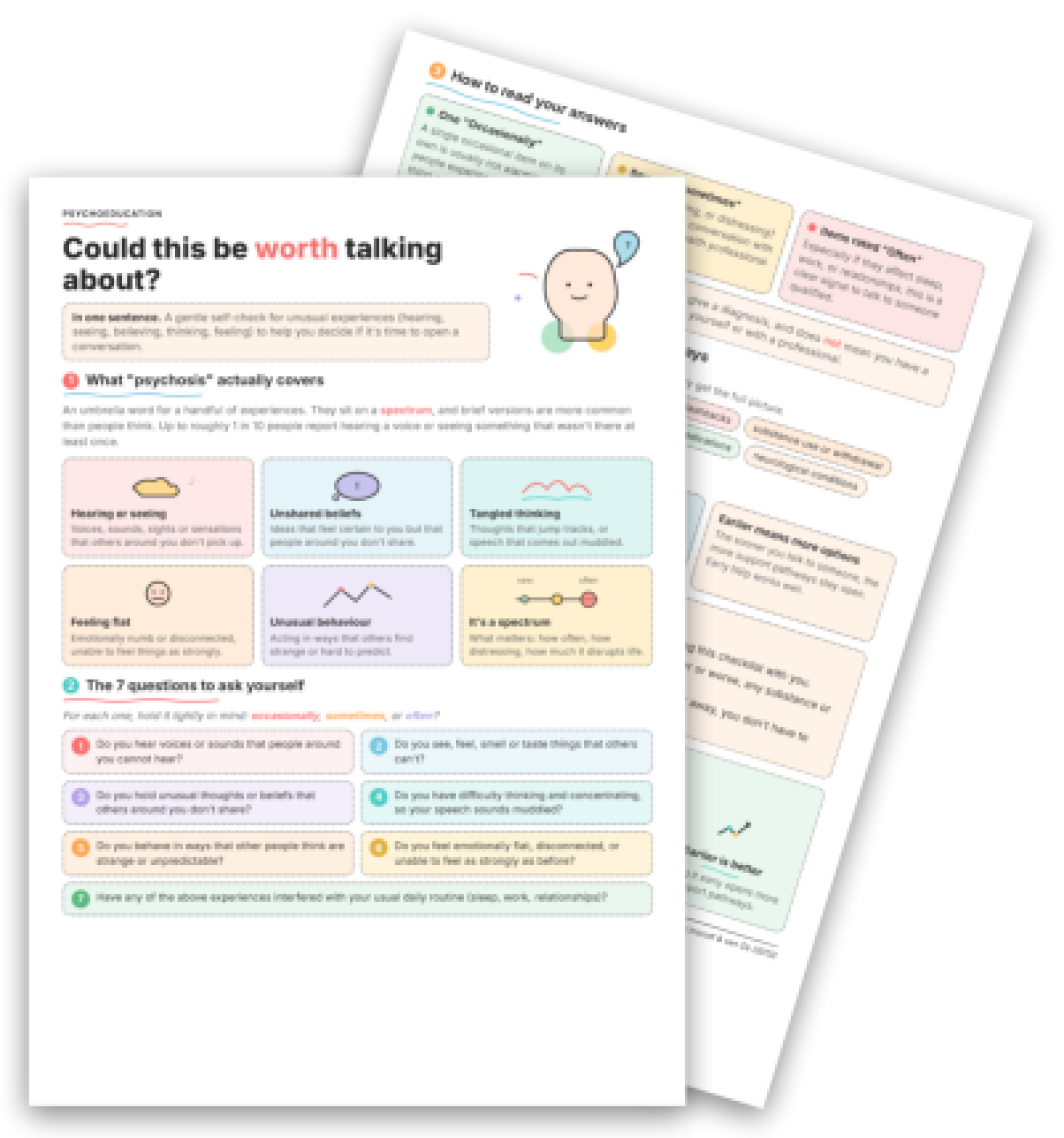
The fiche is structured in five panels, and using it as a shared visual support in session does the explanatory work that oral description cannot.
Panel 1 frames psychosis explicitly as "a handful of experiences on a spectrum" and offers an immediately accessible statistic: up to 1 in 10 people report at least one perceptual anomaly in their lifetime. Five symptom domains are laid out clearly: hearing or seeing, unshared beliefs, tangled thinking, feeling flat, and unusual behaviour. A visual spectrum bar labelled "rare / often" makes the dimensional model visible at a glance, which is precisely what patients who arrive with all-or-nothing thinking (well mapped by the all-or-nothing thinking worksheet) need to see.
Panel 2 presents the seven self-check questions, each rated on a simple frequency anchor: occasionally, sometimes, or often. The seventh question, "Have any of the above experiences interfered with your usual daily routine?", is the functional severity marker and worth reading aloud together.
Panel 3 offers a graduated reading guide. One occasional item is normalised as clinically unremarkable. Several "sometimes" ratings, or any "often" ratings that touch sleep, work, or relationships, are framed as a clear signal to consult. This does the de-escalation work you would otherwise carry alone.
Panel 4 lists eight categories of look-alike experiences: severe sleep deprivation, intense grief, trauma flashbacks, substance use or withdrawal, cultural or spiritual experiences, migraine aura, certain medications, neurological conditions. Presenting this panel explicitly communicates that the fiche is a starting point, not a verdict.
Panel 5 closes with three reframes: naming these experiences is the hardest step; they do not mean "going mad"; and earlier help keeps more support pathways open.
> Key takeaway: This fiche is a visual psychoeducation support to use together in session, not a self-administered screening tool. Its job is to open a grounded conversation, not to label.
750+ clinical tools
A library built with and for clinicians, ready to use in session and extend between appointments.
Access all the toolsWhen and How to Introduce the Fiche
The optimal window is early in the care trajectory: at a first or second session, when a patient mentions unusual perceptual experiences, describes beliefs others find hard to share, or reports feeling "disconnected" and "numb" in ways that don't fit a depression picture or burnout presentation alone. It is also clinically useful when a patient referred for OCD or panic disorder describes intrusive perceptions that warrant differential mapping.
A low-threshold introduction might be: "I'd like to share a one-page document that describes a range of unusual experiences people sometimes have. It's not a diagnostic test. I'd like us to look through it together to see what, if anything, resonates for you." This framing positions the fiche as exploratory, not confirmatory.
Debrief by asking which frequency rating felt most accurate for each item, then move directly to Panel 4 to examine plausible alternative explanations. For patients who are acutely distressed by what they recognise in Panel 2, a grounding exercise before or after the fiche review can help regulate arousal enough to continue. Pair the sheet over subsequent sessions with mental health foundations psychoeducation for patients who need broader psycholiteracy scaffolding.
One genuine limit: for patients already engaged in florid psychotic experiences, the fiche's self-reflective format presupposes an observing capacity that may not be available. In that context, use it after stabilisation rather than at first contact.
The fiche does not replace formulation or diagnostic assessment. What it does is give the patient, and you, a common vocabulary and a concrete reference to carry between sessions.
Use it with your patients
Share this tool in the mobile app and follow the work between sessions.
Sources
- National Institute for Health and Care Excellence (NICE) (2014). Psychosis and Schizophrenia in Adults: Prevention and Management (CG178). NICE.
- Linscott, R. J., van Os, J. (2013). An updated and conservative systematic review and meta-analysis of epidemiological evidence on psychotic experiences in children and adults: on the pathway from proneness to persistence to dimensional impairment. Psychological Medicine.
Your session continues in your patients' pocket
Use with a patientYour resources, available everywhere
The handouts, exercises, programs and audios above: you choose which ones to make available to your patients, in the mobile app dedicated to them.
And far more than a library
The app goes well beyond resources, to support your patients every day:
Related categories
Explore other clinical resources by category.

Understand
Clinical hub for the therapeutic aim 'Understand': worksheets and tools to build patient insight across CBT, ACT, schema therapy and more.

CBT
CBT worksheets, cognitive restructuring exercises & behavioral tools for clinicians. Evidence-based resources for every phase of cognitive behavioral therapy.

Anxiety
Clinical hub for anxiety disorders: CBT and ACT worksheets, psychoeducation sheets, and exercises for assessment and treatment across the anxiety spectrum.
Trauma
Clinical hub on trauma and PTSD: assessment, differential diagnosis, treatment phases, and printable resources for practitioners. 155 chars.

Mood
Evidence-based worksheets and clinical tools for mood disorders: CBT, ACT, and positive psychology resources for psychologists and therapists.

Identity
Clinical resources for self-identity work in therapy: CBT, ACT, schema tools for clinicians addressing self-concept, core beliefs, and identity disruption.