
Clinical picture. A, a woman in her late forties, was referred for adjustment difficulties eight months after the death of her husband. In the third session she disclosed, with visible shame, that she occasionally heard his voice calling her name from another room and had twice "seen" him briefly in a supermarket aisle. She had told no one, fearing it signalled psychiatric illness. The clinician introduced the psychoeducation sheet on everyday unusual experiences, noting that sensory phenomena in bereavement are documented in roughly six in ten widowed individuals. A read the sheet between sessions and returned reporting reduced shame; she no longer interpreted the experiences as evidence of pathology, which allowed grief work to proceed with less avoidance.
Everyday 'Unusual' Experiences: PDF Worksheet, Tools and Exercises
A visual PDF worksheet with tools and exercises to help clinicians explain the experience-meaning split and break the shame loop around unusual inner experiences.
Clinical vignettes
Normalising a Grief-Related Presence
Intrusive Images Reframed, Not Pathologised
Clinical picture. M, a man in his early thirties presenting with generalised anxiety, described recurrent vivid mental images of harm befalling family members, flashing briefly but intensely during otherwise ordinary moments. He had concealed this for two years, convinced it marked him as dangerous. During a psychoeducation session the clinician used the informational sheet to distinguish the raw experience from the meaning attached to it, locating intrusive imagery on a continuum that includes hypnagogic images and trauma-related intrusions common across the general population. M engaged readily with the experience-versus-meaning split and, by the following session, reported that the images felt less catastrophic, which reduced his avoidance of family contact.
Patients who hear their name in an empty room, sense a deceased relative in a crowd, or wake to a vivid hypnagogic image frequently say nothing about it for months, sometimes years. The inhibiting force is almost never the experience itself; it is the meaning attached to it. This PDF worksheet gives you a structured visual support to introduce the continuum of unusual experiences in session, before silence calcifies into shame.
Use this resource with your patients
Handout, exercises and materials ready to use, right inside SessionFuel.
Why Unusual Experiences Resist Oral Explanation
The clinical difficulty is not informational. Your patient likely knows, abstractly, that perceptual anomalies happen to psychologically intact people. What they cannot do, without scaffolding, is locate their own experience on a benign continuum rather than at a pathological cliff edge. Spoken psychoeducation tends to land as reassurance, which patients process through their existing catastrophic frame: "The therapist is being kind, but my case is different."
The experience-versus-meaning split is especially hard to convey verbally because both layers feel equally real from the inside. A cognitive distortions framework helps with thought content, but it presupposes the patient can already separate what happened from what it "proved." For patients carrying an implicit defectiveness belief, the gap between strange experience and catastrophic interpretation collapses instantly. Showing the split on paper changes that dynamic.
There is also the shame loop to contend with. Patients who have concealed an unusual experience, sometimes for years, present with hypervigilance around the next occurrence, social withdrawal, and a well-rehearsed silence. Common reactions to trauma show a structurally similar pattern. Breaking concealment requires a clinical frame that normalises before it analyses.
750+ clinical tools
A library built with and for clinicians, ready to use in session and extend between appointments.
Access all the toolsWhat the Fiche Contains: A Visual Anchor for the Session
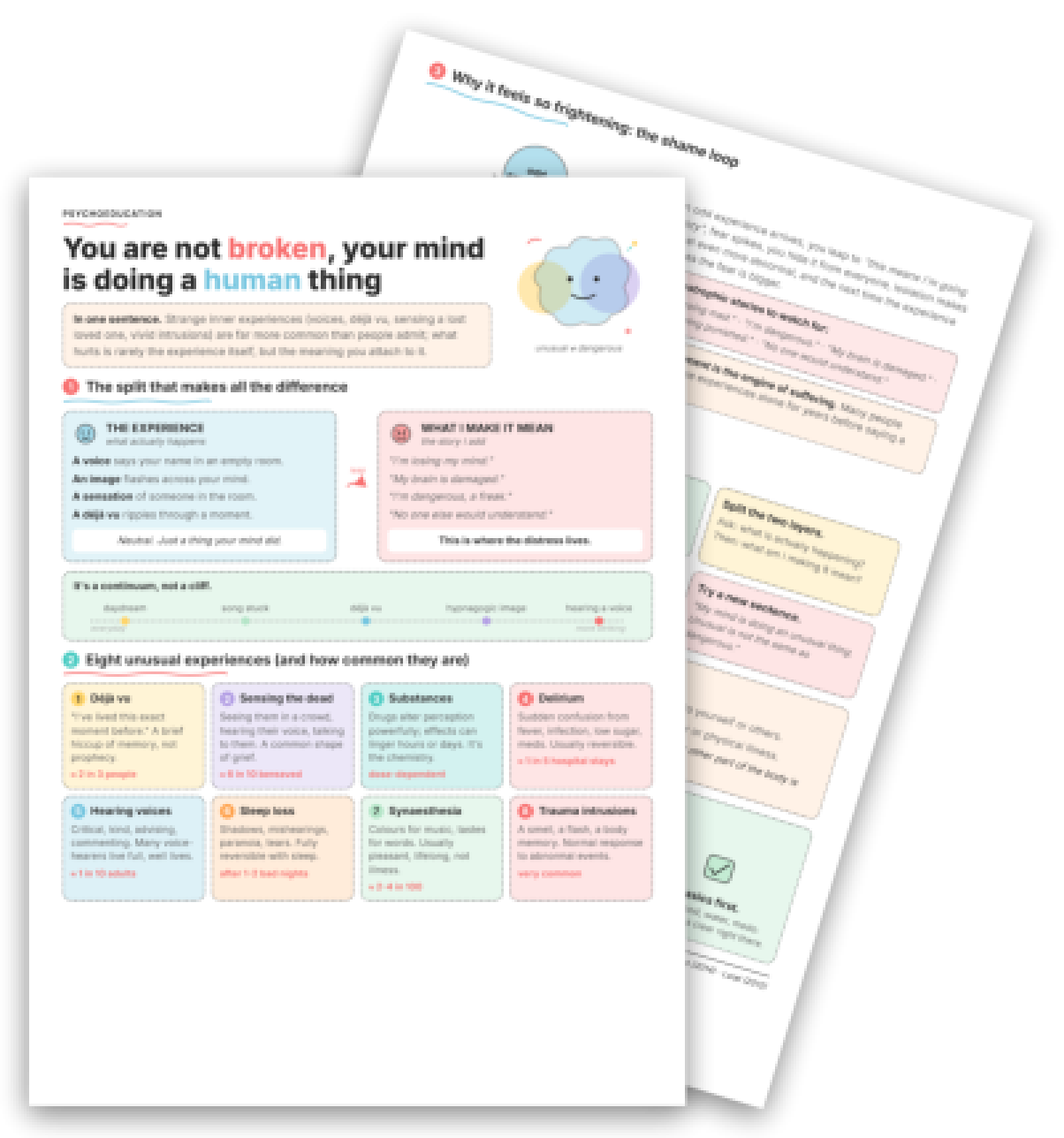
The resource is organised into four visual panels. The first draws a two-column split: THE EXPERIENCE (what actually happens: "A voice says your name in an empty room. A déjà vu ripples through a moment. Neutral. Just a thing your mind did.") against WHAT I MAKE IT MEAN (the catastrophic gloss: "I'm losing my mind," "I'm dangerous, a freak"). The layout makes the central mechanism visible in a way that no verbal explanation quite matches: the distress lives in column two, not column one.
The second panel lists eight categories of unusual experiences with epidemiological anchors: déjà vu (approximately 2 in 3 people), sensing a deceased loved one (approximately 6 in 10 bereaved individuals), hearing voices (approximately 1 in 10 adults), sleep-deprivation phenomena (after one or two disrupted nights, relevant to CBT for insomnia work), along with substance effects, delirium, synaesthesia, and trauma intrusions. The base-rate data is particularly useful with patients who have been quietly convinced they are uniquely defective.
The third panel diagrams the shame loop as a cycle: odd experience, catastrophic interpretation, fear spike, concealment, growing isolation, amplified fear at next occurrence. A CBT maintaining process lens maps directly onto this structure, and you can annotate the diagram in session. The loop makes explicit what patients often sense but cannot articulate: "Concealment is the engine of suffering."
The fourth panel offers six reorientation strategies, from naming the experience plainly ("A voice. An image. A sensation.") to splitting the two layers, checking base rates, disclosing to one safe person, reviewing physical basics (sleep, food, substances, medication, recent illness), and trying a new sentence: "My mind is doing an unusual thing. Unusual is not the same as dangerous." A brief section on when to seek additional help closes the worksheet, preserving appropriate clinical framing without catastrophising the resource itself.
> Key point: The fiche is a visual support that facilitates the explanation of unusual experiences in session. It is not a self-report questionnaire for the patient to complete alone; it is a shared psychoeducation anchor the clinician uses to externalise the experience-meaning split and interrupt the shame loop in real time.
Use it with your patients
Share this tool in the mobile app and follow the work between sessions.
When and How to Introduce It in Session
The worksheet fits two clinical moments particularly well. The first is early in an assessment, when a patient discloses hesitantly that something perceptually strange has been happening. Introducing it before moving into differential formulation signals safety. You might say: "A lot of people have experiences like the ones you're describing. Let me show you something that maps where they tend to fit."
The second moment is mid-treatment, when a patient is doing solid cognitive work but continues interpreting residual unusual experiences as evidence of relapse. The visual continuum counteracts the catastrophising that keeps the shame loop spinning.
The resource translates across presentations: psychosis-spectrum cases, grief, depersonalisation, post-traumatic presentations, and any patient whose primary suffering is the meaning they attach to inner states. Use it cautiously if the patient is acutely destabilised; the normalisation frame can feel minimising when distress is at its peak. Stabilise first, then return.
Debrief by asking which of the eight categories resonates, what the patient notices when comparing the two columns, and where their own shame loop typically breaks down. ACT defusion tools and distancing and decentering techniques pair well at this stage, moving from psychoeducational contact toward experiential work. The fiche does not replace the therapeutic frame; it gives the explanation a shape the patient can take home.
Your session continues in your patients' pocket
Use with a patientYour resources, available everywhere
The handouts, exercises, programs and audios above: you choose which ones to make available to your patients, in the mobile app dedicated to them.
And far more than a library
The app goes well beyond resources, to support your patients every day:
Related categories
Explore other clinical resources by category.
Trauma
Clinical hub on trauma and PTSD: assessment, differential diagnosis, treatment phases, and printable resources for practitioners. 155 chars.

Mood
Evidence-based worksheets and clinical tools for mood disorders: CBT, ACT, and positive psychology resources for psychologists and therapists.

Health
Somatic health clinical resources for practitioners: worksheets, psychoeducation, and exercises for somatic symptom disorder, chronic pain, and more.

Understand
Clinical hub for the therapeutic aim 'Understand': worksheets and tools to build patient insight across CBT, ACT, schema therapy and more.

CBT
CBT worksheets, cognitive restructuring exercises & behavioral tools for clinicians. Evidence-based resources for every phase of cognitive behavioral therapy.
Anxiety
Clinical hub for anxiety disorders: CBT and ACT worksheets, psychoeducation sheets, and exercises for assessment and treatment across the anxiety spectrum.