
Clinical picture. M., a man in his early forties, presented six months after a road traffic collision with persistent sleep disruption, irritability at work, and a pattern of avoiding motorways and any news coverage involving accidents. He had not connected these difficulties to the collision, attributing them instead to stress and poor character. The clinician introduced the PTSD psychoeducation sheet during the second session, walking through the "alarm stuck on" model and the three-part loop of raw memory, unhelpful meanings, and avoidance. M. identified immediately with the image of a memory stored in sensory fragments rather than as a finished story, noting that he experienced sudden smells and physical jolts rather than a coherent recollection. By the end of the session he was able to name his avoidance as the mechanism keeping the memory raw, which reduced some of the shame he had attached to his irritability and reduced his resistance to further assessment.
What Is PTSD? PDF Worksheet, Tools and Exercises for Clinical Practice
A six-panel visual PDF worksheet to explain the PTSD maintenance cycle, symptom clusters, and treatment rationale clearly in session, with tools and exercises for clinical practice.
Clinical vignettes
Naming the Loop for a Reluctant Patient
Psychoeducation Reframing Self-Blame
Clinical picture. T., a woman in her late twenties, was referred following an assault and reported intrusive images, difficulty staying asleep, emotional numbing, and a firm belief that she was "going mad" because her memories arrived as disconnected flashes rather than as a linear account. The clinician used the informational sheet to explain that fragmented, sensory storage is a predictable consequence of being overwhelmed, not a sign of mental illness. T. was visibly relieved by the description of intrusions as unprocessed sensory fragments that the brain had not yet filed, rather than evidence of psychiatric deterioration. The sheet's section on harsh beliefs, specifically "I am going mad," was read aloud and T. noted it described her inner monologue almost verbatim. This reframe did not resolve her distress but lowered her avoidance of discussing the assault, making a subsequent trauma-focused intervention more viable.
Explaining PTSD psychoeducation orally, especially in early sessions, carries a specific clinical risk: the explanation itself can activate the avoidance it describes. This PDF worksheet provides a structured visual support to make the model clear and paced, without requiring the clinician to rebuild the explanation from scratch each time or race against the patient's narrowing window of tolerance.
Use this resource with your patients
Handout, exercises and materials ready to use, right inside SessionFuel.
Why PTSD psychoeducation resists oral explanation
The Ehlers & Clark (2000) maintenance model, which anchors this fiche, involves three mutually reinforcing components: fragmented sensory memory, unhelpful appraisals, and avoidance behaviors that together block emotional processing. Conveying all three simultaneously in spoken language, while monitoring the patient's affect, is genuinely demanding. Patients tend to grasp one component and miss the interdependence of the others.
Shame compounds the difficulty. Beliefs like "I am broken" or "it was my fault" are often already entrenched before the patient walks in. An oral explanation moving too quickly past those meanings can inadvertently confirm them. The patient's hypervigilant monitoring does the rest: they are listening for evidence that something is permanently wrong with them, not for a clinical model. A visual support shifts the attentional frame.
What the fiche contains: a map of the maintenance loop
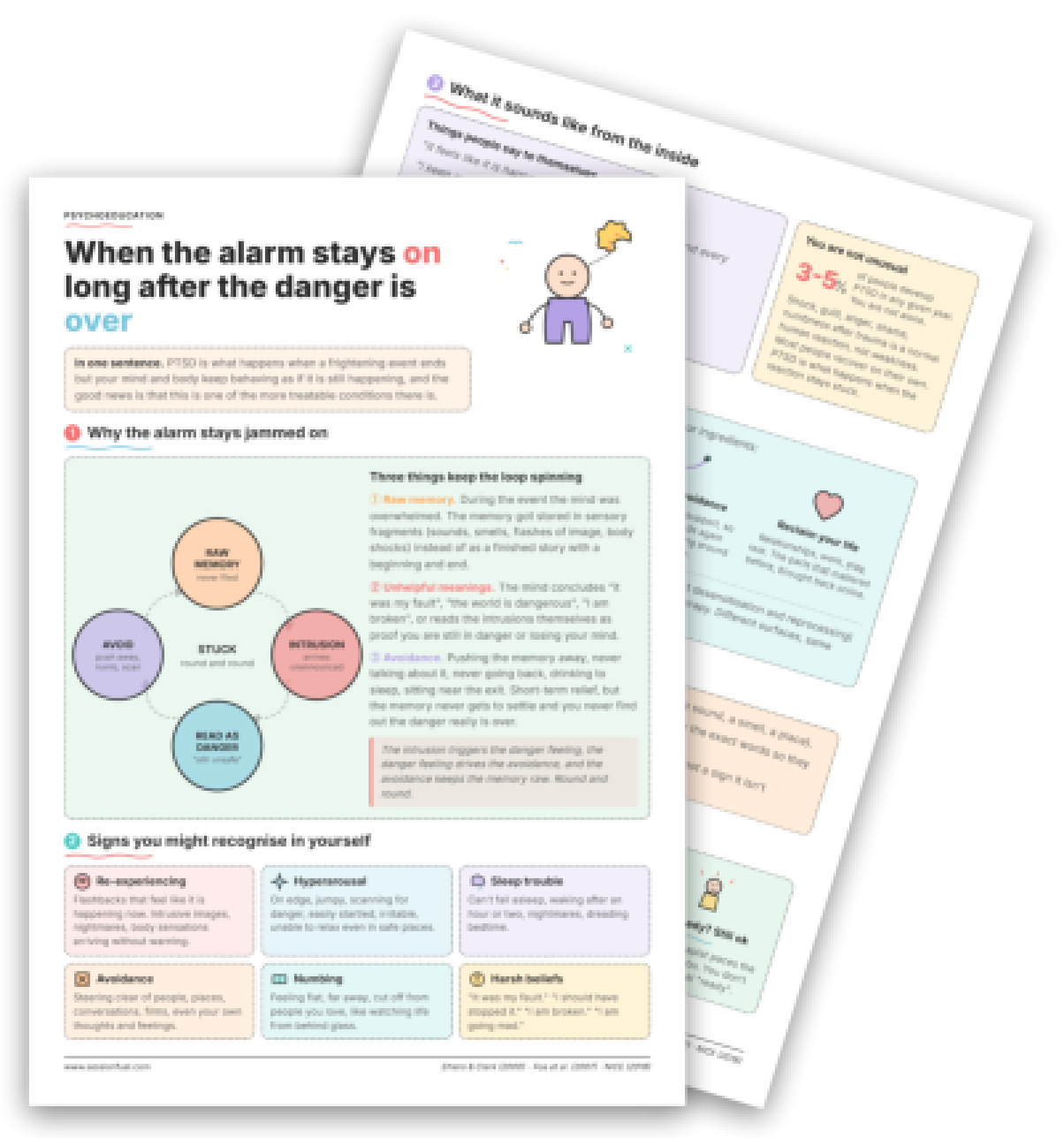
The six-panel fiche opens with a single anchoring sentence: "PTSD is what happens when a frightening event ends but your mind and body keep behaving as if it is still happening." Panel 1 renders the maintenance cycle visually. The patient sees at a glance how raw, unfiled memory feeds intrusion, which triggers a danger signal, which drives avoidance, which keeps the memory raw, labelled simply "round and round." That diagram does the work that ten spoken sentences rarely achieve, and it pairs naturally with the Ehlers & Clark PTSD Model worksheet for clinicians who want to go deeper into the formulation.
Panel 2 maps the six symptom clusters (re-experiencing, hyperarousal, sleep disturbance, avoidance, numbing, and harsh beliefs) in plain language, outside the DSM register. For a complementary symptom inventory, the PTSD symptoms checklist works alongside it. Panel 3 introduces normalizing first-person phrases ("I jump out of my skin when a door slams") and a 3-5% annual prevalence figure, both of which support destigmatization without the clinician needing to directly challenge shame head-on. Panel 4 names the four therapeutic ingredients shared across EMDR, trauma-focused CBT, Cognitive Processing Therapy, and Prolonged Exposure: filing the memory, updating meanings, reducing avoidance, and reclaiming life domains. This panel pairs well with the Therapy Blueprint for PTSD when the patient is ready to understand the treatment arc.
Panel 5 is directly practice-facing. It lists three session prompts: tracking the sensory context of intrusions (sounds, smells, places just before), flagging the exact wording of harsh self-beliefs for examination together, and naming the expected dip in trauma work before improvement. Panel 6 condenses the four normalizing messages: "alarm is jammed," "not weakness," "treatable," "you don't need to feel ready."
> Key point: this fiche is a visual support that facilitates the psychoeducation explanation in session, not a self-completion questionnaire. The clinician uses the diagrams and panels to walk the patient through the model, then leaves the fiche as a concrete reference between appointments.
750+ clinical tools
A library built with and for clinicians, ready to use in session and extend between appointments.
Access all the toolsWhen and how to introduce it in session
The optimal window is typically the second or third session, once the alliance is established and the trauma-oriented anamnesis is complete. Introducing it earlier risks the patient experiencing Panel 2's symptom list as a diagnostic label before feeling genuinely understood.
A low-threshold framing works well: "I'd like to show you a diagram that explains what the brain and body do after a frightening event. It might make sense of some of what you've been experiencing." That opening does not name PTSD explicitly until the patient has seen the visual loop and begun to place their own experience within it.
For patients presenting with marked numbing or dissociation, pace Panel 1 slowly and check the window of tolerance before moving to symptom panels. For patients who meet criteria for Complex PTSD, the single-event framing may need contextualizing alongside resources on how trauma memories form or the common reactions to trauma worksheet.
During debriefing, ask which element of Panel 1 felt most recognizable. The answer orients the next clinical step: a patient pointing to avoidance is ready to begin mapping behavioral avoidance; one pointing to meanings opens work on appraisal. You can also preview the PTSD Linen Cupboard Metaphor as an additional visual metaphor for memory storage, and the Stimulus Discrimination worksheet when the patient is ready to distinguish then from now.
The fiche does not replace the clinical formulation or the therapeutic frame. It makes the explanation more precise, establishes shared vocabulary faster, and leaves the patient with a concrete reference that supports autonomous processing between sessions.
Use it with your patients
Share this tool in the mobile app and follow the work between sessions.
Sources
- Foa, E. B., Keane, T. M., Friedman, M. J., & Cohen, J. A. (2009). Effective Treatments for PTSD: Practice Guidelines from the International Society for Traumatic Stress Studies (2nd ed.). Guilford Press.
- National Institute for Health and Care Excellence (NICE) (2018). Post-traumatic stress disorder (NG116).
- Foa, E. B., Hembree, E. A., & Rothbaum, B. O. (2007). Prolonged Exposure Therapy for PTSD: Emotional Processing of Traumatic Experiences - Therapist Guide. Oxford University Press.
- American Psychiatric Association (APA) (2013). Diagnostic and Statistical Manual of Mental Disorders, Fifth Edition (DSM-5). American Psychiatric Publishing.
Your session continues in your patients' pocket
Use with a patientYour resources, available everywhere
The handouts, exercises, programs and audios above: you choose which ones to make available to your patients, in the mobile app dedicated to them.
And far more than a library
The app goes well beyond resources, to support your patients every day:
Related categories
Explore other clinical resources by category.

Trauma
Clinical hub on trauma and PTSD: assessment, differential diagnosis, treatment phases, and printable resources for practitioners. 155 chars.

Understand
Clinical hub for the therapeutic aim 'Understand': worksheets and tools to build patient insight across CBT, ACT, schema therapy and more.

CBT
CBT worksheets, cognitive restructuring exercises & behavioral tools for clinicians. Evidence-based resources for every phase of cognitive behavioral therapy.

EMDR
Clinical hub for EMDR therapy resources: worksheets, stabilisation tools, and guided audio for all 8 phases of trauma reprocessing. For trained clinicians.

Anxiety
Clinical hub for anxiety disorders: CBT and ACT worksheets, psychoeducation sheets, and exercises for assessment and treatment across the anxiety spectrum.

Mood
Evidence-based worksheets and clinical tools for mood disorders: CBT, ACT, and positive psychology resources for psychologists and therapists.