
Clinical picture. R., a woman in her late thirties, presented eight months after a road traffic collision with persistent hypervigilance, nightly intrusions, and a pattern of leaving rooms whenever driving was mentioned. She described herself as "going mad" and expressed shame about what she called her overreactions. The clinician introduced the linen cupboard metaphor during the second session, using the printed informational sheet as a shared reference rather than a verbal lecture. R. paused at the line "it is a cupboard problem, not a you problem" and said it was the first explanation that had not made her feel broken. In subsequent sessions she was able to engage with graded exposure framed explicitly as "taking out one item at a time," and reported a modest but meaningful reduction in avoidance of car-related contexts by week six.
PTSD Linen Cupboard Metaphor: PDF Worksheet, Tools and Exercises
A printable psychoeducation fiche using the linen cupboard metaphor to make PTSD memory encoding, avoidance costs, and the rationale for trauma-focused work immediately clear in session.
Clinical vignettes
Naming the Chaos, Not the Person
When Avoidance Feels Like Coping
Clinical picture. M., a man in his mid-fifties referred following a workplace assault, had maintained full occupational functioning through sustained busyness and alcohol use most evenings. He was skeptical of trauma-focused work, stating he preferred to "leave the past alone." The clinician used the two-door diagram on the worksheet to map M.'s current strategies onto the "slam it shut" column without framing them as failures, noting that short-term relief was real and made sense. M. recognised his pattern in the description of a weakening latch and agreed, tentatively, to examine one circumscribed memory element in the following session. Progress was slow and non-linear, though he did reduce evening drinking over the subsequent month, which he attributed partly to understanding why the urge peaked at night.
Explaining trauma memory encoding to a patient at the start of treatment often stalls: the Ehlers & Clark model is precise clinically but abstract in the room, and a verbal account of why intrusions behave differently from ordinary memories rarely gives patients something they can hold onto. This fiche PDF uses the linen cupboard metaphor to build that missing handle, in a format you can place on the desk and work through together.
Use this resource with your patients
Handout, exercises and materials ready to use, right inside SessionFuel.
Why the mechanism of PTSD memory resists verbal explanation
The core difficulty is that you are asking a patient to reason abstractly about something they experience sensorially and immediately. When you explain that traumatic memories lack the contextual tagging that signals "this is past, I survived, it ended" (the hotspot model from Ehlers & Clark's cognitive formulation), the patient often nods without the idea attaching to anything felt. And the consequence that matters clinically, that avoidance perpetuates the very intrusions it relieves, is genuinely counterintuitive. Patients who have been using numbing and distraction for months or years have strong experiential evidence that it provides relief. Arguing against that with words alone is slow work.
The fiche solves this by giving the mechanism a concrete spatial image: a bursting cupboard, a weak latch, laundry that tumbles out whenever anything knocks against the door. The abstraction collapses. The common reactions to trauma patients describe, flashbacks, jumpiness, emotional numbing, the sense that danger is still present, suddenly have a cause they can picture rather than merely accept intellectually.
750+ clinical tools
A library built with and for clinicians, ready to use in session and extend between appointments.
Access all the toolsWhat the fiche contains: a visual support for in-session explanation
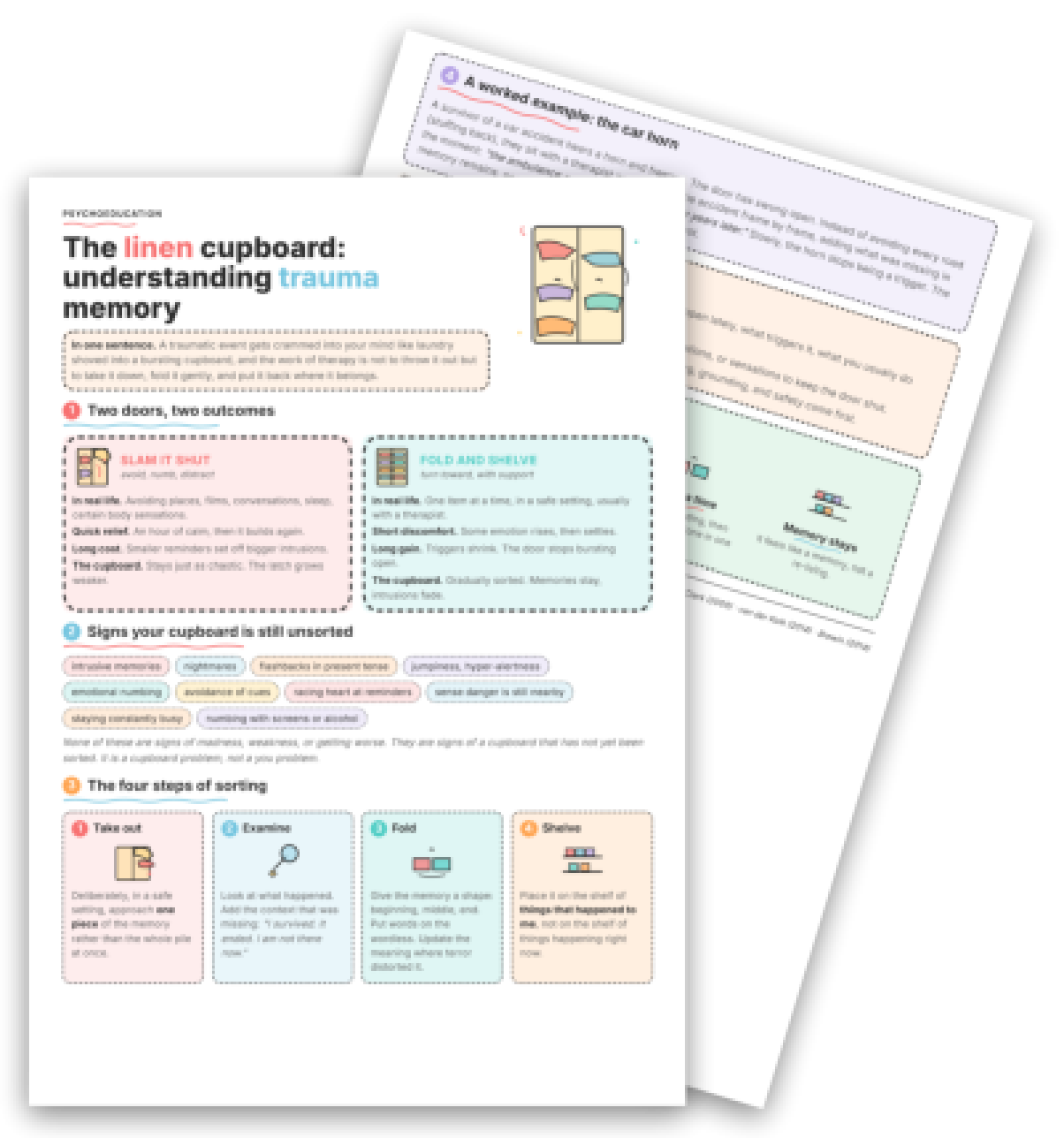
The fiche opens with a one-sentence anchor patients can carry away: "A traumatic event gets crammed into your mind like laundry shoved into a bursting cupboard, and the work of therapy is not to throw it out but to take it down, fold it gently, and put it back where it belongs."
The first panel sets two trajectories side by side: SLAM IT SHUT (avoidance, numbing, distraction) versus FOLD AND SHELVE (turning toward, with support). Each column maps real-life behavioural examples, immediate relief, long-term cost, and what happens to the cupboard over time. Placed visually in parallel, the asymmetry is hard to dispute; the cycle of avoidance that sustains PTSD becomes legible in a glance rather than a paragraph.
The second panel lists ten signs of an unsorted cupboard, from intrusive memories and nightmares to a persistent sense of current danger and numbing with screens or alcohol. Critically, the fiche frames these as "a cupboard problem, not a you problem," doing real destigmatisation work without asking the clinician to argue the point at length. For patients arriving with shame around their PTSD symptoms, this reframe lands differently when they read it on paper than when they hear it from you.
The third panel walks through four steps of sorting: Take out, Examine, Fold, Shelve. Each carries a short clinical rationale. "Give the memory a shape: beginning, middle, end. Put words on the wordless." A worked example, a car accident survivor whose horn-triggered freeze response fades after session-based processing, grounds the abstract steps in something recognisable.
The final section, "To discuss in session," offers three explicit prompts that frame the fiche as a springboard for the clinical conversation, not a task the patient completes alone.
> Key takeaway: The fiche is a visual support that facilitates the explanation of trauma memory in session. The side-by-side cupboard layout makes visible what avoidance sustains and what treatment repairs, a contrast that would take several minutes to construct verbally and that patients can keep as a reference between appointments.
Use it with your patients
Share this tool in the mobile app and follow the work between sessions.
When and how to introduce the fiche in session
The fiche fits best after initial assessment, once you have a working formulation but before the patient has calcified strong beliefs about what their symptoms mean about them. You can introduce it with a simple frame: "I want to show you something that puts into pictures what's been happening. Tell me what you recognise." That phrasing positions the fiche as confirming something the patient already knows from experience, not delivering a diagnosis.
For patients who are ambivalent about starting trauma-focused work, the two-column panel is particularly useful. It externalises the cost-benefit analysis around adaptive versus maladaptive coping without requiring a confrontational exchange. Patients often point to the SLAM IT SHUT column themselves.
For those presenting with dissociation or significant affect dysregulation, introduce grounding techniques first. The cupboard image can activate vivid imagery; the fiche even names this: "If the idea of opening the cupboard feels overwhelming, pacing, grounding, and safety come first." Use that line as a clinical cue rather than a reassurance.
Debrief by asking which column they recognise, which of the ten unsorted-cupboard signs resonates most, and what their usual version of "slamming the door" looks like in practice. The four steps of sorting are worth returning to at each phase transition in treatment, particularly before beginning EMDR or trauma processing work, to re-anchor the rationale and manage expectations about short-term discomfort. The fiche also pairs usefully with material on how past experience shapes present threat perception when patients need more context on why the nervous system responds as it does.
The fiche does not replace the therapeutic frame. It makes the explanation faster, clearer, and concrete enough to survive the week between sessions.
Your session continues in your patients' pocket
Use with a patientYour resources, available everywhere
The handouts, exercises, programs and audios above: you choose which ones to make available to your patients, in the mobile app dedicated to them.
And far more than a library
The app goes well beyond resources, to support your patients every day:
Related categories
Explore other clinical resources by category.
Trauma
Clinical hub on trauma and PTSD: assessment, differential diagnosis, treatment phases, and printable resources for practitioners. 155 chars.

Understand
Clinical hub for the therapeutic aim 'Understand': worksheets and tools to build patient insight across CBT, ACT, schema therapy and more.

Engage & motivate
Clinical hub: printable worksheets and exercises to build therapeutic engagement and motivation across ACT, CBT, and integrative practice. For clinicians.
CBT
CBT worksheets, cognitive restructuring exercises & behavioral tools for clinicians. Evidence-based resources for every phase of cognitive behavioral therapy.

Anxiety
Clinical hub for anxiety disorders: CBT and ACT worksheets, psychoeducation sheets, and exercises for assessment and treatment across the anxiety spectrum.

Mood
Evidence-based worksheets and clinical tools for mood disorders: CBT, ACT, and positive psychology resources for psychologists and therapists.