
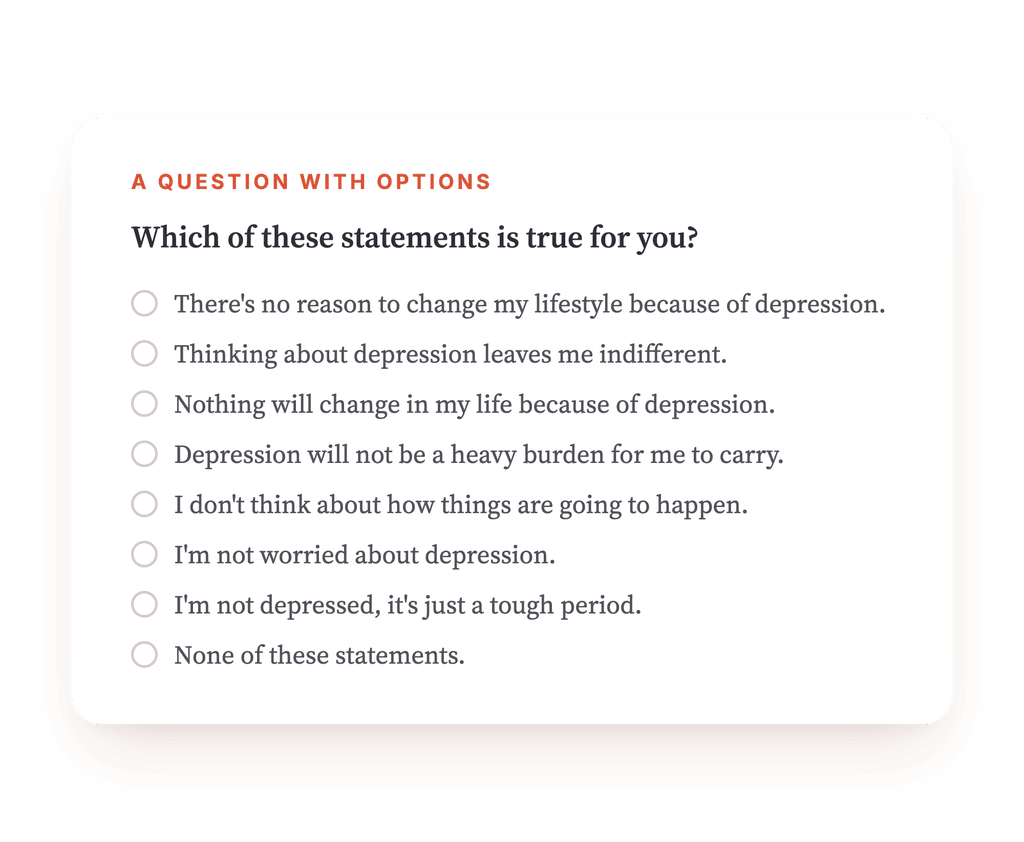
Clinical picture. M., a man in his early forties, was referred after a prolonged period of low mood, social withdrawal, and reduced occupational functioning that he consistently attributed to work stress rather than a depressive episode. His clinician introduced the ACT-based psychoeducation program and asked him to complete Lesson 1 on acceptance before their next appointment. When M. returned, he reported that the multiple-choice prompt asking which statements felt true had caught him off guard: he had selected "I am not depressed, it is just a difficult period," and found that naming the denial out loud shifted something. He did not endorse full acceptance by the following session, but he began using the word "depression" without correction, which opened a more collaborative dialogue about next steps.
ACT for Depression: A Structured Psychoeducation Program
A 4-lesson autonomous program grounded in Acceptance and Commitment Therapy to build psychological flexibility in depressed patients.
Clinical vignettes
Denial as a Barrier to Engagement
Present-Moment Work in Recurrent Depression
Clinical picture. T., a woman in her mid-fifties with a third episode of major depression, was already familiar with basic cognitive strategies but reported that her rumination remained entrenched. Her clinician introduced the program's second lesson on present-moment awareness as between-session work, framing it as a way to observe her inner experience rather than argue with it. T. engaged with the guided prompts and noted, at the next appointment, that she had begun to distinguish between "being in a feeling" and "watching a feeling pass," a shift she described as small but unfamiliar. The clinician used her language from the lesson as a reference point throughout the session, which reduced the time spent re-explaining ACT principles and kept the focus on her specific patterns.
Use this resource with your patients
Handout, exercises and materials ready to use, right inside SessionFuel.
Why ACT is Hard to Convey in Words Alone
Acceptance and Commitment Therapy asks something genuinely counterintuitive of depressed patients: stop fighting your inner experience, and move toward what matters instead. That reframe lands poorly when delivered only verbally. Patients hear "acceptance" as resignation, or they nod politely in the room and return home to the same avoidance loops you mapped together. The Acceptance and Commitment Therapy: PDF Worksheet, Tools and Exercises and the ACT Hexaflex: PDF Worksheet, Tools and Exercises can anchor in-session psychoeducation, but they do not walk a patient through the full arc of change, step by step, at their own pace.
Depression compounds this: low energy and cognitive sluggishness make it hard to absorb new frameworks in a single conversation. What these patients need is structured, repeated engagement with the core ACT processes, between appointments, at a time when they are not performing for a clinician. That is precisely what this program provides.
750+ clinical tools
A library built with and for clinicians, ready to use in session and extend between appointments.
Access all the toolsWhat the Program Contains
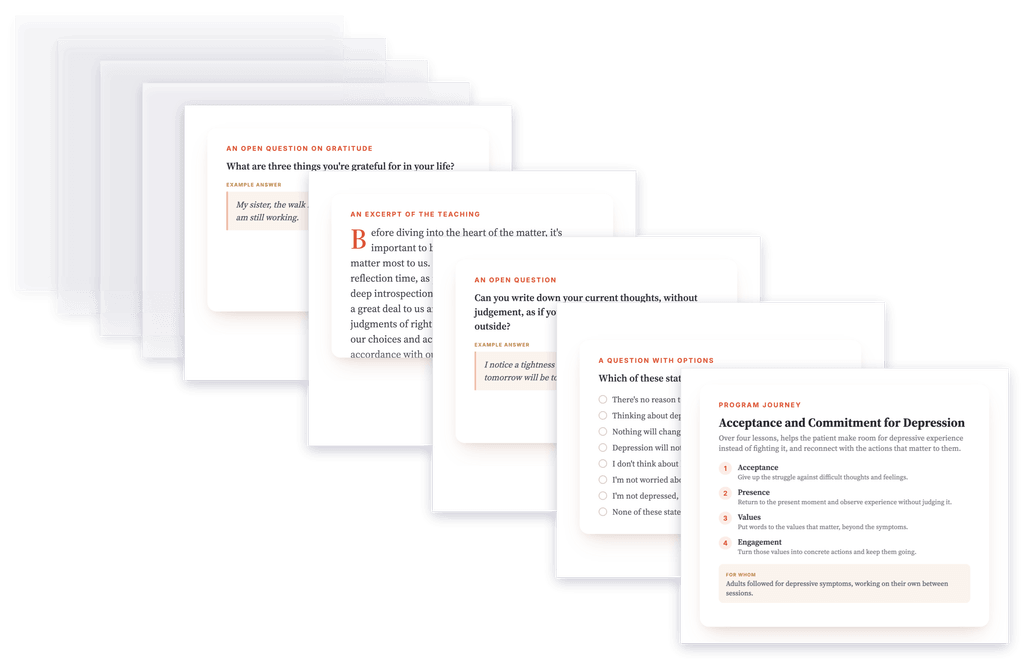
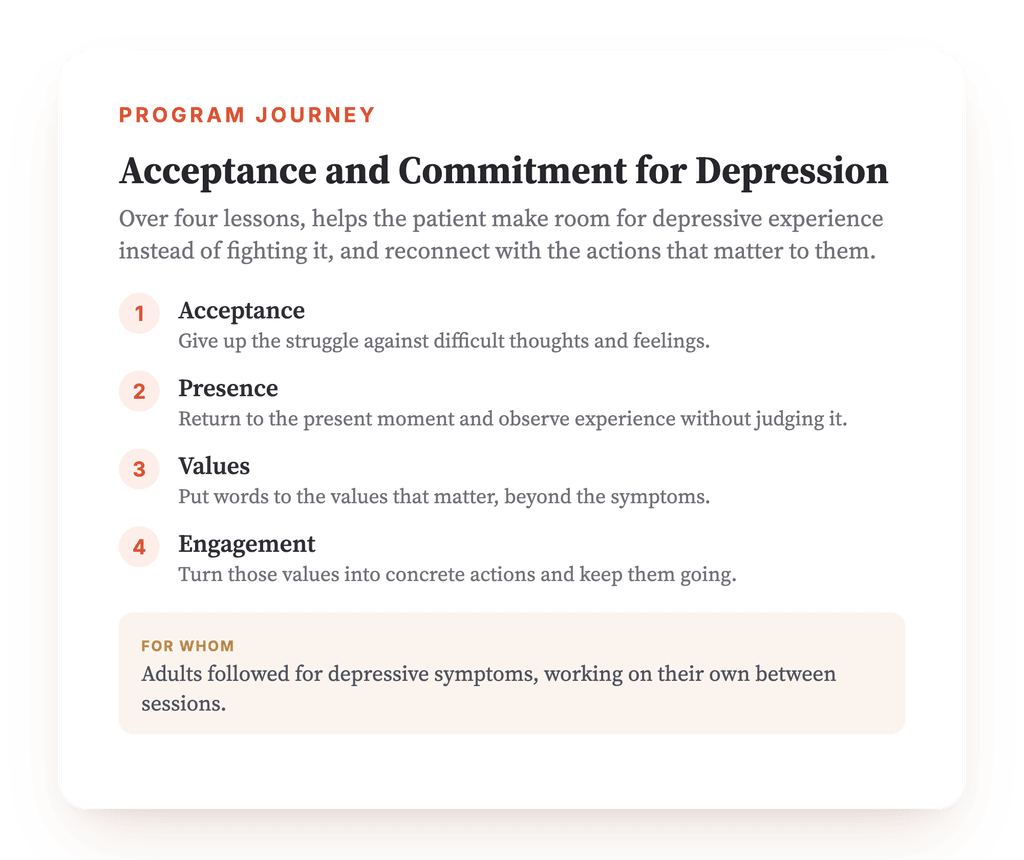
Acceptance and Commitment for Depression unfolds across four thematically sequenced lessons, each building on the last.
Lesson 1 (Acceptance) targets the denial that delays care. It invites patients to name their depressive experience honestly, then reframes acceptance not as passive surrender but as the starting point for agency. Structured multiple-choice questions reveal where denial is still active, and a reflective prompt on personal paradoxes makes the work specific rather than abstract.
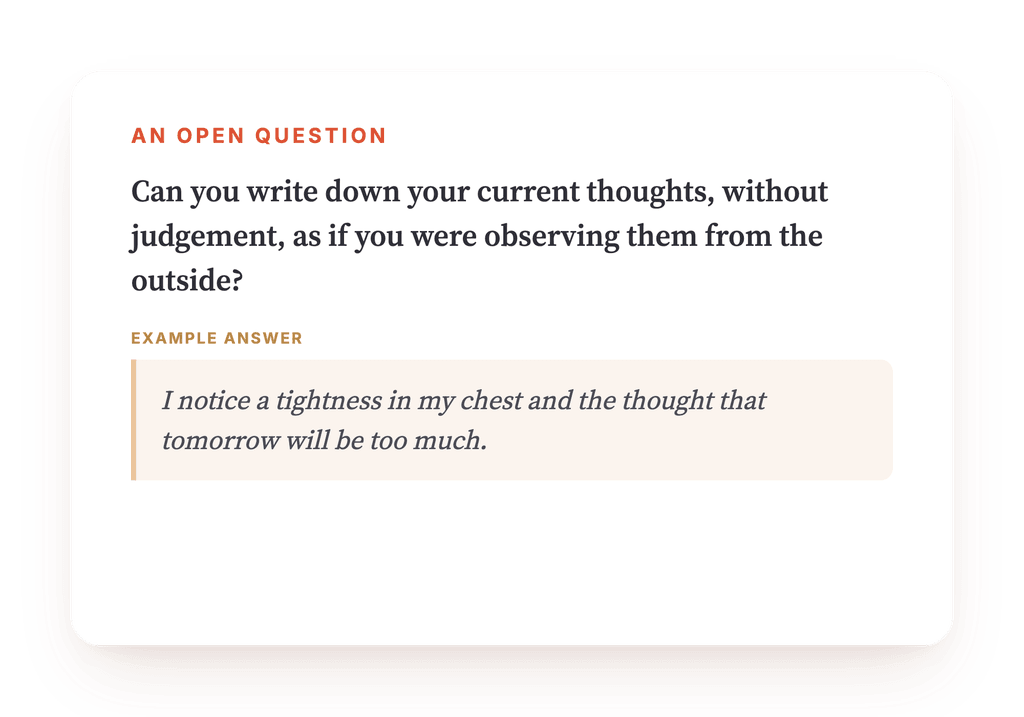
Lesson 2 (Presence) introduces cognitive defusion and sensory grounding. A free-writing prompt asks patients to observe their thoughts as an outside witness, without judgment, creating that essential gap between stimulus and reaction. A multiple-choice inventory surfaces resistance thoughts that keep patients stuck in rumination, directly relevant if you already use the What Keeps Depression Going: PDF Worksheet or work on stopping overthinking in your practice.
Lesson 3 (Values) uses four domain-specific prompts (relationships, work, personal development, leisure) to help patients articulate what genuinely matters to them, then a fifth prompt identifies the gap between those values and current behavior. This pairs naturally with the Valued Domains: PDF Worksheet for ACT Practice and the Exploring Values: PDF Worksheet for ACT Practice you may already use.
Lesson 4 (Commitment) closes the arc with gratitude, values-aligned action, and a sense of belonging. The patient is asked: what one action today is consistent with who you want to be? This lesson connects directly with the work you might do using The Choice Point: PDF Worksheet for ACT Practice or Personal Meaning and Direction: PDF Worksheet.
The preview images embedded here (overview map and sample cards) show only a small fraction of the program. The complete curriculum is far richer, with many more steps, reflective prompts, multiple-choice questions, and psychoeducation text than what these excerpts reveal.
Key insight: The clinical power of this program lies in its sequence: acceptance must come before presence, presence before values, and values before committed action. Patients who skip straight to "doing more" without that foundation tend to relapse into the same loops.
This program is available to your patients through the mobile application that is the dedicated patient-side interface of SessionFuel. You assign it directly from your SessionFuel account, and your patient completes each lesson on their phone, independently, at their own pace.
Use it with your patients
Share this tool in the mobile app and follow the work between sessions.
How to Integrate It Into Your Practice
This program is designed as autonomous between-session work: you assign it as homework after a consultation, and the patient advances through the lessons on their own before you meet again.
It suits patients who have at least some capacity for self-reflection, an adequate reading level, and a willingness to engage with structured exercises. It works well alongside a Depression Psychoeducation Program if you want to pair mechanistic understanding with ACT-based coping, or with the Emotions in Depression: A 4-Lesson Psychoeducation Program for patients who need to name their emotional experience before they can accept it.
Introduce it simply: "Between now and our next appointment, I'd like you to work through one or two lessons of a structured program on your phone. There are no right or wrong answers. Just engage with it honestly."
When the patient returns, the written responses they produced, their defusion observations, their values-domain prompts, their committed-action statement, become direct clinical material. Ask which step surprised them, which resistance thought showed up most, and which value they had been most avoiding. That conversation will be richer than anything reconstructed from memory alone. For patients who are also working on rumination or cognitive distortions, the defusion content in Lesson 2 gives you shared vocabulary to draw on across the work.
For patients earlier in the change process, the Stages of Change: PDF Worksheet can help you gauge whether they are ready for the commitment lesson, or whether the acceptance lesson alone warrants a slower pace.

Your session continues in your patients' pocket
Use with a patientYour resources, available everywhere
The handouts, exercises, programs and audios above: you choose which ones to make available to your patients, in the mobile app dedicated to them.
And far more than a library
The app goes well beyond resources, to support your patients every day:
Related categories
Explore other clinical resources by category.

Mood
Evidence-based worksheets and clinical tools for mood disorders: CBT, ACT, and positive psychology resources for psychologists and therapists.

Understand
Clinical hub for the therapeutic aim 'Understand': worksheets and tools to build patient insight across CBT, ACT, schema therapy and more.

Build awareness
Clinical worksheets and tools to build awareness in therapy: cognitive distortions, schemas, emotions, ACT and CBT resources for practitioners.

Engage & motivate
Clinical hub: printable worksheets and exercises to build therapeutic engagement and motivation across ACT, CBT, and integrative practice. For clinicians.

ACT
Clinical hub for Acceptance and Commitment Therapy (ACT): worksheets, exercises, programs and audio resources for practitioners using the ACT model.

Anxiety
Clinical hub for anxiety disorders: CBT and ACT worksheets, psychoeducation sheets, and exercises for assessment and treatment across the anxiety spectrum.