
Clinical picture. P., a 41-year-old secondary school teacher, presented with low mood and exhaustion following a six-month sick leave for occupational burnout. He described a pervasive sense of emptiness and difficulty imagining what "getting better" would even look like. The clinician introduced the valued domains wheel during the third session, framing it as a mapping exercise rather than a goal-setting task, and invited P. to notice which wedges felt alive versus which felt tender or blank. P. was struck that the learning and friendship wedges lit up quickly, while the work wedge produced mainly dread; he noted this was the first time he had distinguished what mattered to him personally from what he felt he was supposed to want. Over the following two sessions, this distinction became a working reference point for examining the beliefs driving his return-to-work anxiety.
Valued Domains: PDF Worksheet, Tools and Exercises for ACT Practice
A visual wheel of twelve life areas to clarify personal values in session, helping patients move from borrowed shoulds to chosen direction in ACT-informed therapy.
Clinical vignettes
Reorienting After Burnout
Values Clarification in Chronic Anxiety
Clinical picture. M., a woman in her late twenties, had been seen for generalised anxiety for four months and reported that avoidance had progressively narrowed her daily life. When the clinician introduced the twelve domains as an informational sheet, M. initially engaged superficially, listing socially expected responses across most wedges. Using the hidden-camera prompt, the clinician asked her to describe what someone watching her at her best in the intimacy domain would actually observe; M. paused, then said the honest answer felt very different from what she had written. The reframe from rule to chosen direction, specifically distinguishing "I should be a good partner" from a value she could articulate in her own words, reduced some of the shame attached to current avoidance. Subsequent exposure planning drew on the two domains she had identified as genuinely her own, which appeared to support her engagement with the work.
Explaining valued domains verbally rarely lands the first time. Patients hear "what matters to you" and produce goals, obligations, or inherited scripts, not actual values. This PDF worksheet gives you a shared visual reference that makes the distinction concrete and durable the moment you introduce it in session.
Use this resource with your patients
Handout, exercises and materials ready to use, right inside SessionFuel.
Why Valued Domains Resist Verbal Explanation in Session
The central clinical difficulty is conceptual slippage: patients conflate values with goals, rules, or feelings, and they do so genuinely, not because they are resistant. When you say "what direction do you want your life to take in the area of parenting?" a patient often hears "what outcome do you want to achieve?" Without a visual anchor, the distinction between direction and landmark dissolves almost as fast as you articulate it.
A second, quieter problem: many patients produce borrowed values. The list they generate sounds virtuous because it reflects exactly what their parents, partner, or cultural context would write for them. Spotting this in the room is delicate. Naming it without visual support can feel confrontational. A fiche that includes an explicit prompt to check whether a value is chosen or borrowed externalizes the question and makes the exploration feel collaborative rather than challenging.
Finally, the twelve-domain scope matters. Patients with depression, burnout, or high avoidance typically contract around one or two areas, losing sight of the full life canvas. Oral psychoeducation about "multiple life domains" is abstract. A wheel showing all twelve simultaneously is not.
What the Fiche Contains: A Visual Map for ACT-Informed Practice
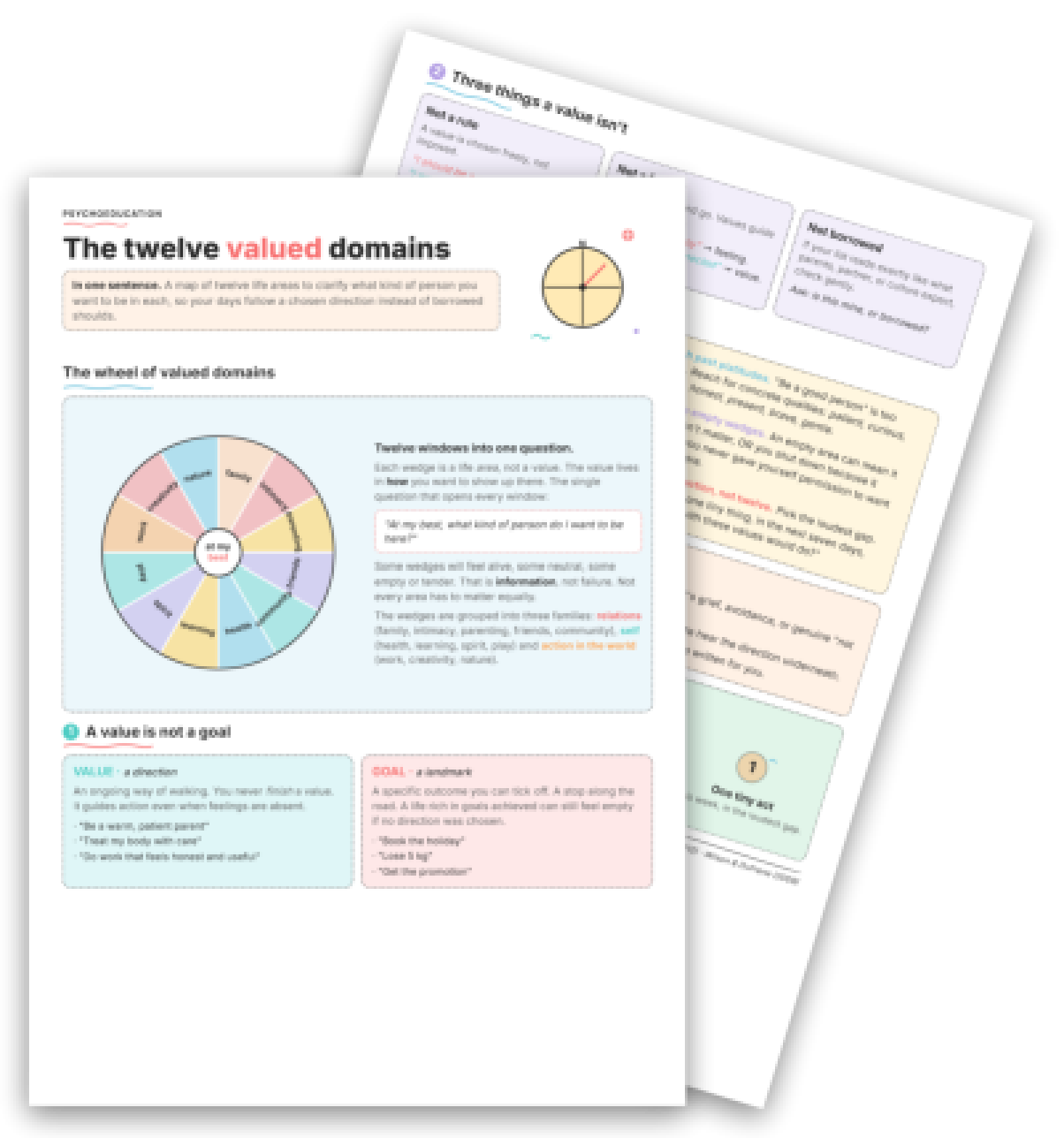
The PDF worksheet opens with a spoke wheel divided into twelve wedges: family, intimacy, parenting, friends, community, health, learning, spirit, play, work, creativity, nature, with the phrase "at my best" at the center. This single layout does something no oral explanation achieves: it shows all domains simultaneously, so the patient can immediately see which wedges feel alive, which feel empty, and which feel tender. That visual information feeds the conversation directly.
Three structured panels follow, each targeting a specific point of confusion.
- Value vs. goal: side-by-side examples ("Be a warm, patient parent" versus "Book the holiday") make the direction-versus-landmark distinction stick faster than any definition.
- Three things a value isn't: explicit comparisons between a rule ("I should be a good parent") and a value ("I want to be warm, patient"), between a feeling and a guiding quality, and a direct prompt to check for borrowed content: "Ask: is this mine, or borrowed?"
- Using the map well: six concrete prompts the patient can work with autonomously, including the hidden-camera prompt ("If a camera filmed me at my best here, what would someone watching see me do?"), a caution against platitudes like "be a good person", and a closing instruction to pick "one tiny thing, in the next seven days" in the loudest gap.
A closing "To discuss in session" block flags three situations that warrant returning to the material with you: an empty wedge the patient cannot fully explain, goals appearing where values should be, and a list that reads suspiciously like someone else wrote it.
> Key takeaway: the fiche is a visual support that facilitates the explanation of valued domains in session; it is not a self-help questionnaire to fill out alone. The wheel creates a shared vocabulary and a concrete reference point the patient keeps after the appointment.
750+ clinical tools
A library built with and for clinicians, ready to use in session and extend between appointments.
Access all the toolsWhen and How to Introduce the Fiche
The fiche fits naturally at the formulation phase, once the presenting problem is mapped and you are beginning to build a case conceptualization around avoidance patterns or évitement expérientiel. It integrates directly with the ACT Hexaflex model and supports the values component of psychological flexibility work. For patients engaged in exploring their core values or working through the ACT Choice Point, the wheel provides a concrete life-canvas to situate the abstract.
For profiles presenting with depression, burnout, or unrelenting standards schemas, the empty-wedge exercise is particularly productive: it surfaces avoidance and grief without requiring you to name them prematurely. For patients with early maladaptive schemas, the borrowed-values check opens a direct route to origins work.
Introduce it simply: "I want to show you a map we'll use together. There are twelve life areas on it. We're not filling it in right now; I just want us to look at it and notice what stands out." That framing removes performance pressure and positions you as a guide rather than an assessor. Once the patient has located their "loudest gap", the fiche connects naturally to goal-setting work, values cultivation exercises, and behavioral activation planning.
Debrief by asking which wedges prompted a reaction, whether the value they wrote could be ticked off a list (goal test), and whether anything on the wheel felt like it belonged to someone else. For ACT defusion work, a natural follow-up is examining which fused thoughts appeared while the patient looked at tender or empty domains.
The fiche does not replace the therapeutic frame. It makes the explanation faster, the vocabulary shared, and the direction visible, in a single page the patient carries out of the room.
Use it with your patients
Share this tool in the mobile app and follow the work between sessions.
Sources
- Wilson, K. G., Sandoz, E. K., Kitchens, J., & Roberts, M. E. (2010). The Valued Living Questionnaire: Defining and Measuring Valued Action within a Behavioral Framework. The Psychological Record, 60, 249-272.
- Wilson, K. G., & Murrell, A. R. (2004). Values work in Acceptance and Commitment Therapy: Setting a course for behavioral treatment. In S. C. Hayes, V. M. Follette, & M. Linehan (Eds.), Mindfulness and acceptance: Expanding the cognitive-behavioral tradition (pp. 120-151). Guilford Press.
- Hayes, S. C., Strosahl, K. D., & Wilson, K. G. (2012). Acceptance and Commitment Therapy: The Process and Practice of Mindful Change (2nd ed.). Guilford Press.
- Harris, R. (2019). ACT Made Simple: An Easy-to-Read Primer on Acceptance and Commitment Therapy (2nd ed.). New Harbinger Publications.
- Harris, R. (2022). The Happiness Trap: How to Stop Struggling and Start Living (2nd ed.). Shambhala Publications.
- Association for Contextual Behavioral Science (ACBS). Valued Living Questionnaire (VLQ) - instrument page and working guide. Association for Contextual Behavioral Science.
Your session continues in your patients' pocket
Use with a patientYour resources, available everywhere
The handouts, exercises, programs and audios above: you choose which ones to make available to your patients, in the mobile app dedicated to them.
And far more than a library
The app goes well beyond resources, to support your patients every day:
Related categories
Explore other clinical resources by category.
Anxiety
Clinical hub for anxiety disorders: CBT and ACT worksheets, psychoeducation sheets, and exercises for assessment and treatment across the anxiety spectrum.

Mood
Evidence-based worksheets and clinical tools for mood disorders: CBT, ACT, and positive psychology resources for psychologists and therapists.

Identity
Clinical resources for self-identity work in therapy: CBT, ACT, schema tools for clinicians addressing self-concept, core beliefs, and identity disruption.

Transitions
Clinical hub for life transitions: tools, worksheets and exercises to support psychosocial adjustment, role change and identity work in practice.

Understand
Clinical hub for the therapeutic aim 'Understand': worksheets and tools to build patient insight across CBT, ACT, schema therapy and more.

Build awareness
Clinical worksheets and tools to build awareness in therapy: cognitive distortions, schemas, emotions, ACT and CBT resources for practitioners.