
Clinical picture. A patient referred to here as M., a man in his late thirties, presented with generalised anxiety and a longstanding pattern of avoiding social and professional situations that felt uncertain. Several sessions had touched on values work without traction; M. described the conversations as abstract and hard to hold onto between appointments. The clinician introduced the Hexaflex informational sheet as a shared map, naming the rigidity side first so M. could locate himself: he immediately pointed to fusion and avoidance as recognisable. From there the pair moved to the corresponding flexibility vertices, and M. chose one micro-action before the session ended: sending a single work email he had been deferring for two weeks. At the following appointment he reported that naming the process had made it easier to observe his own hesitation without simply obeying it.
The ACT Hexaflex: PDF Worksheet, Tools and Exercises for Clinical Practice
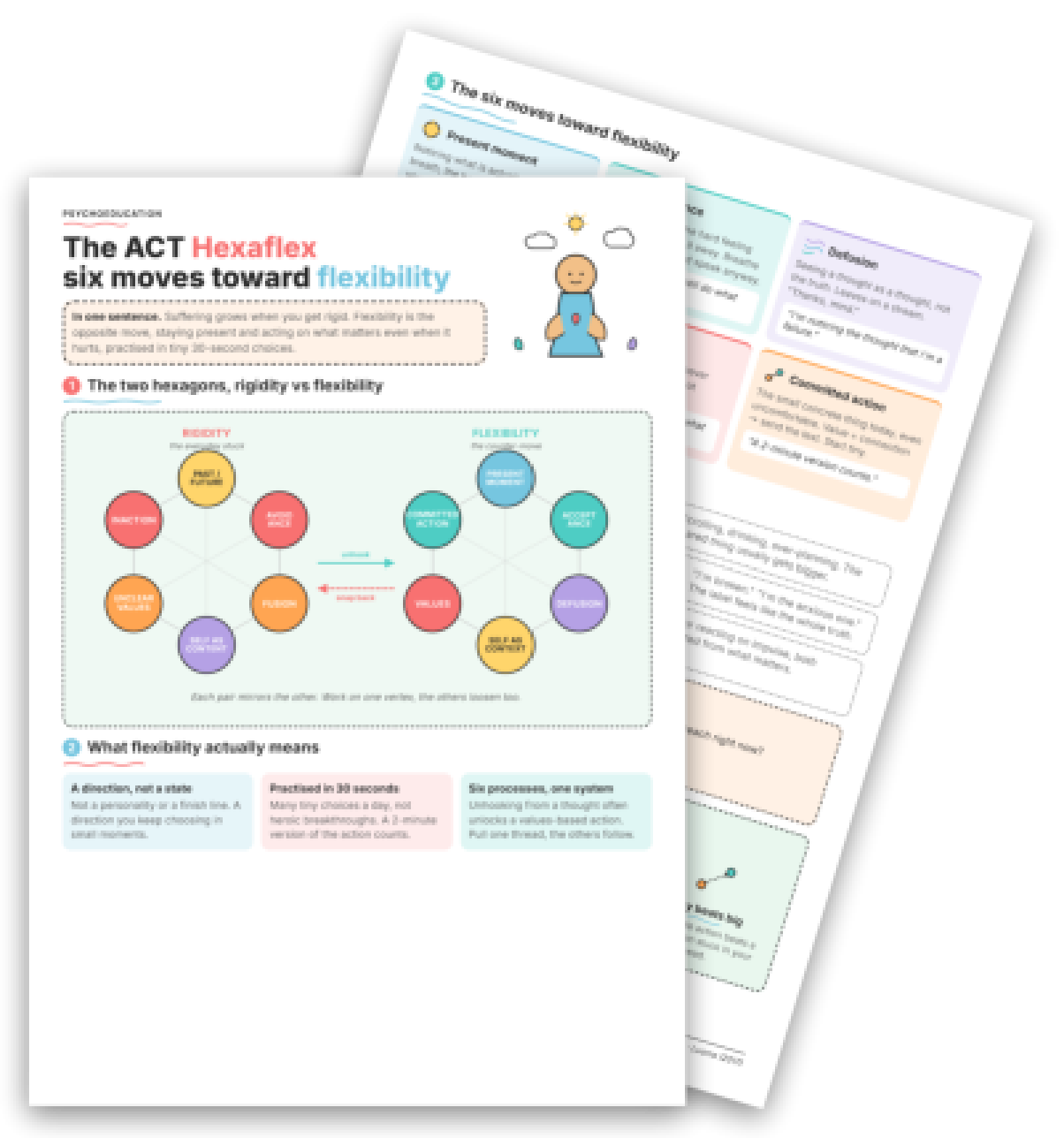
A printable visual support mapping all six ACT processes in one structured fiche, to explain psychological flexibility clearly, in session, with any patient.
Clinical vignettes
Hexaflex Map Orients a Stuck Patient
Self-as-Context Loosens Rigid Self-Narrative
Clinical picture. T., a woman in her mid-forties with recurrent depressive episodes, arrived describing herself as constitutionally broken, a framing she had held for years and that foreclosed any discussion of values or action. The clinician used the Hexaflex sheet to distinguish self-as-content from self-as-context, pointing to the sky-and-weather image on the fiche and asking T. to notice the part of her that had been watching even the worst episodes. T. sat quietly for a moment, then said the distinction felt true rather than reassuring, which she found more useful. Subsequent work on values became less blocked; she was able to name connection as a direction without immediately discounting it as unavailable to someone like her.
Explaining the hexaflex verbally tends to produce a polite nod, patients follow the first two or three processes, then lose the systemic logic that makes ACT coherent. This fiche PDF is a structured visual support designed to do the explanatory work in session, so the clinician can spend time on clinical meaning rather than on scaffolding a diagram from scratch.
Use this resource with your patients
Handout, exercises and materials ready to use, right inside SessionFuel.
Why the Hexaflex Resists Oral Explanation
The hexaflex is, by design, a system. Its clinical power comes precisely from the interdependence of six processes: change one vertex and the others loosen. That idea is almost impossible to convey in speech alone. Most patients will track fusion and avoidance easily enough, they recognise themselves there, but they lose the link to self-as-context or the distinction between values and committed action. And without the full picture, psychological flexibility remains an abstract promise rather than a navigable direction.
A second friction point is the rigidity/flexibility polarity. Naming it verbally leaves patients unsure which pole describes them and when. Without a side-by-side visual, the mirror structure of the model collapses into a list of concepts. That is exactly the explanatory gap this fiche fills.
What the Fiche Contains, and What the Visual Does That Words Cannot
The fiche is built around four structured panels.
- Panel 1 sets the spine of the model: two mirrored hexagons, one labelling the six rigidity traps (past/future, avoidance, fusion, self-as-content, unclear values, inaction), the other showing the six counter-moves. The layout makes the pairing unmissable: "Each pair mirrors the other. Work on one vertex, the others loosen too." Patients can see, at a glance, where they are stuck and what the corresponding move looks like.
- Panel 2 clarifies what flexibility actually means clinically: a direction, not a state; practised in thirty-second micro-choices, not heroic breakthroughs. This reframe matters early in ACT-informed work, especially with perfectionistic or high-expectation profiles.
- Panel 3 walks through each of the six processes with a concrete micro-exercise or phrase. Defusion is anchored with "I'm noticing the thought that I'm a failure"; present-moment contact with a quick 3-2-1 sensory scan (which pairs well with grounding exercises you may already be using); values clarification with "If nothing could go wrong, what would I move toward?"; committed action with "A 2-minute version counts."
- Panel 4 maps the six rigidity traps as observable patterns, rumination, scrolling, "I had the thought I'll mess up, so I won't try", followed by three discussion prompts for in-session use, including "Which mirror-move feels most out of reach right now?"
> Key point: The fiche is not a self-administered questionnaire. It is a visual support that facilitates the explanation in session, the clinician uses it to anchor psychoeducation, establish shared vocabulary, and leave the patient a concrete reference to take home.
750+ clinical tools
A library built with and for clinicians, ready to use in session and extend between appointments.
Access all the toolsWhen and How to Introduce the Fiche in Session
This fiche fits naturally in the early-to-mid phase of an ACT-informed treatment, once the therapeutic alliance is established and the patient has a working sense of why flexibility matters. It works particularly well as a consolidation tool in session two or three, after an initial functional analysis has surfaced the dominant rigidity patterns.
Introduce it without labelling the patient: "I want to show you a map of the six moves we'll be working with, you'll see where some of what you described fits." Orient them first to the rigidity hexagon; most patients locate themselves quickly, which creates momentum for exploring the counter-moves. For ACT work with depression, Panel 4's description of inaction as "freezing or reacting on impulse, both disconnected from what matters" often lands with immediate recognition.
Use the three discussion prompts as a debrief structure at the end of the session. They connect directly to between-session work: the values-to-action alignment exercise, the Choice Point tool, or a longer values clarification exercise depending on where the patient is in their process. For patients who need the six processes unpacked individually, the ACT schemas and modes fiche extends the work without repeating it.
One limit worth noting: with patients in acute dissociative states or severe cognitive overload, the density of six paired processes can feel overwhelming. In those cases, introduce a single vertex at a time before returning to the full hexagon.
The fiche does not replace case formulation or clinical judgement. It makes the explanation faster, clearer, and more durable, the patient leaves with a visual they can return to when a rigidity trap shows up mid-week.
Use it with your patients
Share this tool in the mobile app and follow the work between sessions.
Sources
- Hayes, S. C., Strosahl, K. D., & Wilson, K. G. (2012). Acceptance and Commitment Therapy: The Process and Practice of Mindful Change (2nd ed.). Guilford Press.
- Harris, R. (2019). ACT Made Simple: An Easy-to-Read Primer on Acceptance and Commitment Therapy (2nd ed.). New Harbinger Publications.
- Association for Contextual Behavioral Science (ACBS). ACT Hexaflex: The ACT Model of Psychological Flexibility.
Your session continues in your patients' pocket
Use with a patientYour resources, available everywhere
The handouts, exercises, programs and audios above: you choose which ones to make available to your patients, in the mobile app dedicated to them.
And far more than a library
The app goes well beyond resources, to support your patients every day:
Related categories
Explore other clinical resources by category.

Identity
Clinical resources for self-identity work in therapy: CBT, ACT, schema tools for clinicians addressing self-concept, core beliefs, and identity disruption.

Emotions
Clinical resources on emotion regulation: worksheets, coping tools, CBT, REBT, and ACT exercises for therapists working across diagnoses and age groups.

Cognition
Printable cognitive therapy worksheets and clinical tools for therapists: CBT, ACT, schema work, defusion, distortions, and belief restructuring.

Understand
Clinical hub for the therapeutic aim 'Understand': worksheets and tools to build patient insight across CBT, ACT, schema therapy and more.

Build awareness
Clinical worksheets and tools to build awareness in therapy: cognitive distortions, schemas, emotions, ACT and CBT resources for practitioners.

Engage & motivate
Clinical hub: printable worksheets and exercises to build therapeutic engagement and motivation across ACT, CBT, and integrative practice. For clinicians.