
Clinical picture. A., a 34-year-old man with alcohol use disorder in early recovery, reports that evenings after work reliably trigger intense cravings rated at 8 or 9 out of 10, which he has been managing by drinking "just to make the feeling stop." The clinician introduces the Surfing the Wave informational sheet and walks through the two-curve diagram, drawing A.'s attention to the distinction between the natural arc of an urge and the prolonged plateau that results from acting at the peak. A. is asked to locate the craving in his body during the following week, re-rate it every two minutes, and record whether intensity shifted without any drinking. At the next session he reported that on three occasions the craving dropped from 9 to 4 within roughly fifteen minutes once he stopped trying to suppress it, which he described as "the first time I actually believed it would pass."
Surfing the Wave: PDF Worksheet, Tools and Exercises for Distress Tolerance
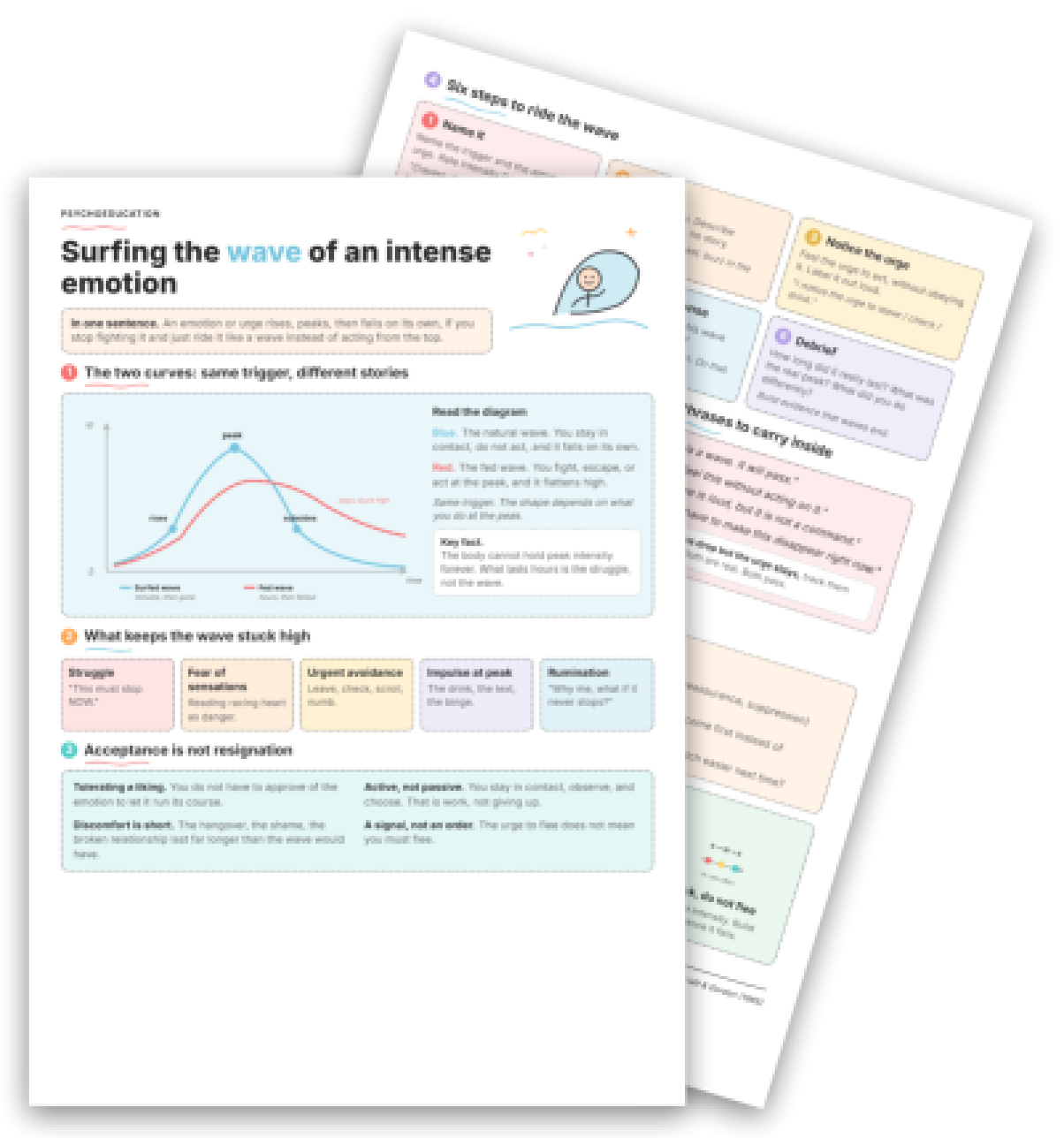
A visual PDF worksheet, tools and exercises to explain urge surfing in session and help patients ride the wave of intense emotion without acting from the peak.
Clinical vignettes
Riding a Craving Without Acting on It
Tolerating Anger Without an Impulsive Text
Clinical picture. M., a 28-year-old woman presenting with borderline personality features, describes a recurrent pattern in which perceived slights from her partner trigger sudden anger peaking at 10 out of 10, followed almost immediately by sending accusatory messages she later regrets. The clinician uses the Surfing the Wave sheet to illustrate how the "fed wave" dynamic, specifically the impulse acted on at peak intensity, prolongs distress and generates secondary shame rather than resolving the original feeling. Together they rehearse step three of the six-step sequence: noticing and labelling the urge to send the text without obeying it, and pairing that with a body-scan description of tight jaw and heat in the chest. Over two weeks M. reported four instances in which she delayed sending a message until intensity had dropped below 4; two of those messages were never sent, and one conversation that did occur was described by both parties as more productive.
Most patients have heard, at some point, that emotions are temporary. At the peak of a craving, a self-harm urge, or a rage spiral, that knowledge is simply unavailable. This fiche PDF gives the concept a visible shape: two curves on a single diagram that the patient can look at before the next peak arrives, not only recall from memory.
Use this resource with your patients
Handout, exercises and materials ready to use, right inside SessionFuel.
Why urge surfing resists verbal explanation in session
The central problem is timing. When you explain in session that the wave will subside on its own if the patient does not act on it, they are calm, receptive, and agreeable. That same patient at 7pm with a craving at 8/10 has no access to an oral explanation. What they can access is a visual contrast they have seen and discussed: two diverging curves, one that falls in minutes, one that flattens high for hours.
A second difficulty is the persistent conflation of acceptance with approval or suppression. Patients with significant emotional dysregulation, substance use histories, or self-harm patterns frequently read "don't act on the urge" as "push the feeling down." Without a concrete counter-frame, the instruction paradoxically intensifies the struggle, which is precisely the maintaining mechanism the experiential avoidance literature describes. The cycle of avoidance and the wave model share the same underlying logic: contact with the sensation breaks the loop; flight from it extends it.
What the fiche contains: a visual support for explaining the wave
The fiche PDF is structured in six numbered sections. It is not a self-report questionnaire; it is a psychoeducation support you walk through with the patient, panel by panel, in session.
Section 1 presents the two-curve diagram: a blue "surfed wave" (rises, peaks, subsides within minutes) and a red "fed wave" (flattens high for hours, then fallout). The caption reads "same trigger, the shape depends on what you do at the peak." That single visual conveys what a paragraph of spoken psychoeducation rarely manages in the same time, and it directly supports the habituation model most clinicians already draw on when explaining exposure work.
Section 2 lists the five maintaining factors that keep the wave stuck high: struggle, fear of sensations, urgent avoidance, impulse at peak, and rumination. Each is named briefly, making it easy to locate the patient's dominant pattern together during the debrief.
Section 3 reframes acceptance as active and chosen, not passive or approving. Section 4 gives six concrete steps: name the trigger and rate intensity 0-10, locate sensations in the body without narrative, notice the urge without obeying it, re-rate every minute or two ("8 → 9 → 7 → 5 → 3 over twelve minutes"), choose a valued action, then debrief. Section 5 anchors the model in five recognisable scenarios, from a supermarket queue panic to a self-harm pull. Section 6 offers short phrases patients can retrieve at peak intensity: "The urge is loud, but it is not a command."
The closing block, "To discuss in session," provides three ready-made debriefing prompts, including one on dissociation: when to use grounding techniques first rather than surfing. The fiche flags its own contraindication, which is a useful clinical anchor.
> Key takeaway: this fiche PDF is a visual support that facilitates the explanation of urge surfing in session; the two-curve diagram does in under a minute what verbal psychoeducation alone rarely achieves, and the patient leaves with a concrete reference to consult at the next peak, not just a memory of something you said.
750+ clinical tools
A library built with and for clinicians, ready to use in session and extend between appointments.
Access all the toolsWhen and how to propose the fiche
No formal DBT protocol is required. The fiche fits naturally into standard TCC, ACT-informed work, and addiction-focused sessions alongside resources such as Marlatt and Gordon's relapse model or adaptive vs maladaptive coping strategies. It is most useful once the patient has identified at least one recurring pattern of impulsive or avoidant response following high-intensity affect.
Introduce it after the patient has described an episode they felt unable to pause: "I want to show you a diagram that explains what was happening physically in that moment." Walk through the two curves together, then the six steps. For patients with significant dissociation at high intensity, pair it with grounding first, as the fiche itself recommends, before introducing surfing. For substance use presentations, connect it explicitly to coping skills for addictions. For anger presentations, the step-six debrief maps cleanly onto anger management skills. When the patient needs more structured crisis tools beyond the wave metaphor, the fiche bridges naturally to DBT distress tolerance skills, IMPROVE the Moment, or DBT TIPP skills.
For patients working on radical acceptance, the section distinguishing tolerating from liking is worth extended discussion: it resolves the most common objection before it is voiced. For those where emotion regulation is a broader goal, the six-step structure gives a repeatable procedural scaffold they can report on between sessions.
The fiche does not replace clinical formulation. It makes one critical mechanism visible and leaves the patient with something they can actually reach for at 8/10.
Use it with your patients
Share this tool in the mobile app and follow the work between sessions.
Sources
- Linehan, M. M. (2015). DBT Skills Training Manual, Second Edition. Guilford Press.
- Bowen, S., Chawla, N., Grow, J., & Marlatt, G. A. (2021). Mindfulness-Based Relapse Prevention for Addictive Behaviors: A Clinician's Guide, Second Edition. Guilford Press.
- Marlatt, G. A., & Gordon, J. R. (1985). Relapse Prevention: Maintenance Strategies in the Treatment of Addictive Behaviors. Guilford Press.
- Taylor, J. B. (2006). My Stroke of Insight: A Brain Scientist's Personal Journey. Viking.
- Wainwright, N., Nansen, H. H., Lichtenstein, M. B., & Elbe, A. M. (2017). Urge Surfing as Aftercare in Adolescent Alcohol Use: a Randomized Control Trial. Mindfulness, 8(3), 455-462.
Your session continues in your patients' pocket
Use with a patientYour resources, available everywhere
The handouts, exercises, programs and audios above: you choose which ones to make available to your patients, in the mobile app dedicated to them.
And far more than a library
The app goes well beyond resources, to support your patients every day:
Related categories
Explore other clinical resources by category.

Anxiety
Clinical hub for anxiety disorders: CBT and ACT worksheets, psychoeducation sheets, and exercises for assessment and treatment across the anxiety spectrum.

Emotions
Clinical resources on emotion regulation: worksheets, coping tools, CBT, REBT, and ACT exercises for therapists working across diagnoses and age groups.

Behaviours
Clinical hub for behaviors in therapy: worksheets and tools for coping, eating disorders, CBT formulation, and maladaptive behavioral patterns.

Understand
Clinical hub for the therapeutic aim 'Understand': worksheets and tools to build patient insight across CBT, ACT, schema therapy and more.

Build awareness
Clinical worksheets and tools to build awareness in therapy: cognitive distortions, schemas, emotions, ACT and CBT resources for practitioners.

Regulate
Clinical resources for emotion regulation: worksheets, ACT exercises, and psychoeducation tools for affect regulation across diagnoses. For clinicians.